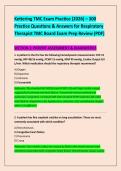
Kettering TMC Exam Practice (2026) – 300
Practice Questions & Answers for Respiratory
Therapist TMC Board Exam Prep Review (PDF)
SECTION 1: PATIENT ASSESSMENT & DIAGNOSTICS
1. A patient in the ICU has the following hemodynamic measurements: CVP 12
mmHg, PAP 48/16 mmHg, PCWP 15 mmHg, MAP 99 mmHg, Cardiac Output 8.0
L/min. Which medication should the respiratory therapist recommend?
A) Oxygen
B) Dopamine
C) Lidocaine
D) Furosemide
Rationale: The elevated PAP (48/16) and PCWP (15) with high cardiac output
suggest fluid overload and heart failure. Furosemide reduces preload and
pulmonary congestion. Increased PAP with elevated PCWP indicates left-sided
heart failure. Dopamine is for hypotension; Lidocaine is for arrhythmias; Oxygen
alone is insufficient .
2. A patient has fine crepitant crackles on lung auscultation. These are most
commonly associated with which condition?
A) Bronchiectasis
B) Congestive heart failure
C) Pneumonia
D) Croup
Rationale: Fine crackles (rales) are caused by fluid in the alveoli and are most
commonly associated with congestive heart failure. Bronchiectasis causes coarse
,crackles, pneumonia can cause crackles but is less specific, and croup causes
stridor .
3. A 55-year-old patient in the CCU with chest pain has an ECG showing
ventricular tachycardia. The patient becomes pulseless. What is the immediate
intervention?
A) Administer amiodarone IV
B) Perform defibrillation
C) Perform synchronized cardioversion
D) Administer lidocaine
Rationale: Pulseless ventricular tachycardia is a shockable rhythm requiring
immediate defibrillation. Amiodarone and lidocaine are given after defibrillation
for refractory VT. Synchronized cardioversion is for stable VT with a pulse .
4. The blood pressure obtained from the arterial line is higher than the blood
pressure obtained from a sphygmomanometer. The respiratory therapist should
conclude:
A) Non-compliant tubing is being used
B) The transducer is placed too low
C) The patient was lying flat during measurement
D) The transducer dome contained air bubbles
Rationale: For every inch the transducer is below the phlebostatic axis (right
atrium), the pressure reading will be falsely elevated by approximately 2 mmHg. If
the transducer is too low, the hydrostatic pressure adds to the measured pressure,
giving falsely high readings .
, 5. A patient has been intubated and is receiving volume control ventilation. To
inflate the endotracheal tube cuff, the respiratory therapist should add air to the
cuff:
A) Until no leak is heard during inspiration
B) And then remove it until a slight leak is heard at peak inspiration
C) To establish a pressure of 20 mmHg
D) To establish a pressure of 40 cmH2O
Rationale: The minimal leak technique involves inflating the cuff until no leak is
heard, then slowly removing air until a slight leak is heard at peak inspiration. This
minimizes tracheal damage while maintaining an adequate seal. Cuff pressure
should ideally be 20-30 cmH2O .
6. Which of the following techniques measures total lung capacity?
1. Helium dilution
2. Body plethysmography
3. Single breath nitrogen elimination
A) 1 & 2
B) 2 only
C) 3 only
D) 1 & 3
Rationale: Body plethysmography measures total lung capacity directly by
measuring thoracic gas volume. Helium dilution and nitrogen washout measure
ventilated lung volumes and may underestimate TLC in patients with air trapping .
7. A patient in the ICU has CVP 6 mmHg, Mean PAP 13 mmHg, PCWP 7 mmHg,
MAP 86 mmHg, Cardiac Output 4.0 L/min. What is the systemic vascular
resistance?
Practice Questions & Answers for Respiratory
Therapist TMC Board Exam Prep Review (PDF)
SECTION 1: PATIENT ASSESSMENT & DIAGNOSTICS
1. A patient in the ICU has the following hemodynamic measurements: CVP 12
mmHg, PAP 48/16 mmHg, PCWP 15 mmHg, MAP 99 mmHg, Cardiac Output 8.0
L/min. Which medication should the respiratory therapist recommend?
A) Oxygen
B) Dopamine
C) Lidocaine
D) Furosemide
Rationale: The elevated PAP (48/16) and PCWP (15) with high cardiac output
suggest fluid overload and heart failure. Furosemide reduces preload and
pulmonary congestion. Increased PAP with elevated PCWP indicates left-sided
heart failure. Dopamine is for hypotension; Lidocaine is for arrhythmias; Oxygen
alone is insufficient .
2. A patient has fine crepitant crackles on lung auscultation. These are most
commonly associated with which condition?
A) Bronchiectasis
B) Congestive heart failure
C) Pneumonia
D) Croup
Rationale: Fine crackles (rales) are caused by fluid in the alveoli and are most
commonly associated with congestive heart failure. Bronchiectasis causes coarse
,crackles, pneumonia can cause crackles but is less specific, and croup causes
stridor .
3. A 55-year-old patient in the CCU with chest pain has an ECG showing
ventricular tachycardia. The patient becomes pulseless. What is the immediate
intervention?
A) Administer amiodarone IV
B) Perform defibrillation
C) Perform synchronized cardioversion
D) Administer lidocaine
Rationale: Pulseless ventricular tachycardia is a shockable rhythm requiring
immediate defibrillation. Amiodarone and lidocaine are given after defibrillation
for refractory VT. Synchronized cardioversion is for stable VT with a pulse .
4. The blood pressure obtained from the arterial line is higher than the blood
pressure obtained from a sphygmomanometer. The respiratory therapist should
conclude:
A) Non-compliant tubing is being used
B) The transducer is placed too low
C) The patient was lying flat during measurement
D) The transducer dome contained air bubbles
Rationale: For every inch the transducer is below the phlebostatic axis (right
atrium), the pressure reading will be falsely elevated by approximately 2 mmHg. If
the transducer is too low, the hydrostatic pressure adds to the measured pressure,
giving falsely high readings .
, 5. A patient has been intubated and is receiving volume control ventilation. To
inflate the endotracheal tube cuff, the respiratory therapist should add air to the
cuff:
A) Until no leak is heard during inspiration
B) And then remove it until a slight leak is heard at peak inspiration
C) To establish a pressure of 20 mmHg
D) To establish a pressure of 40 cmH2O
Rationale: The minimal leak technique involves inflating the cuff until no leak is
heard, then slowly removing air until a slight leak is heard at peak inspiration. This
minimizes tracheal damage while maintaining an adequate seal. Cuff pressure
should ideally be 20-30 cmH2O .
6. Which of the following techniques measures total lung capacity?
1. Helium dilution
2. Body plethysmography
3. Single breath nitrogen elimination
A) 1 & 2
B) 2 only
C) 3 only
D) 1 & 3
Rationale: Body plethysmography measures total lung capacity directly by
measuring thoracic gas volume. Helium dilution and nitrogen washout measure
ventilated lung volumes and may underestimate TLC in patients with air trapping .
7. A patient in the ICU has CVP 6 mmHg, Mean PAP 13 mmHg, PCWP 7 mmHg,
MAP 86 mmHg, Cardiac Output 4.0 L/min. What is the systemic vascular
resistance?