
NUR 114 Exam 3 EKG, ventricular rhythms, heart blocks
NUR 114 Exam 3: EKG, ventricular rhythms, heart blocks
Study online at https://quizlet.com/_jqgiev
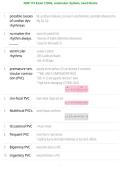
1. possible causes MI, acid/base imbalances, increase in catecholamines, electrolyte imbalances (K+,
of cardiac dys- Mg, Na, Ca)
rhythmias
2. no matter the assess the patient first!
rhythm always *tolerance of rhythm determines interventions
______ *assess for decreased CO
3. ventricular -p wave is absent
rhythms -QRS is wide and bizarre
-rate: 20-40 bpm
4. premature ven- typically do not perfuse (CO can decrease if consistent)
tricular contrac- ***WILL HAVE A COMPENSATORY PAUSE
tion (PVC) *QRS >0.12 and opposite direction T wave
**high risk for developing VT (TREAT CAUSE
5. Uni-focal PVC have similar shape and size
6. Multifocal PVCs varied shapes and forms
7. Occasional PVC 1-4 per minute
8. frequent PVC more than 5-7 per minute
*could be due to electrolyte imbalances or too much caffeine
9. Bigeminy PVC every other beat is a PVC
10. trigeminy PVC every third beat is a PVC
1/5
, NUR 114 Exam 3 EKG, ventricular rhythms, heart blocks
NUR 114 Exam 3: EKG, ventricular rhythms, heart blocks
Study online at https://quizlet.com/_jqgiev
11. quadgeminy Every fourth beat is a PVC
12. coupling PVC Two PVCs occur back to back
13. what are 3 PVC's 3 beat run of v tac
back to back
called?
14. sustained v tac does not go back into a normal rhythm
15. PVC interven- amiodarone (IV, PO)
tions Lidocaine IV
considerations: ischemia, decreased potassium, acidosis, hypoxia
16. sustained ven- decreased CO
tricular tachycar- **synchronized cardioversion!!
dia with pulse
17. Sustained VT in- 911, CODE BLUE, CPR, defibrillation (unsynchonized cardioversion), IVP epineph-
tervention rine, amiodarone (300 mg) or lidocaine
**defibrillate after every IVP drug
18. runs of VT inter- amiodarone IV/PO, AICD implant
vention
19. oxygen increase tissue oxygenation
tx: cardiopulmonary arrest, CP, hypoxia
dose: keep O2 sat > 94% (100% during code blue)
side effects: respiratory alkalosis
20. epinephrine
2/5
NUR 114 Exam 3: EKG, ventricular rhythms, heart blocks
Study online at https://quizlet.com/_jqgiev
1. possible causes MI, acid/base imbalances, increase in catecholamines, electrolyte imbalances (K+,
of cardiac dys- Mg, Na, Ca)
rhythmias
2. no matter the assess the patient first!
rhythm always *tolerance of rhythm determines interventions
______ *assess for decreased CO
3. ventricular -p wave is absent
rhythms -QRS is wide and bizarre
-rate: 20-40 bpm
4. premature ven- typically do not perfuse (CO can decrease if consistent)
tricular contrac- ***WILL HAVE A COMPENSATORY PAUSE
tion (PVC) *QRS >0.12 and opposite direction T wave
**high risk for developing VT (TREAT CAUSE
5. Uni-focal PVC have similar shape and size
6. Multifocal PVCs varied shapes and forms
7. Occasional PVC 1-4 per minute
8. frequent PVC more than 5-7 per minute
*could be due to electrolyte imbalances or too much caffeine
9. Bigeminy PVC every other beat is a PVC
10. trigeminy PVC every third beat is a PVC
1/5
, NUR 114 Exam 3 EKG, ventricular rhythms, heart blocks
NUR 114 Exam 3: EKG, ventricular rhythms, heart blocks
Study online at https://quizlet.com/_jqgiev
11. quadgeminy Every fourth beat is a PVC
12. coupling PVC Two PVCs occur back to back
13. what are 3 PVC's 3 beat run of v tac
back to back
called?
14. sustained v tac does not go back into a normal rhythm
15. PVC interven- amiodarone (IV, PO)
tions Lidocaine IV
considerations: ischemia, decreased potassium, acidosis, hypoxia
16. sustained ven- decreased CO
tricular tachycar- **synchronized cardioversion!!
dia with pulse
17. Sustained VT in- 911, CODE BLUE, CPR, defibrillation (unsynchonized cardioversion), IVP epineph-
tervention rine, amiodarone (300 mg) or lidocaine
**defibrillate after every IVP drug
18. runs of VT inter- amiodarone IV/PO, AICD implant
vention
19. oxygen increase tissue oxygenation
tx: cardiopulmonary arrest, CP, hypoxia
dose: keep O2 sat > 94% (100% during code blue)
side effects: respiratory alkalosis
20. epinephrine
2/5

