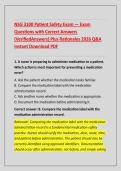
NSG 3100 Patient Safety Exam — Exam
Questions with Correct Answers
(VerifiedAnswers) Plus Rationales 2026 Q&A
Instant Download PDF
1. A nurse is preparing to administer medication to a patient.
Which action is most important for preventing a medication
error?
A. Ask the patient whether the medication looks familiar.
B. Compare the medication label with the medication
administration record.
C. Ask another nurse whether the medication is appropriate.
D. Document the medication before administering it.
Correct answer: B. Compare the medication label with the
medication administration record.
Rationale: Comparing the medication label with the medication
administration record is a fundamental medication-safety
practice. Nurses should verify the medication, dose, route, time,
and patient before administration. The patient should also be
correctly identified using approved identifiers. Documentation
should occur after administration, not before, and simply asking
,whether a medication looks familiar is not a reliable safety
check.
2. Which patient identification practice is safest before
administering medication?
A. Confirming the patient's room number.
B. Asking the patient to state their room number.
C. Using at least two approved patient identifiers.
D. Confirming the patient's diagnosis.
Correct answer: C. Using at least two approved patient
identifiers.
Rationale: Using two approved identifiers, such as the patient's
full name and date of birth or medical record number, helps
prevent wrong-patient errors. A room number is not an
acceptable identifier because patients may be transferred or
room assignments may change. The patient's diagnosis also
does not uniquely identify the individual.
3. A nurse discovers that a medication was administered to
the wrong patient. What should the nurse do first?
A. Complete the incident report.
B. Notify the patient's family.
,C. Assess the patient for adverse effects.
D. Wait for the provider to determine what happened.
Correct answer: C. Assess the patient for adverse effects.
Rationale: The patient's immediate safety takes priority. The
nurse should promptly assess the patient, determine the
patient's condition, and take appropriate clinical action. The
provider and appropriate members of the healthcare team
should then be notified. An incident report may be required, but
it does not replace immediate patient assessment and
intervention.
4. Which intervention is most effective for reducing the
transmission of healthcare-associated infections?
A. Wearing gloves for every patient interaction.
B. Performing hand hygiene at appropriate times.
C. Administering prophylactic antibiotics to all patients.
D. Keeping all patients in isolation.
Correct answer: B. Performing hand hygiene at appropriate
times.
Rationale: Hand hygiene is one of the most important measures
for preventing the spread of microorganisms in healthcare
settings. Gloves do not replace hand hygiene and should be
used according to the anticipated exposure. Routine
, prophylactic antibiotics are inappropriate and can contribute to
antimicrobial resistance. Isolation is reserved for situations in
which specific precautions are indicated.
5. A patient is identified as having a high risk for falls. Which
intervention is most appropriate?
A. Keep all four side rails raised.
B. Place frequently used items within the patient's reach.
C. Encourage the patient to walk independently to maintain
strength.
D. Keep the patient's room dark at night.
Correct answer: B. Place frequently used items within the
patient's reach.
Rationale: Keeping the call light, personal belongings, and
frequently needed items within reach reduces the likelihood that
a patient will attempt to get out of bed without assistance. Four
raised side rails can function as a restraint and may increase
injury risk. High-risk patients should receive appropriate
assistance with mobility, and adequate lighting should be
maintained.
6. Which patient is at greatest risk for developing a pressure
injury?
Questions with Correct Answers
(VerifiedAnswers) Plus Rationales 2026 Q&A
Instant Download PDF
1. A nurse is preparing to administer medication to a patient.
Which action is most important for preventing a medication
error?
A. Ask the patient whether the medication looks familiar.
B. Compare the medication label with the medication
administration record.
C. Ask another nurse whether the medication is appropriate.
D. Document the medication before administering it.
Correct answer: B. Compare the medication label with the
medication administration record.
Rationale: Comparing the medication label with the medication
administration record is a fundamental medication-safety
practice. Nurses should verify the medication, dose, route, time,
and patient before administration. The patient should also be
correctly identified using approved identifiers. Documentation
should occur after administration, not before, and simply asking
,whether a medication looks familiar is not a reliable safety
check.
2. Which patient identification practice is safest before
administering medication?
A. Confirming the patient's room number.
B. Asking the patient to state their room number.
C. Using at least two approved patient identifiers.
D. Confirming the patient's diagnosis.
Correct answer: C. Using at least two approved patient
identifiers.
Rationale: Using two approved identifiers, such as the patient's
full name and date of birth or medical record number, helps
prevent wrong-patient errors. A room number is not an
acceptable identifier because patients may be transferred or
room assignments may change. The patient's diagnosis also
does not uniquely identify the individual.
3. A nurse discovers that a medication was administered to
the wrong patient. What should the nurse do first?
A. Complete the incident report.
B. Notify the patient's family.
,C. Assess the patient for adverse effects.
D. Wait for the provider to determine what happened.
Correct answer: C. Assess the patient for adverse effects.
Rationale: The patient's immediate safety takes priority. The
nurse should promptly assess the patient, determine the
patient's condition, and take appropriate clinical action. The
provider and appropriate members of the healthcare team
should then be notified. An incident report may be required, but
it does not replace immediate patient assessment and
intervention.
4. Which intervention is most effective for reducing the
transmission of healthcare-associated infections?
A. Wearing gloves for every patient interaction.
B. Performing hand hygiene at appropriate times.
C. Administering prophylactic antibiotics to all patients.
D. Keeping all patients in isolation.
Correct answer: B. Performing hand hygiene at appropriate
times.
Rationale: Hand hygiene is one of the most important measures
for preventing the spread of microorganisms in healthcare
settings. Gloves do not replace hand hygiene and should be
used according to the anticipated exposure. Routine
, prophylactic antibiotics are inappropriate and can contribute to
antimicrobial resistance. Isolation is reserved for situations in
which specific precautions are indicated.
5. A patient is identified as having a high risk for falls. Which
intervention is most appropriate?
A. Keep all four side rails raised.
B. Place frequently used items within the patient's reach.
C. Encourage the patient to walk independently to maintain
strength.
D. Keep the patient's room dark at night.
Correct answer: B. Place frequently used items within the
patient's reach.
Rationale: Keeping the call light, personal belongings, and
frequently needed items within reach reduces the likelihood that
a patient will attempt to get out of bed without assistance. Four
raised side rails can function as a restraint and may increase
injury risk. High-risk patients should receive appropriate
assistance with mobility, and adequate lighting should be
maintained.
6. Which patient is at greatest risk for developing a pressure
injury?