

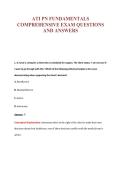
ATI PN FUNDAMENTALS
COMPREHENSIVE EXAM QUESTIONS
AND ANSWERS
1. A nurse is caring for a client who is scheduled for surgery. The client states, ‘I am not sure if
I want to go through with this.’ Which of the following ethical principles is the nurse
demonstrating when supporting the client’s decision?
A. Beneficence
B. Nonmaleficence
C. Justice
D. Autonomy
Answer: D
Conceptual Explanation: Autonomy refers to the right of the client to make their own
decisions about their healthcare, even if those decisions conflict with the medical team’s
advice.
,2. A nurse is preparing to document a late entry in a client’s electronic health record. Which
of the following actions should the nurse take?
A. Change the time of the original entry to reflect when the care was provided.
B. Request the supervisor to authorize the modification of the previous log.
C. Delete the previous entry and start a new one.
D. Label the entry as a ‘Late Entry’ and include the current date and time.
Answer: D
Conceptual Explanation: Proper documentation requires that late entries be clearly
identified as such, with the current date/time recorded alongside the time the event
actually occurred.
3. A nurse is providing care for a client who has a prescription for a clear liquid diet. Which of
the following food items should the nurse allow?
A. Chicken broth
B. Orange juice with pulp
C. Vanilla pudding
D. Sherbet
Answer: A
, Conceptual Explanation: Clear liquids consist of foods that are liquid at room
temperature and transparent. Chicken broth fits this criteria, whereas pudding and sherbet
are full liquids.
4. A nurse is caring for a client who is on contact precautions for C. difficile. Which of the
following actions is the priority?
A. Wear a mask when entering the room.
B. Perform hand hygiene with soap and water.
C. Use an alcohol-based hand rub after providing care.
D. Keep the client’s door closed at all times.
Answer: B
Conceptual Explanation: C. difficile spores are resistant to alcohol-based hand rubs;
therefore, mechanical scrubbing with soap and water is required to remove the spores
from hands.
5. A nurse is reinforcing teaching with a client about using a cane. Which of the following
instructions should the nurse include?
A. Maintain two points of support on the ground at all times.
B. Move the stronger leg forward first when walking.
C. Hold the cane on the weaker side of the body.
D. Keep the cane 30 cm (12 in) in front of the feet when walking.
COMPREHENSIVE EXAM QUESTIONS
AND ANSWERS
1. A nurse is caring for a client who is scheduled for surgery. The client states, ‘I am not sure if
I want to go through with this.’ Which of the following ethical principles is the nurse
demonstrating when supporting the client’s decision?
A. Beneficence
B. Nonmaleficence
C. Justice
D. Autonomy
Answer: D
Conceptual Explanation: Autonomy refers to the right of the client to make their own
decisions about their healthcare, even if those decisions conflict with the medical team’s
advice.
,2. A nurse is preparing to document a late entry in a client’s electronic health record. Which
of the following actions should the nurse take?
A. Change the time of the original entry to reflect when the care was provided.
B. Request the supervisor to authorize the modification of the previous log.
C. Delete the previous entry and start a new one.
D. Label the entry as a ‘Late Entry’ and include the current date and time.
Answer: D
Conceptual Explanation: Proper documentation requires that late entries be clearly
identified as such, with the current date/time recorded alongside the time the event
actually occurred.
3. A nurse is providing care for a client who has a prescription for a clear liquid diet. Which of
the following food items should the nurse allow?
A. Chicken broth
B. Orange juice with pulp
C. Vanilla pudding
D. Sherbet
Answer: A
, Conceptual Explanation: Clear liquids consist of foods that are liquid at room
temperature and transparent. Chicken broth fits this criteria, whereas pudding and sherbet
are full liquids.
4. A nurse is caring for a client who is on contact precautions for C. difficile. Which of the
following actions is the priority?
A. Wear a mask when entering the room.
B. Perform hand hygiene with soap and water.
C. Use an alcohol-based hand rub after providing care.
D. Keep the client’s door closed at all times.
Answer: B
Conceptual Explanation: C. difficile spores are resistant to alcohol-based hand rubs;
therefore, mechanical scrubbing with soap and water is required to remove the spores
from hands.
5. A nurse is reinforcing teaching with a client about using a cane. Which of the following
instructions should the nurse include?
A. Maintain two points of support on the ground at all times.
B. Move the stronger leg forward first when walking.
C. Hold the cane on the weaker side of the body.
D. Keep the cane 30 cm (12 in) in front of the feet when walking.

