

Escrito por estudiantes que aprobaron Inmediatamente disponible después del pago Leer en línea o como PDF ¿Documento equivocado? Cámbialo gratis 4,6 TrustPilot
logo-home
Document preview thumbnail
Vista previa 2 fuera de 12 páginas
Examen

MBLEx Exam 2026/2027 | 100+ Questions & Answers | Anatomy, Kinesiology, Muscles, Joints, Nervous System & Pathology

Document preview thumbnail
Vista previa 2 fuera de 12 páginas

This comprehensive MBLEx Exam 2026/2027 study resource contains 100+ questions, answers, definitions, and high-yield review points across 12 pages. It provides focused preparation in major Massage & Bodywork Licensing Examination subject areas, including anatomy and physiology, kinesiology, muscular anatomy, muscle contractions, joint structure and movement, skeletal anatomy, nervous-system function, medical terminology, lymphatic and immune-system concepts, and basic cellular biology. The document uses a direct question-and-answer format that supports active recall and rapid review before an MBLEx-style examination. The opening section emphasizes muscular anatomy and kinesiology. Students review the hip adductor group—adductor brevis, adductor longus, adductor magnus, gracilis, and pectineus—as well as hip abductors and the major flexors and extensors of the neck. The document distinguishes isometric, isotonic, concentric, and eccentric contractions, explaining whether the muscle changes length and whether it shortens or lengthens during contraction. These concepts provide a foundation for understanding muscular function and movement during massage assessment and treatment. A substantial section covers cardiovascular, lymphatic, respiratory, and immune-system anatomy. The resource distinguishes arteries from veins, describes the thoracic duct and its lymphatic drainage, and reviews cytotoxic T cells. Respiratory structures include the pharynx and larynx, while proprioceptive physiology includes muscle spindles and Golgi tendon organs. According to the source, muscle spindles provide information about skeletal-muscle length and changes in length, while Golgi tendon organs are located where muscles join tendons. The document also provides extensive review of anatomical terminology and body organization. Students encounter medical word components such as -algia, arthro-, brachio-, caud-, cephal-, nephro-, -trophy, and viscero-, alongside definitions of tissues and organs. Directional terminology includes ventral, dorsal, cephalic, and caudal, while body-cavity questions review the ventral, thoracic, abdominopelvic, abdominal, pelvic, dorsal, cranial, and spinal cavities and the major structures contained within them. Cellular and chemical fundamentals include molecules, mixtures, solutions, suspensions, acids, bases, prokaryotes, eukaryotes, the Golgi apparatus, mitochondria, and ribosomes. The material also distinguishes hypertonic, isotonic, and hypotonic solutions. Tissue and integumentary concepts include epithelial tissue, fascia, sebaceous glands, sudoriferous glands, ceruminous glands, and the structure of fingernails and toenails as described in the source. Skeletal anatomy receives substantial attention through osteoclasts, the diaphysis, epiphysis, periosteum, and bone markings. Students review processes, tubercles, spines, condyles, epicondyles, lines, crests, foramina, fossae, grooves, sinuses, meatuses, fissures, and sutures. The document then distinguishes fibrous, cartilaginous, and synovial joints and reviews six synovial-joint types: hinge, condylar, gliding, saddle, ball-and-socket, and pivot joints. Another high-value section addresses joint movements and ligament anatomy. Movements covered include flexion, extension, abduction, adduction, dorsiflexion, plantar flexion, eversion, inversion, protraction, and lateral flexion. Ligaments reviewed include the nuchal ligament, acromioclavicular ligament, transverse carpal ligament, anterior cruciate ligament, medial collateral ligament, and anterior talofibular ligament. The material additionally distinguishes a muscle's origin as the more stationary attachment and insertion as the more movable attachment. The nervous-system section provides focused preparation on synaptic vesicles, neuroglia, nodes of Ranvier, acetylcholine, the somatic nervous system, autonomic nervous system, sympathetic and parasympathetic divisions, meninges, dura mater, cerebrum, cerebellum, and cerebral hemispheres. Peripheral nerve review includes the axillary, radial, median, ulnar, and sciatic nerves, with the source listing their spinal levels and selected sensory and motor distributions. This material is particularly relevant for students reviewing neuromuscular anatomy and peripheral nerve function. The resource also includes the seven chakras as presented in the uploaded study material, alongside its conventional anatomy and physiology content. Because the document is an exam-preparation source, this description preserves the terminology and framing found in the uploaded material rather than adding or correcting content that the source itself does not provide. Overall, this is a detailed MBLEx question-and-answer study guide suitable for active recall, terminology memorization, and review of anatomy, physiology, kinesiology, joint mechanics, neurology, and massage-related foundational science. The uploaded document identifies itself as “Mblex Exam 2026/2027 Exam Questions and Answers | Already Graded A+.” No university or academic institution is specified in the source, while MBLEx is the examination identifier used throughout the document. Relevant Students: MBLEx candidates, massage therapy students, massage and bodywork students, aspiring licensed massage therapists, massage therapy graduates preparing for licensure, therapeutic massage students, bodywork practitioners, and learners reviewing anatomy, physiology, kinesiology, neurology, joint mechanics, and musculoskeletal terminology. Keywords: MBLEx exam 2026, MBLEx exam 2027, MBLEx questions and answers, MBLEx practice questions, MBLEx study guide, MBLEx exam preparation, massage therapy licensing exam, massage therapy anatomy, massage therapy physiology, massage therapy kinesiology, muscle contractions, isometric contraction, isotonic contraction, concentric contraction, eccentric contraction, hip adductors, hip abductors, muscle spindles, Golgi tendon organs, medical terminology, body cavities, skeletal anatomy, bone markings, synovial joints, joint movements, flexion and extension, abduction and adduction, ACL, MCL, nervous system, somatic nervous system, autonomic nervous system, sympathetic nervous system, parasympathetic nervous system, peripheral nerves, radial nerve, median nerve, ulnar nerve, sciatic nerve, MBLEx anatomy and physiology

Vista previa del contenido

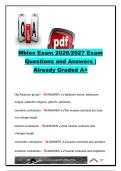
Mblex Exam 2026/2027 Exam
Questions and Answers |
Already Graded A+


Hip Adductor group? - ANSWER ✔✔adductor brevis, adductore

longus, adductor magnus, gracilis, pectineus


isometric contraction - ANSWER ✔✔the muscle contracts but does

not change length


isotonic contraction - ANSWER ✔✔the muscle contracts and

changes length


concentric contraction - ANSWER ✔✔muscle contracts and shortens


eccentric contraction - ANSWER ✔✔muscle contracts and lengthens

, flexors of the neck - ANSWER ✔✔SCM, scalenes, and platysma


extensors of the neck - ANSWER ✔✔splenius capitus, traps (upper

portion)


hip abductors - ANSWER ✔✔glut med, glut min, iliopsoas, TFL,

sartorius


arteries - ANSWER ✔✔blood vessels that carry blood AWAY from the

heart


veins - ANSWER ✔✔blood vessels that carry blood TO the heart


thoracic duct - ANSWER ✔✔brings lymph from the upper-left

quadrant and lower extrmeties of the body and drains into the left

subclavian vein


T cytotoxic cells - ANSWER ✔✔in the immune system, identify

foreign antigen on surface of a cell, bind to it, and destroy the cell.


pharynx - ANSWER ✔✔connects nasal cavities to the larynx


larynx - ANSWER ✔✔contains vocal cords, and the adams apple,

aka voice box


muscle spindles - ANSWER ✔✔proprioceptors found in belly of the

muscle, provides info on length or changes in skeletal muscles

Información del documento

Subido en
19 de agosto de 2026
Número de páginas
12
Escrito en
2026/2027
Tipo
Examen
Contiene
Preguntas y respuestas
$18.99

¿Documento equivocado? Cámbialo gratis Dentro de los 14 días posteriores a la compra y antes de descargarlo, puedes elegir otro documento. Puedes gastar el importe de nuevo.
Escrito por estudiantes que aprobaron
Inmediatamente disponible después del pago
Leer en línea o como PDF

Seller avatar
Los indicadores de reputación están sujetos a la cantidad de artículos vendidos por una tarifa y las reseñas que ha recibido por esos documentos. Hay tres niveles: Bronce, Plata y Oro. Cuanto mayor reputación, más podrás confiar en la calidad del trabajo del vendedor.
NinjaNerd
3.4
(78)
Vendido
417
Seguidores
6
Artículos
15918
Última venta
5 días hace


Por qué los estudiantes eligen Stuvia

Creado por compañeros estudiantes, verificado por reseñas

Calidad en la que puedes confiar: escrito por estudiantes que aprobaron y evaluado por otros que han usado estos resúmenes.

¿No estás satisfecho? Elige otro documento

¡No te preocupes! Puedes elegir directamente otro documento que se ajuste mejor a lo que buscas.

Paga como quieras, empieza a estudiar al instante

Sin suscripción, sin compromisos. Paga como estés acostumbrado con tarjeta de crédito y descarga tu documento PDF inmediatamente.

Student with book image

“Comprado, descargado y aprobado. Así de fácil puede ser.”

Alisha Student

Preguntas frecuentes
