

Escrito por estudiantes que aprobaron Inmediatamente disponible después del pago Leer en línea o como PDF ¿Documento equivocado? Cámbialo gratis 4,6 TrustPilot
logo-home
Document preview thumbnail
Vista previa 3 fuera de 28 páginas
Examen

CLC Exam 2026/2027 | 150+ Questions & Correct Answers | Lactation, Milk Supply, Latch, Breastfeeding & Infant Feeding | Course Code: CLC | 2026/2027 | Certified Lactation Counselor

Document preview thumbnail
Vista previa 3 fuera de 28 páginas

This comprehensive CLC Exam 2026/2027 study document contains 150+ exam questions, correct answers, definitions, and applied review points across 28 pages, designed for students preparing for Certified Lactation Counselor examinations and lactation education. Key topics include evidence-based breastfeeding practice, the International Code, breastfeeding promotion and support, lactation anatomy and physiology, prolactin and oxytocin, Lactogenesis I–III, human milk composition, milk supply, infant growth, latch and positioning, engorgement, mastitis, maternal conditions, newborn complications, formula feeding, donor milk, counseling, skin-to-skin care, complementary feeding, weaning, and the Baby-Friendly Hospital Initiative (BFHI). The opening section establishes the broader public-health and evidence-based foundations of lactation support. Students review the International Code and inappropriate marketing practices, the three-part framework of protecting, promoting, and supporting breastfeeding, the hierarchy of evidence from systematic reviews and meta-analyses through case studies, the WHO/UNICEF Global Strategy for Infant and Young Child Feeding, and the World Breastfeeding Trends Initiative. The document also identifies the period approximately 3–7 days after hospital discharge as a significant point for breastfeeding cessation and discusses latch difficulties, breast pain or soreness, employment, and school as barriers to continued breastfeeding. A substantial portion examines breast anatomy and lactation physiology. The notes identify alveolar cells as milk-producing cells surrounded by myoepithelial cells and explain the roles of prolactin in milk production and oxytocin in milk ejection. Students review anterior versus posterior pituitary secretion, nipple stimulation and stretching, receptor-site priming, the effects of frequent versus infrequent nursing, and the relationship between placental delivery, progesterone withdrawal, prolactin, and initiation of copious milk production. Early suckling and milk expression are emphasized as important factors supporting ongoing milk supply. The resource provides detailed review of Lactogenesis I, II, and III and human milk composition. Topics include colostrum, secretory activation, galactopoiesis, progesterone and prolactin, preterm milk, changes in milk composition during a feeding, breast storage capacity, degree of breast emptying, feeding frequency, and variations in milk-fat transfer. Students also study lactose as an important component of human milk, human milk oligosaccharides (HMOs), Lactobacillus bifidus, intestinal microbiota, antibodies, and the protective functions attributed to human milk in the infant gastrointestinal and immune systems. Another major section covers milk-supply challenges and maternal factors affecting lactation. The questions discuss engorgement, breast implants and reduction surgery, inverted nipples, iron-deficiency anemia, Sheehan syndrome following severe postpartum hemorrhage, maternal obesity, PCOS, smoking, pseudoephedrine, corticosteroids, and other factors presented as potentially affecting lactogenesis or milk production. The material also reviews breast storage and expression, hand expression, pump-flange sizing, early milk expression for mothers of premature infants, and strategies intended to increase milk volume. The document devotes significant attention to breast and nipple complications. Students encounter plugged ducts, nipple blebs, engorgement, mastitis, abscesses, MRSA, herpes, nipple vasospasm, and recurrent feeding difficulties. It also reviews torticollis and Goldsmith sign as possible explanations for unilateral breastfeeding preference. The notes discuss maintaining milk flow during mastitis and recognizing systemic symptoms or persistent breast abnormalities that warrant referral to an appropriate healthcare professional. Newborn assessment topics include weight loss and gain, hypoglycemia, jaundice, kernicterus, prematurity, feeding stamina, and milk transfer. The resource discusses infants who are SGA, LGA, born to mothers with diabetes, or late preterm as groups highlighted in the notes for hypoglycemia concerns. It also covers late-preterm and early-term breastfeeding difficulties, the Preterm Infant Breastfeeding Behavior Scale (PIBBS), the dancer breastfeeding position for hypotonic infants, and feeding challenges associated with cleft lip or palate. A valuable behavioral component focuses on lactation counseling and communication. Students review Mary Belenky's Women's Ways of Knowing, including silence, received knowledge, subjective knowing, procedural knowing, and constructed knowing, together with suggested counseling approaches for each style. The document recommends gathering information, asking open-ended questions, verifying what has been heard, providing individualized information, collaboratively developing a plan, checking understanding, arranging referrals when appropriate, documenting care, and maintaining a client-centered approach. The later pages broaden the review to formula safety, infant-feeding alternatives, breastfeeding contraindications, medications, and maternal substance exposure. Topics include powdered formula preparation, formula-associated organisms, hand expression and milk storage, galactosemia, selected maternal infections, radiopharmaceuticals, chemotherapy, illicit drug exposure, cannabis, nicotine, and breastfeeding-related medication considerations. The document also discusses donor/expressed milk choices, complementary feeding, breastfeeding strikes, parent-led and baby-led weaning, and breastfeeding during different stages of infant development. The final section reviews skin-to-skin care and the Baby-Friendly Hospital Initiative. The document lists nine stages following birth—from the birth cry and relaxation through crawling, familiarization, suckling, and sleep—and concludes with the BFHI's Ten Steps, including written breastfeeding policies, staff training, prenatal education, early breastfeeding initiation, teaching milk expression, avoiding unnecessary supplementation, rooming-in, responsive feeding, limiting artificial nipples, and connecting families with breastfeeding support. For academic reference, the topics in this study guide are closely related to material addressed in Breastfeeding and Human Lactation by Wambach and Spencer and professional guidance from the World Health Organization, UNICEF, Centers for Disease Control and Prevention, American Academy of Pediatrics, and Academy of Breastfeeding Medicine. The uploaded document itself contains several simplified, internally inconsistent, or potentially outdated clinical statements, so its answers should be treated as exam-review material and verified against current clinical guidelines before being used for patient-care decisions. Relevant Students: Certified Lactation Counselor candidates, CLC exam students, lactation counselor trainees, breastfeeding educators, nursing students, maternal-newborn nursing students, midwifery students, postpartum nurses, labor and delivery nurses, pediatric nursing students, NICU nurses and trainees, doulas, childbirth educators, WIC breastfeeding staff, maternal-child health students, breastfeeding peer counselors, and healthcare professionals studying human lactation and infant feeding. Keywords: CLC exam , CLC exam questions and answers, Certified Lactation Counselor exam, CLC correct answers, CLC practice test, CLC study guide, lactation counselor certification, breastfeeding exam questions, human lactation study guide, lactation physiology, prolactin and oxytocin, Lactogenesis I II III, human milk composition, breastfeeding hormones, milk supply breastfeeding, low milk supply, breast anatomy lactation, alveolar cells, myoepithelial cells, human milk oligosaccharides, HMO breast milk, infant gut microbiome, breastfeeding latch, breastfeeding positioning, infant milk transfer, breastfeeding engorgement, mastitis breastfeeding, plugged milk duct, nipple bleb, inverted nipples, Sheehan syndrome lactation, PCOS breastfeeding, postpartum depression breastfeeding, Edinburgh Postnatal Depression Scale, breastfeeding counseling, Womens Ways of Knowing, infant hypoglycemia, breastfeeding jaundice, kernicterus, late preterm breastfeeding, donor human milk, formula preparation, galactosemia breastfeeding, skin to skin breastfeeding, Baby Friendly Hospital Initiative, BFHI Ten Steps, complementary feeding, breastfeeding weaning, CLC certification preparation

Vista previa del contenido

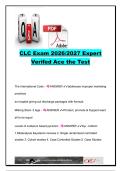
CLC Exam 2026/2027 Expert
Verifed Ace the Test


The International Code - ANSWER ✔✔addresses improper marketing

practices

ex hospital giving out discharge packages with formula


Milking Stool- 3 legs - ANSWER ✔✔Protect, promote & Support-want

all to be equal


Levels of evidence based pyramid - ANSWER ✔✔top - bottom:

1.Metanalysis &systemic reviews 2. Single randomized controlled

studies 3. Cohort studies 4. Case Controlled Studies 5. Case Studies

,When is greatest risk of stopping breastfeeding? - ANSWER ✔✔3-7

days (after going home from hospital)


Top reasons people stop breastfeeding - ANSWER ✔✔baby won't

latch, breast pain/soreness, work/school


Russ Labs Marketing Survey - ANSWER ✔✔survey 1965-2001

formula company tracking breastfeeding goals


Races in Order most likely to BF - ANSWER ✔✔spanish speaking-

hispanic, white, hispanic, black


Global Strategy for Infant and young feeding - ANSWER ✔✔WHO

and UNICEF developed this global strategy to focus world attention on

impact of feeding practices on the nutritional status, growth,

development and health and thus the survival of infants and young

children.


World Breastfeeding trends innitive - ANSWER ✔✔help track how

they are doing on global outcomes


innocenti ospitale -florence - ANSWER ✔✔BF orphan babies

increased rate of survival-today UNICEF child resource nutrition center

, path of messages to make milk - ANSWER ✔✔message to breast-to

nervous system -to brain- to hormones to travel to breast- then to blood

stream


what cells make milk - ANSWER ✔✔alveolar cells


alveolar cells are what?


what are they surrounded by - ANSWER ✔✔layer of cells with milk

inside, surrounded by myoepitheal cells


Myoepitheal cells will contract when what hits them - ANSWER

✔✔oxytocin


Are the ducts in breast evenly spaced? - ANSWER ✔✔No varies

woman to woman


How many nipple pores each breast? - ANSWER ✔✔3-5


Milk is ____ &_____ from sebaceous gland - ANSWER

✔✔antimicrobial and sticky


what are the two major hormone of lactation? Where are they secreted

from? - ANSWER ✔✔oxytocin and prolactin, pituitary gland


Prolactin is the hormone responsible for? - ANSWER ✔✔Milk

production

COPYRIGHT©NINJANERD 2025/2026. YEAR PUBLISHED 2026. COMPANY REGISTRATION NUMBER: 619652435. TERMS OF USE. PRIVACY
STATEMENT. ALL RIGHTS RESERVED
3


Información del documento

Subido en
19 de agosto de 2026
Número de páginas
28
Escrito en
2026/2027
Tipo
Examen
Contiene
Preguntas y respuestas
$18.99

¿Documento equivocado? Cámbialo gratis Dentro de los 14 días posteriores a la compra y antes de descargarlo, puedes elegir otro documento. Puedes gastar el importe de nuevo.
Escrito por estudiantes que aprobaron
Inmediatamente disponible después del pago
Leer en línea o como PDF

Seller avatar
Los indicadores de reputación están sujetos a la cantidad de artículos vendidos por una tarifa y las reseñas que ha recibido por esos documentos. Hay tres niveles: Bronce, Plata y Oro. Cuanto mayor reputación, más podrás confiar en la calidad del trabajo del vendedor.
NinjaNerd
3.4
(76)
Vendido
406
Seguidores
6
Artículos
15556
Última venta
4 horas hace


Por qué los estudiantes eligen Stuvia

Creado por compañeros estudiantes, verificado por reseñas

Calidad en la que puedes confiar: escrito por estudiantes que aprobaron y evaluado por otros que han usado estos resúmenes.

¿No estás satisfecho? Elige otro documento

¡No te preocupes! Puedes elegir directamente otro documento que se ajuste mejor a lo que buscas.

Paga como quieras, empieza a estudiar al instante

Sin suscripción, sin compromisos. Paga como estés acostumbrado con tarjeta de crédito y descarga tu documento PDF inmediatamente.

Student with book image

“Comprado, descargado y aprobado. Así de fácil puede ser.”

Alisha Student

Preguntas frecuentes