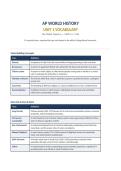
AP WORLD HISTORY
UNIT 1 VOCABULARY
The Global Tapestry, c. 1200 to c. 1450
25 essential terms, organized by topic and aligned to the official College Board framework.
State-Building Concepts
Term Definition
Dynasty A sequence of rulers from the same family or lineage governing a state over time.
Bureaucracy A system of appointed officials who administer the day-to-day functions of a state.
Tribute system A system in which subject or allied states/peoples send goods or wealth to a central
ruler in exchange for protection or autonomy.
Mandate of Heaven The Chinese belief that a ruler's authority to govern is granted by heaven, contingent
on just rule.
Syncretism The blending of different religious or cultural traditions into a new, combined form.
Decentralization A political structure in which power is distributed among many local authorities
rather than concentrated centrally.
East Asia & Dar al-Islam
Term Definition
Song Dynasty Chinese dynasty (960–1279) known for its civil service examination system, economic
prosperity, and technological innovation.
Civil service A merit-based test on Confucian classics used to select government officials in China,
examination open (in theory) regardless of birth.
Neo-Confucianism A revived and adapted form of Confucian philosophy emphasizing social hierarchy,
moral duty, and the proper roles of rulers and subjects.
Abbasid Caliphate A major Islamic empire (750–1258) centered in Baghdad, known for scholarship,
trade, and administrative sophistication.
Delhi Sultanate A Muslim-ruled state in South Asia (1206–1526) governing a majority-Hindu
population through a mix of force, taxation, and patronage.
Sufism A mystical branch of Islam emphasizing personal spiritual experience, significant in
spreading Islam syncretically in South/Southeast Asia.
UNIT 1 VOCABULARY
The Global Tapestry, c. 1200 to c. 1450
25 essential terms, organized by topic and aligned to the official College Board framework.
State-Building Concepts
Term Definition
Dynasty A sequence of rulers from the same family or lineage governing a state over time.
Bureaucracy A system of appointed officials who administer the day-to-day functions of a state.
Tribute system A system in which subject or allied states/peoples send goods or wealth to a central
ruler in exchange for protection or autonomy.
Mandate of Heaven The Chinese belief that a ruler's authority to govern is granted by heaven, contingent
on just rule.
Syncretism The blending of different religious or cultural traditions into a new, combined form.
Decentralization A political structure in which power is distributed among many local authorities
rather than concentrated centrally.
East Asia & Dar al-Islam
Term Definition
Song Dynasty Chinese dynasty (960–1279) known for its civil service examination system, economic
prosperity, and technological innovation.
Civil service A merit-based test on Confucian classics used to select government officials in China,
examination open (in theory) regardless of birth.
Neo-Confucianism A revived and adapted form of Confucian philosophy emphasizing social hierarchy,
moral duty, and the proper roles of rulers and subjects.
Abbasid Caliphate A major Islamic empire (750–1258) centered in Baghdad, known for scholarship,
trade, and administrative sophistication.
Delhi Sultanate A Muslim-ruled state in South Asia (1206–1526) governing a majority-Hindu
population through a mix of force, taxation, and patronage.
Sufism A mystical branch of Islam emphasizing personal spiritual experience, significant in
spreading Islam syncretically in South/Southeast Asia.