

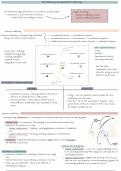
The behaviourist approach to learning
The behaviourist approach believes we are all born as blank slates: 2 types of learning:
• all behaviour is learnt from the environment • classical conditioning (Pavlov)
⑭
◦ Product of the surroundings (nurture) • Operant conditioning (Skinner)
Classical conditioning:
3.
Classical conditioning = learning through association 1. Unconditioned stimulus → unconditioned response
Pairing 2 stimulus to create response 2. Unconditioned stimulus + neutral stimulus → unconditioned response
3. Conditioned stimulus (previously the neutral stimulus) → conditioned response
are Other important features:
Occurn
Pavlov (1927) - fed dogs naturally Timing
Extinction
alongside bell ringing, dogs Unconditioned stimulus -> Unconditioned response
eventually salivated in 🥩 🐶
💧
Spontaneous recovery
response to both Stimulus generalisation
independent of each other Neutral -> Unconditioned response
Unconditioned stimulus +
stimulus 🐶
🥩 1920: Little Albert:
🛎 💧
A
Conditioned to fear white
rats after pairing as neutral
Conditioned stimulus -> Conditioned response
🛎 & 🐶 stimulus to loud sound
new learnt 💧
response
response
A03 evaluation - classical conditioning: becomeoaned
I
Strengths Weaknesses
• Spontaneous recovery - following extinction, when the CS
• Timing - if the NS cannot be used to predict the UCS,
and UCS are paired, the link is made quicker.
conditioning won’t take place.
• Stimulus generation - Pavlov discovered that once an
• Extinction - the CR isn’t a permanent response - after
animal had been conditioned, it also responded to similar
presentations of the CS in absence of the UCS, it loses
stimuli
the ability to produce the CR.
Operant conditioning:
eve
Learning through reinforcement → Consequences of behaviour determine chances of repeating again ve
pense
• Reinforcement - a consequence that strengthens the behaviour and increases the
likelihood of the behaviour occurring.
↑
·
◦ Positive reinforcement - Producing satisfying/pleasant consequence (food/praise
etc.)
◦ Negative reinforcement - Removing something unpleasant to elicit desired
behaviour
• Punishment - undesirable/unpleasant consequence after behaviour which decreases
the likelihood of recurrence
Skinners rats and pigeons:
• Positive reinforcement - a rat in box would accidentally knock a
Schedules of reinforcement: lever which dispensed food. After linking lever with food, the rat
• continuous reinforcement: reinforcing a behaviour every single repeatedly pressed it.
time • Negative reinforcement - Added small electrical current to box.
• Partial reinforcement: only reinforcing a behaviour every few When the lever was pulled, the current immediately stopped. The
times (eg. every third level) - this is more effective in rat continually pulled the lever to stop the current.
maintaining the response
, Social learning theory
Key psychologist = Bandura (1986) Social learning theory assumes we learn through observation.
The theory: learning through observation:
1. Modelling - The people we observe + learn from are referred to as Example:
models (live or symbolic models) There are 2 students satodelling
together in a lesson.
2. Imitation - copying the model’s behaviour Student 1 has completed all tasks whilst
3. Identification - individuals must feel they are similar to the model (eg. age student 2 has done nothing. Student 1 receives
and gender) a sticker + sweet for their work, which
mitation
4. Vicarious reinforcement - seeing the model receive reward increases encourages student 2 to complete their work.
likelihood of imitating behaviour (indirect reinforcement)
Bandura also argued that mediational processes are essential in learning for behaviour to be imitated.
Attention - paying attention to the person being observed
·
Retention - being able to remember what we have seen until its needed
Reproduction - being able to act out what we see
Motivation - The incentive to copy what has been seen
Bandura's Bobo dolls (1961):
Condition a: Child witnesses adult (model) aggressively play with bobo doll
◦ child then played with doll violently
Condition b: Child witnesses adult playing regularly
◦ child then played regularly
→ children in aggressive condition often chose more violent toys (eg. toy guns) without prompting
A03 evaluation - social learning theory:
Research evidence:
• Bobo doll study supports social learning theory S
• Importance of identification - Andsanger (2006): perceived similarity to a model was positively related to the effectiveness of
an alcohol advert’s message
Application:
• Advertising - eg. H&M used David Beckham to model men’s underwear on an advert so it would appeal to more men and
make them buy the product
• Regulation of TV and computer games - eg. 9pm watershed and Pegi ratings - ensures that children don’t learn from the
media
Alternatives:
• contradicts the biological approach which states behaviour is genetic and inherited
• Behaviour may be a result of deviant role models but may also have been there previously.
The behaviourist approach believes we are all born as blank slates: 2 types of learning:
• all behaviour is learnt from the environment • classical conditioning (Pavlov)
⑭
◦ Product of the surroundings (nurture) • Operant conditioning (Skinner)
Classical conditioning:
3.
Classical conditioning = learning through association 1. Unconditioned stimulus → unconditioned response
Pairing 2 stimulus to create response 2. Unconditioned stimulus + neutral stimulus → unconditioned response
3. Conditioned stimulus (previously the neutral stimulus) → conditioned response
are Other important features:
Occurn
Pavlov (1927) - fed dogs naturally Timing
Extinction
alongside bell ringing, dogs Unconditioned stimulus -> Unconditioned response
eventually salivated in 🥩 🐶
💧
Spontaneous recovery
response to both Stimulus generalisation
independent of each other Neutral -> Unconditioned response
Unconditioned stimulus +
stimulus 🐶
🥩 1920: Little Albert:
🛎 💧
A
Conditioned to fear white
rats after pairing as neutral
Conditioned stimulus -> Conditioned response
🛎 & 🐶 stimulus to loud sound
new learnt 💧
response
response
A03 evaluation - classical conditioning: becomeoaned
I
Strengths Weaknesses
• Spontaneous recovery - following extinction, when the CS
• Timing - if the NS cannot be used to predict the UCS,
and UCS are paired, the link is made quicker.
conditioning won’t take place.
• Stimulus generation - Pavlov discovered that once an
• Extinction - the CR isn’t a permanent response - after
animal had been conditioned, it also responded to similar
presentations of the CS in absence of the UCS, it loses
stimuli
the ability to produce the CR.
Operant conditioning:
eve
Learning through reinforcement → Consequences of behaviour determine chances of repeating again ve
pense
• Reinforcement - a consequence that strengthens the behaviour and increases the
likelihood of the behaviour occurring.
↑
·
◦ Positive reinforcement - Producing satisfying/pleasant consequence (food/praise
etc.)
◦ Negative reinforcement - Removing something unpleasant to elicit desired
behaviour
• Punishment - undesirable/unpleasant consequence after behaviour which decreases
the likelihood of recurrence
Skinners rats and pigeons:
• Positive reinforcement - a rat in box would accidentally knock a
Schedules of reinforcement: lever which dispensed food. After linking lever with food, the rat
• continuous reinforcement: reinforcing a behaviour every single repeatedly pressed it.
time • Negative reinforcement - Added small electrical current to box.
• Partial reinforcement: only reinforcing a behaviour every few When the lever was pulled, the current immediately stopped. The
times (eg. every third level) - this is more effective in rat continually pulled the lever to stop the current.
maintaining the response
, Social learning theory
Key psychologist = Bandura (1986) Social learning theory assumes we learn through observation.
The theory: learning through observation:
1. Modelling - The people we observe + learn from are referred to as Example:
models (live or symbolic models) There are 2 students satodelling
together in a lesson.
2. Imitation - copying the model’s behaviour Student 1 has completed all tasks whilst
3. Identification - individuals must feel they are similar to the model (eg. age student 2 has done nothing. Student 1 receives
and gender) a sticker + sweet for their work, which
mitation
4. Vicarious reinforcement - seeing the model receive reward increases encourages student 2 to complete their work.
likelihood of imitating behaviour (indirect reinforcement)
Bandura also argued that mediational processes are essential in learning for behaviour to be imitated.
Attention - paying attention to the person being observed
·
Retention - being able to remember what we have seen until its needed
Reproduction - being able to act out what we see
Motivation - The incentive to copy what has been seen
Bandura's Bobo dolls (1961):
Condition a: Child witnesses adult (model) aggressively play with bobo doll
◦ child then played with doll violently
Condition b: Child witnesses adult playing regularly
◦ child then played regularly
→ children in aggressive condition often chose more violent toys (eg. toy guns) without prompting
A03 evaluation - social learning theory:
Research evidence:
• Bobo doll study supports social learning theory S
• Importance of identification - Andsanger (2006): perceived similarity to a model was positively related to the effectiveness of
an alcohol advert’s message
Application:
• Advertising - eg. H&M used David Beckham to model men’s underwear on an advert so it would appeal to more men and
make them buy the product
• Regulation of TV and computer games - eg. 9pm watershed and Pegi ratings - ensures that children don’t learn from the
media
Alternatives:
• contradicts the biological approach which states behaviour is genetic and inherited
• Behaviour may be a result of deviant role models but may also have been there previously.

