

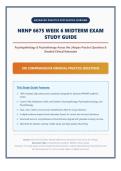
A D VA N C E D P R AC T I C E P S YC H I AT R I C N U R S I N G
NRNP 6675 WEEK 6 MIDTERM EXAM
STUDY GUIDE
Psychopathology & Psychotherapy Across the Lifespan Practice Questions &
Detailed Clinical Rationales
200 COMPREHENSIVE ORIGINAL PRACTICE QUESTIONS
This Study Guide Features:
✓ 100% Original, high-yield practice questions designed for advanced PMHNP academic
review.
✓ Covers Child, Adolescent, Adult, and Geriatric Psychopathology, Psychopharmacology, and
Psychotherapy.
✓ Clear, color-coded correct answer identification (Red) for visual retention.
✓ In-depth evidence-based clinical rationales (Green) for correct and incorrect distractors.
✓ Structured across 6 comprehensive clinical domains aligned with graduate nursing curricula.
✓ Optimized for desktop viewing, mobile study, and high-quality A4 printing.
Course: Advanced Psychiatric Mental Health Nurse Practitioner Care Across the Lifespan
Document Type: Comprehensive Academic Midterm Review Guide
Disclaimer: This study guide consists of original practice questions created independently for educational review
and self-assessment. It is not an actual, leaked, or official exam bank.
,NRNP 6675: PMHNP Midterm Exam Preparation Guide 200 Practice Questions & Rationales
Table of Contents by Clinical Domain
Domain 1: Mood, Anxiety, Psychotic, and Personality Disorders Questions 1 – 40
Domain 2: Neurodevelopmental, Child, and Adolescent Psychopathology Questions 41 – 80
Domain 3: Neurocognitive, Geriatric, and Organic Psychiatry Questions 81 – 120
Domain 4: Psychotherapy Modalities, Human Development, and Family Questions 121 –
Systems 150
Domain 5: Advanced Psychopharmacology and Somatic Interventions Questions 151 – 185
Domain 6: Emergency Psychiatry, Substance Use, Ethics, and Legal Practice Questions 186 – 200
, DOMAIN 1: MOOD, ANXIETY, PSYCHOTIC, AND PERSONALITY
DISORDERS (QUESTIONS 1 – 40)
Question 1
A 34-year-old male with Major Depressive Disorder has not responded to trial of sertraline 150 mg daily for 8
weeks and trial of venlafaxine XR 225 mg daily for 8 weeks. The PMHNP considers augmenting or switching
therapy. Which strategy is most appropriate according to STAR*D principles?
A. Switch to fluoxetine 20 mg daily.
B. Augment with bupropion XL or an atypical antipsychotic like aripiprazole.
C. Immediately start a monoamine oxidase inhibitor (MAOI).
D. Discontinue all medications and initiate electroconvulsive therapy (ECT) immediately.
Correct Answer: B
Rationale:
Following two failed adequate trials of first-line antidepressants (SSRI and SNRI), augmentation strategies using
bupropion or an atypical antipsychotic (e.g., aripiprazole) demonstrate higher evidence-based response rates
compared to switching to another SSRI (like fluoxetine). MAOIs require extensive washouts and are reserved for
resistant cases. ECT is indicated after multiple drug failures or urgent clinical severe features, not automatically after
two medication trials.
Question 2
A 28-year-old female presents with persistent worry for 8 months regarding work performance, finances, and
family health. She reports muscle tension, fatigue, and restlessness. What is the primary diagnostic criterion
required for Generalized Anxiety Disorder (GAD)?
A. Panic attacks triggered by public places
B. Excessive worry occurring more days than not for at least 6 months about a number of events
C. Recurrent intrusive memories of a traumatic event lasting over 1 month
D. Fear of social scrutiny and embarrassment in performance settings
Correct Answer: B
Rationale:
DSM-5-TR criteria for GAD specify excessive anxiety and worry occurring more days than not for at least 6 months
about various domains. Option A describes Agoraphobia/Panic Disorder. Option C describes PTSD. Option D describes
, Social Anxiety Disorder.
Question 3
A 42-year-old male diagnosed with Bipolar I Disorder presents in a acute manic episode with severe
psychomotor agitation and grandiose delusions. Which pharmacotherapy regimen represents first-line acute
treatment?
A. Monotherapy with lamotrigine 25 mg daily
B. Monotherapy with citalopram 20 mg daily
C. Combination of lithium or valproate with an atypical antipsychotic (e.g., quetiapine or olanzapine)
D. Lorazepam monotherapy orally as needed
Correct Answer: C
Rationale:
Severe acute mania with psychotic features responds best to combination therapy with a mood stabilizer (lithium or
divalproex) plus a second-generation antipsychotic. Lamotrigine requires slow titration and is for bipolar depression
maintenance, not acute mania. Antidepressants (citalopram) can induce mania. Benzodiazepines alone are insufficient
for mood stabilization or psychosis.
Question 4
A patient with Schizophrenia treatment-resistant to risperidone and haloperidol is started on Clozapine. Which
absolute neutrophil count (ANC) baseline is required before initiating therapy?
A. ANC ≥ 500/mcL
B. ANC ≥ 1,000/mcL
C. ANC ≥ 1,500/mcL (or ≥ 1,000/mcL for Benign Ethnic Neutropenia)
D. ANC ≥ 3,000/mcL
Correct Answer: C
Rationale:
According to the Clozapine REMS program, the baseline ANC must be at least 1,500/mcL for the general population or
at least 1,000/mcL for patients with documented Benign Ethnic Neutropenia (BEN) prior to clozapine initiation to
mitigate agranulocytosis risk.
NRNP 6675 WEEK 6 MIDTERM EXAM
STUDY GUIDE
Psychopathology & Psychotherapy Across the Lifespan Practice Questions &
Detailed Clinical Rationales
200 COMPREHENSIVE ORIGINAL PRACTICE QUESTIONS
This Study Guide Features:
✓ 100% Original, high-yield practice questions designed for advanced PMHNP academic
review.
✓ Covers Child, Adolescent, Adult, and Geriatric Psychopathology, Psychopharmacology, and
Psychotherapy.
✓ Clear, color-coded correct answer identification (Red) for visual retention.
✓ In-depth evidence-based clinical rationales (Green) for correct and incorrect distractors.
✓ Structured across 6 comprehensive clinical domains aligned with graduate nursing curricula.
✓ Optimized for desktop viewing, mobile study, and high-quality A4 printing.
Course: Advanced Psychiatric Mental Health Nurse Practitioner Care Across the Lifespan
Document Type: Comprehensive Academic Midterm Review Guide
Disclaimer: This study guide consists of original practice questions created independently for educational review
and self-assessment. It is not an actual, leaked, or official exam bank.
,NRNP 6675: PMHNP Midterm Exam Preparation Guide 200 Practice Questions & Rationales
Table of Contents by Clinical Domain
Domain 1: Mood, Anxiety, Psychotic, and Personality Disorders Questions 1 – 40
Domain 2: Neurodevelopmental, Child, and Adolescent Psychopathology Questions 41 – 80
Domain 3: Neurocognitive, Geriatric, and Organic Psychiatry Questions 81 – 120
Domain 4: Psychotherapy Modalities, Human Development, and Family Questions 121 –
Systems 150
Domain 5: Advanced Psychopharmacology and Somatic Interventions Questions 151 – 185
Domain 6: Emergency Psychiatry, Substance Use, Ethics, and Legal Practice Questions 186 – 200
, DOMAIN 1: MOOD, ANXIETY, PSYCHOTIC, AND PERSONALITY
DISORDERS (QUESTIONS 1 – 40)
Question 1
A 34-year-old male with Major Depressive Disorder has not responded to trial of sertraline 150 mg daily for 8
weeks and trial of venlafaxine XR 225 mg daily for 8 weeks. The PMHNP considers augmenting or switching
therapy. Which strategy is most appropriate according to STAR*D principles?
A. Switch to fluoxetine 20 mg daily.
B. Augment with bupropion XL or an atypical antipsychotic like aripiprazole.
C. Immediately start a monoamine oxidase inhibitor (MAOI).
D. Discontinue all medications and initiate electroconvulsive therapy (ECT) immediately.
Correct Answer: B
Rationale:
Following two failed adequate trials of first-line antidepressants (SSRI and SNRI), augmentation strategies using
bupropion or an atypical antipsychotic (e.g., aripiprazole) demonstrate higher evidence-based response rates
compared to switching to another SSRI (like fluoxetine). MAOIs require extensive washouts and are reserved for
resistant cases. ECT is indicated after multiple drug failures or urgent clinical severe features, not automatically after
two medication trials.
Question 2
A 28-year-old female presents with persistent worry for 8 months regarding work performance, finances, and
family health. She reports muscle tension, fatigue, and restlessness. What is the primary diagnostic criterion
required for Generalized Anxiety Disorder (GAD)?
A. Panic attacks triggered by public places
B. Excessive worry occurring more days than not for at least 6 months about a number of events
C. Recurrent intrusive memories of a traumatic event lasting over 1 month
D. Fear of social scrutiny and embarrassment in performance settings
Correct Answer: B
Rationale:
DSM-5-TR criteria for GAD specify excessive anxiety and worry occurring more days than not for at least 6 months
about various domains. Option A describes Agoraphobia/Panic Disorder. Option C describes PTSD. Option D describes
, Social Anxiety Disorder.
Question 3
A 42-year-old male diagnosed with Bipolar I Disorder presents in a acute manic episode with severe
psychomotor agitation and grandiose delusions. Which pharmacotherapy regimen represents first-line acute
treatment?
A. Monotherapy with lamotrigine 25 mg daily
B. Monotherapy with citalopram 20 mg daily
C. Combination of lithium or valproate with an atypical antipsychotic (e.g., quetiapine or olanzapine)
D. Lorazepam monotherapy orally as needed
Correct Answer: C
Rationale:
Severe acute mania with psychotic features responds best to combination therapy with a mood stabilizer (lithium or
divalproex) plus a second-generation antipsychotic. Lamotrigine requires slow titration and is for bipolar depression
maintenance, not acute mania. Antidepressants (citalopram) can induce mania. Benzodiazepines alone are insufficient
for mood stabilization or psychosis.
Question 4
A patient with Schizophrenia treatment-resistant to risperidone and haloperidol is started on Clozapine. Which
absolute neutrophil count (ANC) baseline is required before initiating therapy?
A. ANC ≥ 500/mcL
B. ANC ≥ 1,000/mcL
C. ANC ≥ 1,500/mcL (or ≥ 1,000/mcL for Benign Ethnic Neutropenia)
D. ANC ≥ 3,000/mcL
Correct Answer: C
Rationale:
According to the Clozapine REMS program, the baseline ANC must be at least 1,500/mcL for the general population or
at least 1,000/mcL for patients with documented Benign Ethnic Neutropenia (BEN) prior to clozapine initiation to
mitigate agranulocytosis risk.

