

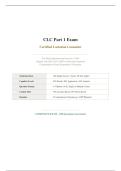
CLC Part 1 Exam
Certified Lactation Counselor
Test Guide Questions and Answers | 100%
Aligned with 2026-2027 ALPP Certification Standards
Comprehensive Exam Preparation | 6 Domains
Total Questions 100 (Single Answer + Select All That Apply)
Cognitive Levels 30% Recall | 40% Application | 30% Analysis
Question Format 4-5 Options (A-E), Single or Multiple Correct
Content Style 70% Scenario-Based | 30% Direct Recall
Domains 6 Comprehensive Domains per ALPP Blueprint
COMPLETE EXAM - 100 Questions Generated
,CLC Part 1 Exam | Certified Lactation Counselor | ALPP 2026-2027 100 Questions | Select All That Apply Included
Section 1: Anatomy, Physiology, and Biochemistry of Lactation
Q1: Which hormone triggers the let-down reflex?
A. Prolactin
B. Oxytocin [CORRECT]
C. Estrogen
D. Progesterone
Correct Answer: B
Rationale: Oxytocin from the posterior pituitary triggers myoepithelial contraction to eject milk. Prolactin handles
synthesis. Estrogen and progesterone suppress lactogenesis until they drop after delivery.
Q2: A mother 3 days postpartum has full warm slightly tender breasts. Infant breastfeeds 8-10x/day
with good latch. Most likely?
A. Mastitis
B. Normal engorgement during lactogenesis II [CORRECT]
C. Plugged duct
D. Breast abscess
Correct Answer: B
Rationale: Classic lactogenesis II engorgement at 48-72 hours. Progesterone drops and prolactin activates causing
fullness from increased blood and lymph flow. Mastitis requires fever and chills.
Q3: Colostrum compared to mature milk:
A. Higher lactose lower protein
B. Lower fat and higher protein and immunoglobulins [CORRECT]
C. Higher volume lower sodium
D. Lower immunoglobulins higher casein
Correct Answer: B
Rationale: Colostrum has higher protein especially sIgA and immunoglobulins but lower fat lactose and volume. sIgA
provides passive immunity coating intestinal mucosa. Mature milk has higher lactose and fat.
Q4: Which hormonal changes prepare the mammary gland during pregnancy? (Select All That Apply)
[Select All That Apply]
A. Increased estrogen promoting ductal development [CORRECT]
B. Increased progesterone promoting alveolar development [CORRECT]
C. Decreased prolactin preventing premature lactation
D. Placental lactogen contributing to mammary growth [CORRECT]
E. Elevated oxytocin causing milk secretion in third trimester
Correct Answer: A, B, D
Rationale: Estrogen stimulates ducts, progesterone promotes alveoli, placental lactogen contributes to growth. Prolactin
actually increases but is suppressed by estrogen and progesterone. Oxytocin does not cause milk secretion during
pregnancy.
Q5: Alveolar cells produce milk through which processes?
A. Pinocytosis only
B. Apocrine merocrine and transcytosis [CORRECT]
C. Exocytosis of lipid droplets only
D. Active transport of lactose and casein
Correct Answer: B
Page 2
, CLC Part 1 Exam | Certified Lactation Counselor | ALPP 2026-2027 100 Questions | Select All That Apply Included
Rationale: Fat secreted by apocrine mechanisms, proteins by exocytosis, lactose and minerals through transcytosis, and
IgA via pIgR. This multi-mechanism approach allows independent variation of milk components.
Q6: About foremilk and hindmilk, which is most accurate?
A. Foremilk higher in fat lower lactose
B. Hindmilk higher in fat and caloric density [CORRECT]
C. They come from different glands
D. Hindmilk contains no lactose
Correct Answer: B
Rationale: Foremilk at start is higher in lactose and water but lower in fat. Hindmilk later has more fat and calories as
fat globules release with drainage. Both from same gland. Lactose stays consistent.
Q7: Which lactogenesis stage is copious milk secretion?
A. Lactogenesis I mid-pregnancy
B. Lactogenesis II at 48-72 hours postpartum [CORRECT]
C. Lactogenesis III at weaning
D. Lactogenesis IV at 6 months
Correct Answer: B
Rationale: Lactogenesis II at 48-72 hours triggered by progesterone withdrawal after placental delivery. Causes breast
fullness and warmth. L I is pregnancy colostrum. L III is ongoing maintenance. No L IV.
Q8: Which about prolactin is accurate?
A. Levels constant all day
B. Released in pulses during breastfeeding
C. Produced by anterior pituitary stimulates milk synthesis [CORRECT]
D. Responsible for let-down
Correct Answer: C
Rationale: Prolactin from anterior pituitary is the primary milk synthesis hormone. Releases in pulses highest during
breastfeeding from nipple stimulation. Oxytocin handles let-down. Frequent removal maintains receptors.
Q9: Primary role of myoepithelial cells?
A. Synthesize casein
B. Produce prolactin receptors
C. Contract to eject milk during let-down [CORRECT]
D. Transport immunoglobulins
Correct Answer: C
Rationale: Smooth muscle-like cells surrounding alveoli and ducts. Oxytocin binding causes contraction squeezing milk
into ductal system. This is the mechanical basis of milk ejection.
Q10: Which immunoglobulin is highest in human milk?
A. IgG
B. IgA [CORRECT]
C. IgM
D. IgE
Correct Answer: B
Rationale: Secretory IgA is predominant providing primary immune protection by coating mucosal surfaces preventing
pathogen adhesion. Resists digestion. IgG crosses placenta. IgM and IgE minimal in milk.
Q11: Mother with pre-gestational type 2 diabetes at increased risk for delayed lactogenesis II. Why?
Page 3
Certified Lactation Counselor
Test Guide Questions and Answers | 100%
Aligned with 2026-2027 ALPP Certification Standards
Comprehensive Exam Preparation | 6 Domains
Total Questions 100 (Single Answer + Select All That Apply)
Cognitive Levels 30% Recall | 40% Application | 30% Analysis
Question Format 4-5 Options (A-E), Single or Multiple Correct
Content Style 70% Scenario-Based | 30% Direct Recall
Domains 6 Comprehensive Domains per ALPP Blueprint
COMPLETE EXAM - 100 Questions Generated
,CLC Part 1 Exam | Certified Lactation Counselor | ALPP 2026-2027 100 Questions | Select All That Apply Included
Section 1: Anatomy, Physiology, and Biochemistry of Lactation
Q1: Which hormone triggers the let-down reflex?
A. Prolactin
B. Oxytocin [CORRECT]
C. Estrogen
D. Progesterone
Correct Answer: B
Rationale: Oxytocin from the posterior pituitary triggers myoepithelial contraction to eject milk. Prolactin handles
synthesis. Estrogen and progesterone suppress lactogenesis until they drop after delivery.
Q2: A mother 3 days postpartum has full warm slightly tender breasts. Infant breastfeeds 8-10x/day
with good latch. Most likely?
A. Mastitis
B. Normal engorgement during lactogenesis II [CORRECT]
C. Plugged duct
D. Breast abscess
Correct Answer: B
Rationale: Classic lactogenesis II engorgement at 48-72 hours. Progesterone drops and prolactin activates causing
fullness from increased blood and lymph flow. Mastitis requires fever and chills.
Q3: Colostrum compared to mature milk:
A. Higher lactose lower protein
B. Lower fat and higher protein and immunoglobulins [CORRECT]
C. Higher volume lower sodium
D. Lower immunoglobulins higher casein
Correct Answer: B
Rationale: Colostrum has higher protein especially sIgA and immunoglobulins but lower fat lactose and volume. sIgA
provides passive immunity coating intestinal mucosa. Mature milk has higher lactose and fat.
Q4: Which hormonal changes prepare the mammary gland during pregnancy? (Select All That Apply)
[Select All That Apply]
A. Increased estrogen promoting ductal development [CORRECT]
B. Increased progesterone promoting alveolar development [CORRECT]
C. Decreased prolactin preventing premature lactation
D. Placental lactogen contributing to mammary growth [CORRECT]
E. Elevated oxytocin causing milk secretion in third trimester
Correct Answer: A, B, D
Rationale: Estrogen stimulates ducts, progesterone promotes alveoli, placental lactogen contributes to growth. Prolactin
actually increases but is suppressed by estrogen and progesterone. Oxytocin does not cause milk secretion during
pregnancy.
Q5: Alveolar cells produce milk through which processes?
A. Pinocytosis only
B. Apocrine merocrine and transcytosis [CORRECT]
C. Exocytosis of lipid droplets only
D. Active transport of lactose and casein
Correct Answer: B
Page 2
, CLC Part 1 Exam | Certified Lactation Counselor | ALPP 2026-2027 100 Questions | Select All That Apply Included
Rationale: Fat secreted by apocrine mechanisms, proteins by exocytosis, lactose and minerals through transcytosis, and
IgA via pIgR. This multi-mechanism approach allows independent variation of milk components.
Q6: About foremilk and hindmilk, which is most accurate?
A. Foremilk higher in fat lower lactose
B. Hindmilk higher in fat and caloric density [CORRECT]
C. They come from different glands
D. Hindmilk contains no lactose
Correct Answer: B
Rationale: Foremilk at start is higher in lactose and water but lower in fat. Hindmilk later has more fat and calories as
fat globules release with drainage. Both from same gland. Lactose stays consistent.
Q7: Which lactogenesis stage is copious milk secretion?
A. Lactogenesis I mid-pregnancy
B. Lactogenesis II at 48-72 hours postpartum [CORRECT]
C. Lactogenesis III at weaning
D. Lactogenesis IV at 6 months
Correct Answer: B
Rationale: Lactogenesis II at 48-72 hours triggered by progesterone withdrawal after placental delivery. Causes breast
fullness and warmth. L I is pregnancy colostrum. L III is ongoing maintenance. No L IV.
Q8: Which about prolactin is accurate?
A. Levels constant all day
B. Released in pulses during breastfeeding
C. Produced by anterior pituitary stimulates milk synthesis [CORRECT]
D. Responsible for let-down
Correct Answer: C
Rationale: Prolactin from anterior pituitary is the primary milk synthesis hormone. Releases in pulses highest during
breastfeeding from nipple stimulation. Oxytocin handles let-down. Frequent removal maintains receptors.
Q9: Primary role of myoepithelial cells?
A. Synthesize casein
B. Produce prolactin receptors
C. Contract to eject milk during let-down [CORRECT]
D. Transport immunoglobulins
Correct Answer: C
Rationale: Smooth muscle-like cells surrounding alveoli and ducts. Oxytocin binding causes contraction squeezing milk
into ductal system. This is the mechanical basis of milk ejection.
Q10: Which immunoglobulin is highest in human milk?
A. IgG
B. IgA [CORRECT]
C. IgM
D. IgE
Correct Answer: B
Rationale: Secretory IgA is predominant providing primary immune protection by coating mucosal surfaces preventing
pathogen adhesion. Resists digestion. IgG crosses placenta. IgM and IgE minimal in milk.
Q11: Mother with pre-gestational type 2 diabetes at increased risk for delayed lactogenesis II. Why?
Page 3

