
PA Life Insurance Exam 2026 | Actual Questions with Verified Answers
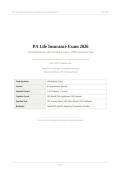
PA Life Insurance Exam 2026
Actual Questions with Verified Answers, 100% Guarantee Pass
Academic Year
Pennsylvania Insurance Licensing Examination
Aligned with Pearson VUE Testing Format
Total Questions 100 Multiple Choice
Sections 8 Comprehensive Sections
Question Format A-D (4 Options, 1 Correct)
Cognitive Levels 30% Recall | 50% Application | 20% Analysis
Question Style 70% Scenario-Based | 20% Direct Recall | 10% Calculation
Rationales Detailed PA-Specific Regulatory Explanations Included
This exam is for educational and examination preparation purposes.
Page 1
,PA Life Insurance Exam 2026 | Actual Questions with Verified Answers
Section 1: Life Insurance Fundamentals and Policy Types
Q1. Which type of term life insurance provides a level death benefit but has premiums that increase each year at
renewal?
A. A. Level term insurance
B. B. Decreasing term insurance
C. C. Annual renewable term (ART) insurance **[CORRECT]**
D. D. Return of premium term insurance
Correct Answer: C
Rationale: Annual renewable term (ART) insurance allows the policyowner to renew the policy each year without evidence of
insurability, but the premium increases at each renewal to reflect the insured's increasing age and mortality risk. Level term
maintains a fixed premium, decreasing term has a declining death benefit, and return of premium term refunds premiums at
the end of the term.
Q2. A client purchases a whole life policy with premiums payable for 20 years, after which the policy is
considered paid-up with the same death benefit. Which type of whole life policy did the client purchase?
A. A. Straight whole life
B. B. Single premium whole life
C. C. 20-pay life insurance **[CORRECT]**
D. D. Graded premium whole life
Correct Answer: C
Rationale: Limited-pay life insurance, such as a 20-pay life policy, requires premium payments for a specified period (20
years in this case). After the payment period ends, the policy is paid-up and no further premiums are due, but the full death
benefit remains in force for the insured's entire life. Straight whole life requires premiums to age 100, single premium is paid
with one lump sum, and graded premium starts low and increases over time.
Q3. A universal life insurance policyowner selects Option A for the death benefit. If the policy's cash value
increases over time, what happens to the total death benefit paid to the beneficiary?
A. A. The death benefit increases proportionally with the cash value
B. B. The death benefit remains level, and the beneficiary receives only the stated face amount
**[CORRECT]**
C. C. The death benefit decreases as cash value accumulates
D. D. The beneficiary receives both the face amount and the entire cash value as separate payments
Correct Answer: B
Rationale: Under Option A (level death benefit) of a universal life policy, the death benefit remains fixed at the stated face
amount. As the cash value grows, the net amount at risk to the insurer decreases, but the total death benefit paid to the
beneficiary stays the same. Option B, by contrast, provides an increasing death benefit equal to the face amount plus the
accumulated cash value.
Page 2
,PA Life Insurance Exam 2026 | Actual Questions with Verified Answers
Q4. Which type of life insurance policy places the investment risk directly on the policyowner and requires
registration with the Securities and Exchange Commission (SEC)?
A. A. Participating whole life insurance
B. B. Variable life insurance **[CORRECT]**
C. C. Universal life insurance
D. D. Group term life insurance
Correct Answer: B
Rationale: Variable life insurance places the investment risk on the policyowner because the cash value and death benefit
vary based on the performance of the policy's separate account investments. Because of this investment feature, variable life
policies are considered securities and must be registered with the SEC and sold by agents with FINRA licenses. Whole life,
universal life, and group term do not involve separate account investment risk.
Q5. An estate planner recommends a survivorship life policy to a married couple. Which of the following best
explains why a survivorship (second-to-die) policy is particularly suited for estate planning purposes?
A. A. It pays the death benefit upon the first death, providing immediate liquidity
B. B. It is always less expensive than two individual policies regardless of health
C. C. It pays the death benefit upon the second death, which is when federal estate taxes are typically due
**[CORRECT]**
D. D. It does not require insurable interest for either insured
Correct Answer: C
Rationale: Survivorship life insurance, also known as second-to-die insurance, covers two individuals and pays the death
benefit only upon the second death. This is particularly valuable in estate planning because federal estate taxes are generally
assessed and due upon the second spouse's death. The policy provides liquidity to pay estate taxes without forcing the sale of
estate assets. It does not pay on the first death and does require insurable interest.
Q6. A 35-year-old employee is covered under her employer's group life insurance plan. If she terminates
employment, which provision allows her to convert her group coverage to an individual policy without evidence
of insurability?
A. A. The reinstatement provision
B. B. The convertibility provision **[CORRECT]**
C. C. The waiver of premium provision
D. D. The nonforfeiture provision
Correct Answer: B
Rationale: The convertibility provision in a group life insurance policy allows an employee who leaves the group to convert
their group coverage to an individual permanent life insurance policy without providing evidence of insurability. This
conversion must typically be exercised within 31 days of leaving the group. Reinstatement applies to lapsed individual
policies, waiver of premium is for disability, and nonforfeiture applies to cash value policies.
Page 3
, PA Life Insurance Exam 2026 | Actual Questions with Verified Answers
Q7. Credit life insurance is designed to cover which of the following?
A. A. The borrower's outstanding debt obligation in the event of death **[CORRECT]**
B. B. The lender's business overhead expenses
C. C. The borrower's income replacement needs after retirement
D. D. The co-signer's estate tax liability
Correct Answer: A
Rationale: Credit life insurance is a type of decreasing term insurance that is purchased in connection with a specific loan or
credit obligation. Its primary purpose is to pay off the borrower's outstanding debt balance in the event of the borrower's
death, protecting both the lender from loss and the borrower's family from inheriting the debt. The death benefit decreases as
the loan balance is paid down.
Q8. A client purchases a variable universal life (VUL) policy. Which combination of features distinguishes VUL
from a traditional universal life policy?
A. A. Fixed premiums with a guaranteed minimum interest rate
B. B. Flexible premiums with investment options in separate accounts **[CORRECT]**
C. C. Level death benefit with no cash value accumulation
D. D. Fixed premiums with no investment risk to the policyowner
Correct Answer: B
Rationale: Variable universal life (VUL) combines the flexible premium feature of universal life with the investment options
of variable life. VUL policyowners can allocate their premiums among various subaccounts (separate accounts) that invest in
stocks, bonds, and other securities, similar to mutual funds. The cash value fluctuates based on the performance of these
accounts, and the investment risk is borne by the policyowner. Traditional universal life credits interest at a rate declared by
the insurer.
Q9. What is the defining characteristic of decreasing term life insurance?
A. A. The death benefit remains level while premiums increase over time
B. B. The death benefit decreases over time while premiums remain level **[CORRECT]**
C. C. Both the death benefit and premiums decrease over time
D. D. The policy builds cash value that decreases over the term
Correct Answer: B
Rationale: Decreasing term life insurance features a death benefit that gradually decreases over the policy's term (typically
in proportion to a declining loan balance), while the premium remains level throughout the term. This type of policy is
commonly used in conjunction with mortgages and other installment loans. It does not build cash value, unlike permanent
policies.
Page 4
PA Life Insurance Exam 2026
Actual Questions with Verified Answers, 100% Guarantee Pass
Academic Year
Pennsylvania Insurance Licensing Examination
Aligned with Pearson VUE Testing Format
Total Questions 100 Multiple Choice
Sections 8 Comprehensive Sections
Question Format A-D (4 Options, 1 Correct)
Cognitive Levels 30% Recall | 50% Application | 20% Analysis
Question Style 70% Scenario-Based | 20% Direct Recall | 10% Calculation
Rationales Detailed PA-Specific Regulatory Explanations Included
This exam is for educational and examination preparation purposes.
Page 1
,PA Life Insurance Exam 2026 | Actual Questions with Verified Answers
Section 1: Life Insurance Fundamentals and Policy Types
Q1. Which type of term life insurance provides a level death benefit but has premiums that increase each year at
renewal?
A. A. Level term insurance
B. B. Decreasing term insurance
C. C. Annual renewable term (ART) insurance **[CORRECT]**
D. D. Return of premium term insurance
Correct Answer: C
Rationale: Annual renewable term (ART) insurance allows the policyowner to renew the policy each year without evidence of
insurability, but the premium increases at each renewal to reflect the insured's increasing age and mortality risk. Level term
maintains a fixed premium, decreasing term has a declining death benefit, and return of premium term refunds premiums at
the end of the term.
Q2. A client purchases a whole life policy with premiums payable for 20 years, after which the policy is
considered paid-up with the same death benefit. Which type of whole life policy did the client purchase?
A. A. Straight whole life
B. B. Single premium whole life
C. C. 20-pay life insurance **[CORRECT]**
D. D. Graded premium whole life
Correct Answer: C
Rationale: Limited-pay life insurance, such as a 20-pay life policy, requires premium payments for a specified period (20
years in this case). After the payment period ends, the policy is paid-up and no further premiums are due, but the full death
benefit remains in force for the insured's entire life. Straight whole life requires premiums to age 100, single premium is paid
with one lump sum, and graded premium starts low and increases over time.
Q3. A universal life insurance policyowner selects Option A for the death benefit. If the policy's cash value
increases over time, what happens to the total death benefit paid to the beneficiary?
A. A. The death benefit increases proportionally with the cash value
B. B. The death benefit remains level, and the beneficiary receives only the stated face amount
**[CORRECT]**
C. C. The death benefit decreases as cash value accumulates
D. D. The beneficiary receives both the face amount and the entire cash value as separate payments
Correct Answer: B
Rationale: Under Option A (level death benefit) of a universal life policy, the death benefit remains fixed at the stated face
amount. As the cash value grows, the net amount at risk to the insurer decreases, but the total death benefit paid to the
beneficiary stays the same. Option B, by contrast, provides an increasing death benefit equal to the face amount plus the
accumulated cash value.
Page 2
,PA Life Insurance Exam 2026 | Actual Questions with Verified Answers
Q4. Which type of life insurance policy places the investment risk directly on the policyowner and requires
registration with the Securities and Exchange Commission (SEC)?
A. A. Participating whole life insurance
B. B. Variable life insurance **[CORRECT]**
C. C. Universal life insurance
D. D. Group term life insurance
Correct Answer: B
Rationale: Variable life insurance places the investment risk on the policyowner because the cash value and death benefit
vary based on the performance of the policy's separate account investments. Because of this investment feature, variable life
policies are considered securities and must be registered with the SEC and sold by agents with FINRA licenses. Whole life,
universal life, and group term do not involve separate account investment risk.
Q5. An estate planner recommends a survivorship life policy to a married couple. Which of the following best
explains why a survivorship (second-to-die) policy is particularly suited for estate planning purposes?
A. A. It pays the death benefit upon the first death, providing immediate liquidity
B. B. It is always less expensive than two individual policies regardless of health
C. C. It pays the death benefit upon the second death, which is when federal estate taxes are typically due
**[CORRECT]**
D. D. It does not require insurable interest for either insured
Correct Answer: C
Rationale: Survivorship life insurance, also known as second-to-die insurance, covers two individuals and pays the death
benefit only upon the second death. This is particularly valuable in estate planning because federal estate taxes are generally
assessed and due upon the second spouse's death. The policy provides liquidity to pay estate taxes without forcing the sale of
estate assets. It does not pay on the first death and does require insurable interest.
Q6. A 35-year-old employee is covered under her employer's group life insurance plan. If she terminates
employment, which provision allows her to convert her group coverage to an individual policy without evidence
of insurability?
A. A. The reinstatement provision
B. B. The convertibility provision **[CORRECT]**
C. C. The waiver of premium provision
D. D. The nonforfeiture provision
Correct Answer: B
Rationale: The convertibility provision in a group life insurance policy allows an employee who leaves the group to convert
their group coverage to an individual permanent life insurance policy without providing evidence of insurability. This
conversion must typically be exercised within 31 days of leaving the group. Reinstatement applies to lapsed individual
policies, waiver of premium is for disability, and nonforfeiture applies to cash value policies.
Page 3
, PA Life Insurance Exam 2026 | Actual Questions with Verified Answers
Q7. Credit life insurance is designed to cover which of the following?
A. A. The borrower's outstanding debt obligation in the event of death **[CORRECT]**
B. B. The lender's business overhead expenses
C. C. The borrower's income replacement needs after retirement
D. D. The co-signer's estate tax liability
Correct Answer: A
Rationale: Credit life insurance is a type of decreasing term insurance that is purchased in connection with a specific loan or
credit obligation. Its primary purpose is to pay off the borrower's outstanding debt balance in the event of the borrower's
death, protecting both the lender from loss and the borrower's family from inheriting the debt. The death benefit decreases as
the loan balance is paid down.
Q8. A client purchases a variable universal life (VUL) policy. Which combination of features distinguishes VUL
from a traditional universal life policy?
A. A. Fixed premiums with a guaranteed minimum interest rate
B. B. Flexible premiums with investment options in separate accounts **[CORRECT]**
C. C. Level death benefit with no cash value accumulation
D. D. Fixed premiums with no investment risk to the policyowner
Correct Answer: B
Rationale: Variable universal life (VUL) combines the flexible premium feature of universal life with the investment options
of variable life. VUL policyowners can allocate their premiums among various subaccounts (separate accounts) that invest in
stocks, bonds, and other securities, similar to mutual funds. The cash value fluctuates based on the performance of these
accounts, and the investment risk is borne by the policyowner. Traditional universal life credits interest at a rate declared by
the insurer.
Q9. What is the defining characteristic of decreasing term life insurance?
A. A. The death benefit remains level while premiums increase over time
B. B. The death benefit decreases over time while premiums remain level **[CORRECT]**
C. C. Both the death benefit and premiums decrease over time
D. D. The policy builds cash value that decreases over the term
Correct Answer: B
Rationale: Decreasing term life insurance features a death benefit that gradually decreases over the policy's term (typically
in proportion to a declining loan balance), while the premium remains level throughout the term. This type of policy is
commonly used in conjunction with mortgages and other installment loans. It does not build cash value, unlike permanent
policies.
Page 4

