

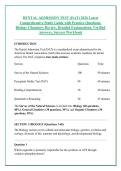
DENTAL ADMISSION TEST (DAT) 2026 Latest
Comprehensive Study Guide with Practice Questions,
Biology Chemistry Review, Detailed Explanations, Verified
Answers, Success Workbook
INTRODUCTION
The Dental Admission Test (DAT) is a standardized exam administered by the
American Dental Association (ADA) that assesses academic readiness for dental
school. The DAT comprises four main sections:
Section Questions Time
Survey of the Natural Sciences 100 90 minutes
Perceptual Ability Test (PAT) 90 60 minutes
Reading Comprehension 50 60 minutes
Quantitative Reasoning 40 45 minutes
The Survey of the Natural Sciences is divided into: Biology (40 questions,
40%), General Chemistry (30 questions, 30%), and Organic Chemistry (30
questions, 30%).
SECTION 1: BIOLOGY (Questions 1-40)
The Biology section covers cellular and molecular biology, genetics, evolution and
ecology, diversity of life, anatomy and physiology, and developmental biology.
Question 1
Which organelle is primarily responsible for the synthesis of ATP through
oxidative phosphorylation?
,A) Ribosome
B) Golgi apparatus
C) Mitochondrion
D) Endoplasmic reticulum
E) Lysosome
Correct Answer: C
Rationale: The mitochondrion is the site of oxidative phosphorylation, where ATP
is produced through the electron transport chain and chemiosmosis. Ribosomes (A)
synthesize proteins. The Golgi apparatus (B) modifies and packages proteins. The
endoplasmic reticulum (D) is involved in protein and lipid synthesis. Lysosomes
(E) are involved in intracellular digestion.
Question 2
During which phase of the cell cycle does DNA replication occur?
A) G₁ phase
B) S phase
C) G₂ phase
D) M phase
E) G₀ phase
Correct Answer: B
Rationale: DNA replication occurs during the S (synthesis) phase of interphase.
The G₁ phase (A) involves cell growth and preparation for DNA replication. The
G₂ phase (C) involves preparation for mitosis. The M phase (D) involves mitosis
and cytokinesis. The G₀ phase (E) is a resting phase where cells are not actively
dividing.
Question 3
In Mendelian genetics, the physical appearance of an organism is referred to as its:
,A) Genotype
B) Phenotype
C) Allele
D) Locus
E) Karyotype
Correct Answer: B
Rationale: The phenotype is the observable physical appearance of an organism,
resulting from the interaction of its genotype with the environment. The genotype
(A) is the genetic makeup. An allele (C) is a variant of a gene. A locus (D) is the
position of a gene on a chromosome. A karyotype (E) is the complete set of
chromosomes in a cell.
Question 4
Which of the following is a product of the light-dependent reactions of
photosynthesis?
A) Glucose
B) Carbon dioxide
C) ATP and NADPH
D) Water
E) Glyceraldehyde-3-phosphate
Correct Answer: C
Rationale: The light-dependent reactions produce ATP and NADPH, which are
used in the Calvin cycle. Glucose (A) and Glyceraldehyde-3-phosphate (E) are
products of the Calvin cycle. Carbon dioxide (B) is a reactant. Water (D) is a
reactant that is split during the light reactions.
Question 5
A cell membrane is composed primarily of:
, A) Nucleic acids and proteins
B) Phospholipids and proteins
C) Carbohydrates and nucleic acids
D) Steroids and carbohydrates
E) Phospholipids and nucleic acids
Correct Answer: B
Rationale: The cell membrane is primarily composed of a phospholipid bilayer
with embedded proteins. Nucleic acids (A, C, E) are not major components of the
membrane. Carbohydrates (C, D) are present as glycolipids and glycoproteins but
are not primary components. Steroids (D) such as cholesterol are present but not
primary.
Question 6
Which of the following is an example of a vestigial structure in humans?
A) Appendix
B) Heart
C) Lungs
D) Liver
E) Brain
Correct Answer: A
Rationale: The appendix is considered a vestigial structure, as it has reduced
function compared to its ancestral role in digesting cellulose. The heart (B), lungs
(C), liver (D), and brain (E) are all essential, functional organs.
Question 7
In the lac operon, the repressor protein binds to which region to inhibit
transcription?
Comprehensive Study Guide with Practice Questions,
Biology Chemistry Review, Detailed Explanations, Verified
Answers, Success Workbook
INTRODUCTION
The Dental Admission Test (DAT) is a standardized exam administered by the
American Dental Association (ADA) that assesses academic readiness for dental
school. The DAT comprises four main sections:
Section Questions Time
Survey of the Natural Sciences 100 90 minutes
Perceptual Ability Test (PAT) 90 60 minutes
Reading Comprehension 50 60 minutes
Quantitative Reasoning 40 45 minutes
The Survey of the Natural Sciences is divided into: Biology (40 questions,
40%), General Chemistry (30 questions, 30%), and Organic Chemistry (30
questions, 30%).
SECTION 1: BIOLOGY (Questions 1-40)
The Biology section covers cellular and molecular biology, genetics, evolution and
ecology, diversity of life, anatomy and physiology, and developmental biology.
Question 1
Which organelle is primarily responsible for the synthesis of ATP through
oxidative phosphorylation?
,A) Ribosome
B) Golgi apparatus
C) Mitochondrion
D) Endoplasmic reticulum
E) Lysosome
Correct Answer: C
Rationale: The mitochondrion is the site of oxidative phosphorylation, where ATP
is produced through the electron transport chain and chemiosmosis. Ribosomes (A)
synthesize proteins. The Golgi apparatus (B) modifies and packages proteins. The
endoplasmic reticulum (D) is involved in protein and lipid synthesis. Lysosomes
(E) are involved in intracellular digestion.
Question 2
During which phase of the cell cycle does DNA replication occur?
A) G₁ phase
B) S phase
C) G₂ phase
D) M phase
E) G₀ phase
Correct Answer: B
Rationale: DNA replication occurs during the S (synthesis) phase of interphase.
The G₁ phase (A) involves cell growth and preparation for DNA replication. The
G₂ phase (C) involves preparation for mitosis. The M phase (D) involves mitosis
and cytokinesis. The G₀ phase (E) is a resting phase where cells are not actively
dividing.
Question 3
In Mendelian genetics, the physical appearance of an organism is referred to as its:
,A) Genotype
B) Phenotype
C) Allele
D) Locus
E) Karyotype
Correct Answer: B
Rationale: The phenotype is the observable physical appearance of an organism,
resulting from the interaction of its genotype with the environment. The genotype
(A) is the genetic makeup. An allele (C) is a variant of a gene. A locus (D) is the
position of a gene on a chromosome. A karyotype (E) is the complete set of
chromosomes in a cell.
Question 4
Which of the following is a product of the light-dependent reactions of
photosynthesis?
A) Glucose
B) Carbon dioxide
C) ATP and NADPH
D) Water
E) Glyceraldehyde-3-phosphate
Correct Answer: C
Rationale: The light-dependent reactions produce ATP and NADPH, which are
used in the Calvin cycle. Glucose (A) and Glyceraldehyde-3-phosphate (E) are
products of the Calvin cycle. Carbon dioxide (B) is a reactant. Water (D) is a
reactant that is split during the light reactions.
Question 5
A cell membrane is composed primarily of:
, A) Nucleic acids and proteins
B) Phospholipids and proteins
C) Carbohydrates and nucleic acids
D) Steroids and carbohydrates
E) Phospholipids and nucleic acids
Correct Answer: B
Rationale: The cell membrane is primarily composed of a phospholipid bilayer
with embedded proteins. Nucleic acids (A, C, E) are not major components of the
membrane. Carbohydrates (C, D) are present as glycolipids and glycoproteins but
are not primary components. Steroids (D) such as cholesterol are present but not
primary.
Question 6
Which of the following is an example of a vestigial structure in humans?
A) Appendix
B) Heart
C) Lungs
D) Liver
E) Brain
Correct Answer: A
Rationale: The appendix is considered a vestigial structure, as it has reduced
function compared to its ancestral role in digesting cellulose. The heart (B), lungs
(C), liver (D), and brain (E) are all essential, functional organs.
Question 7
In the lac operon, the repressor protein binds to which region to inhibit
transcription?

