

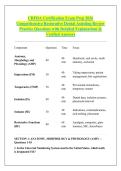
CRFDA Certification Exam Prep 2026
Comprehensive Restorative Dental Assisting Review
Practice Questions with Detailed Explanations &
Verified Answers
Component Questions Time Focus
Anatomy,
40 Head/neck, oral cavity, tooth
Morphology and 40
min anatomy, occlusion
Physiology (AMP)
40 Taking impressions, patient
Impressions (IM) 50
min management, bite registrations
40 Provisional restorations,
Temporaries (TMP) 50
min temporary cement
40 Dental dam, isolation systems,
Isolation (IS) 40
min placement/removal
40 Indications, contraindications,
Sealants (SE) 50
min acid etching, placement
Restorative Functions 60 Amalgam, composite, glass
80
(RF) min ionomer, SSC, liners/bases
SECTION 1: ANATOMY, MORPHOLOGY & PHYSIOLOGY (AMP) —
Questions 1-18
1. In the Universal Numbering System used in the United States, which tooth
is designated #14?
,A) Maxillary right first molar
B) Maxillary left first molar
C) Mandibular left first molar
D) Mandibular right first molar
Rationale: The correct answer is B) Maxillary left first molar. The Universal
Numbering System assigns 1-32 to permanent teeth starting at the maxillary right
third molar (#1) and proceeding clockwise to the maxillary left third molar (#16),
then continuing along the mandibular arch. Tooth #14 is the maxillary left first
molar .
2. Which dental tissue is the hardest, most highly mineralized substance in the
human body?
A) Dentin
B) Enamel
C) Cementum
D) Pulp
Rationale: The correct answer is B) Enamel. Enamel covers the anatomic crown
and is approximately 96% inorganic hydroxyapatite, making it the hardest, most
mineralized tissue in the human body . Its structure of enamel rods provides
strength but limited flexibility. Dentin is less mineralized (approximately 70%),
cementum covers the root, and pulp is the soft tissue core.
3. How many permanent teeth are in a complete adult dentition?
A) 28 permanent teeth
B) 32 permanent teeth
C) 30 permanent teeth
D) 24 permanent teeth
Rationale: The correct answer is B) 32 permanent teeth. A complete permanent
dentition contains 32 teeth: 8 incisors, 4 canines, 8 premolars, and 12 molars
(including third molars). A complete primary dentition contains 20 teeth .
,4. Which Angle classification describes a normal molar relationship in which
the mesiobuccal cusp of the maxillary first molar occludes with the
mesiobuccal groove of the mandibular first molar?
A) Class I
B) Class II Division 1
C) Class II Division 2
D) Class III
Rationale: The correct answer is A) Class I. Angle Class I (normal occlusion) is
defined by the mesiobuccal cusp of the maxillary first molar aligning with the
mesiobuccal groove of the mandibular first molar . Class II is characterized by a
retruded mandible (distocclusion), and Class III by a protruded mandible
(mesiocclusion).
5. The tooth surface that is closest to the midline of the dental arch is the:
A) Distal surface
B) Mesial surface
C) Buccal surface
D) Lingual surface
Rationale: The correct answer is B) Mesial surface. The mesial surface is the
tooth surface closest to the midline of the dental arch. The distal surface is farthest
from the midline. The buccal surface faces the cheek, and the lingual surface faces
the tongue .
6. Which of the following teeth is typically the first permanent tooth to erupt?
A) Maxillary central incisor
B) Mandibular central incisor
C) Maxillary first molar
D) Mandibular first molar
Rationale: The correct answer is B) Mandibular central incisor. The mandibular
central incisors are typically the first permanent teeth to erupt at approximately 6
years of age. The permanent first molars erupt at approximately the same time
(also around age 6), followed by the maxillary central incisors.
, 7. The temporomandibular joint (TMJ) is classified as which type of joint?
A) Fibrous joint
B) Cartilaginous joint
C) Synovial joint with both hinge and gliding movements
D) Hinge joint only
Rationale: The correct answer is C) Synovial joint with both hinge and gliding
movements. The TMJ is a synovial joint that permits both hinge (rotation) and
gliding (translation) movements. This dual movement allows for the complex
motions required for mastication, speech, and swallowing. The articular disc
divides the joint into upper (gliding) and lower (hinge) compartments.
8. Which cranial nerve provides motor innervation to the muscles of
mastication?
A) Facial nerve (CN VII)
B) Trigeminal nerve (CN V)
C) Hypoglossal nerve (CN XII)
D) Glossopharyngeal nerve (CN IX)
Rationale: The correct answer is B) Trigeminal nerve (CN V) . The trigeminal
nerve is the largest cranial nerve and provides motor innervation to the muscles of
mastication (masseter, temporalis, medial pterygoid, lateral pterygoid) via the
mandibular division (V3). The facial nerve (CN VII) innervates the muscles of
facial expression.
9. The permanent maxillary first molar typically has how many roots?
A) One
B) Two
C) Three
D) Four
Rationale: The correct answer is C) Three. The permanent maxillary first molar
typically has three roots: two buccal (mesiobuccal and distobuccal) and one palatal
root. The mesiobuccal root is the most commonly affected by procedural errors due
Comprehensive Restorative Dental Assisting Review
Practice Questions with Detailed Explanations &
Verified Answers
Component Questions Time Focus
Anatomy,
40 Head/neck, oral cavity, tooth
Morphology and 40
min anatomy, occlusion
Physiology (AMP)
40 Taking impressions, patient
Impressions (IM) 50
min management, bite registrations
40 Provisional restorations,
Temporaries (TMP) 50
min temporary cement
40 Dental dam, isolation systems,
Isolation (IS) 40
min placement/removal
40 Indications, contraindications,
Sealants (SE) 50
min acid etching, placement
Restorative Functions 60 Amalgam, composite, glass
80
(RF) min ionomer, SSC, liners/bases
SECTION 1: ANATOMY, MORPHOLOGY & PHYSIOLOGY (AMP) —
Questions 1-18
1. In the Universal Numbering System used in the United States, which tooth
is designated #14?
,A) Maxillary right first molar
B) Maxillary left first molar
C) Mandibular left first molar
D) Mandibular right first molar
Rationale: The correct answer is B) Maxillary left first molar. The Universal
Numbering System assigns 1-32 to permanent teeth starting at the maxillary right
third molar (#1) and proceeding clockwise to the maxillary left third molar (#16),
then continuing along the mandibular arch. Tooth #14 is the maxillary left first
molar .
2. Which dental tissue is the hardest, most highly mineralized substance in the
human body?
A) Dentin
B) Enamel
C) Cementum
D) Pulp
Rationale: The correct answer is B) Enamel. Enamel covers the anatomic crown
and is approximately 96% inorganic hydroxyapatite, making it the hardest, most
mineralized tissue in the human body . Its structure of enamel rods provides
strength but limited flexibility. Dentin is less mineralized (approximately 70%),
cementum covers the root, and pulp is the soft tissue core.
3. How many permanent teeth are in a complete adult dentition?
A) 28 permanent teeth
B) 32 permanent teeth
C) 30 permanent teeth
D) 24 permanent teeth
Rationale: The correct answer is B) 32 permanent teeth. A complete permanent
dentition contains 32 teeth: 8 incisors, 4 canines, 8 premolars, and 12 molars
(including third molars). A complete primary dentition contains 20 teeth .
,4. Which Angle classification describes a normal molar relationship in which
the mesiobuccal cusp of the maxillary first molar occludes with the
mesiobuccal groove of the mandibular first molar?
A) Class I
B) Class II Division 1
C) Class II Division 2
D) Class III
Rationale: The correct answer is A) Class I. Angle Class I (normal occlusion) is
defined by the mesiobuccal cusp of the maxillary first molar aligning with the
mesiobuccal groove of the mandibular first molar . Class II is characterized by a
retruded mandible (distocclusion), and Class III by a protruded mandible
(mesiocclusion).
5. The tooth surface that is closest to the midline of the dental arch is the:
A) Distal surface
B) Mesial surface
C) Buccal surface
D) Lingual surface
Rationale: The correct answer is B) Mesial surface. The mesial surface is the
tooth surface closest to the midline of the dental arch. The distal surface is farthest
from the midline. The buccal surface faces the cheek, and the lingual surface faces
the tongue .
6. Which of the following teeth is typically the first permanent tooth to erupt?
A) Maxillary central incisor
B) Mandibular central incisor
C) Maxillary first molar
D) Mandibular first molar
Rationale: The correct answer is B) Mandibular central incisor. The mandibular
central incisors are typically the first permanent teeth to erupt at approximately 6
years of age. The permanent first molars erupt at approximately the same time
(also around age 6), followed by the maxillary central incisors.
, 7. The temporomandibular joint (TMJ) is classified as which type of joint?
A) Fibrous joint
B) Cartilaginous joint
C) Synovial joint with both hinge and gliding movements
D) Hinge joint only
Rationale: The correct answer is C) Synovial joint with both hinge and gliding
movements. The TMJ is a synovial joint that permits both hinge (rotation) and
gliding (translation) movements. This dual movement allows for the complex
motions required for mastication, speech, and swallowing. The articular disc
divides the joint into upper (gliding) and lower (hinge) compartments.
8. Which cranial nerve provides motor innervation to the muscles of
mastication?
A) Facial nerve (CN VII)
B) Trigeminal nerve (CN V)
C) Hypoglossal nerve (CN XII)
D) Glossopharyngeal nerve (CN IX)
Rationale: The correct answer is B) Trigeminal nerve (CN V) . The trigeminal
nerve is the largest cranial nerve and provides motor innervation to the muscles of
mastication (masseter, temporalis, medial pterygoid, lateral pterygoid) via the
mandibular division (V3). The facial nerve (CN VII) innervates the muscles of
facial expression.
9. The permanent maxillary first molar typically has how many roots?
A) One
B) Two
C) Three
D) Four
Rationale: The correct answer is C) Three. The permanent maxillary first molar
typically has three roots: two buccal (mesiobuccal and distobuccal) and one palatal
root. The mesiobuccal root is the most commonly affected by procedural errors due

