

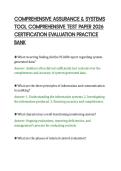
COMPREHENSIVE ASSURANCE & SYSTEMS
TOOL COMPREHENSIVE TEST PAPER 2026
CERTIFICATION EVALUATION PRACTICE
BANK
◉ What recurring finding did the PCAOB report regarding system-
generated data?
Answer: Auditors often did not sufficiently test controls over the
completeness and accuracy of system-generated data.
◉ What are the three principles of information and communication
in auditing?
Answer: 1. Understanding the information systems. 2. Investigating
the information produced. 3. Ensuring accuracy and completeness.
◉ What characterizes a well-functioning monitoring system?
Answer: Ongoing evaluations, reporting deficiencies, and
management's process for evaluating controls.
◉ What are the phases of internal control evaluation?
, Answer: 1. Understand and document the client's internal control. 2.
Assess control risk (Preliminary). 3. Identify controls to test and
perform tests of controls.
◉ What are entity-level controls?
Answer: Controls that are pervasive to the internal control system
and affect the reliability of financial statements.
◉ How should auditors document their understanding of internal
controls?
Answer: Through narrative descriptions, questionnaires, or
flowcharts.
◉ What is the significance of assessing control risk?
Answer: To identify internal control activities that support reliable
financial statement reporting.
◉ What are the two common approaches to testing controls?
Answer: 1. Testing all items in a population (exception testing). 2.
Testing a sample from a population (audit sampling).
◉ What is the hierarchy of types of control tests?
TOOL COMPREHENSIVE TEST PAPER 2026
CERTIFICATION EVALUATION PRACTICE
BANK
◉ What recurring finding did the PCAOB report regarding system-
generated data?
Answer: Auditors often did not sufficiently test controls over the
completeness and accuracy of system-generated data.
◉ What are the three principles of information and communication
in auditing?
Answer: 1. Understanding the information systems. 2. Investigating
the information produced. 3. Ensuring accuracy and completeness.
◉ What characterizes a well-functioning monitoring system?
Answer: Ongoing evaluations, reporting deficiencies, and
management's process for evaluating controls.
◉ What are the phases of internal control evaluation?
, Answer: 1. Understand and document the client's internal control. 2.
Assess control risk (Preliminary). 3. Identify controls to test and
perform tests of controls.
◉ What are entity-level controls?
Answer: Controls that are pervasive to the internal control system
and affect the reliability of financial statements.
◉ How should auditors document their understanding of internal
controls?
Answer: Through narrative descriptions, questionnaires, or
flowcharts.
◉ What is the significance of assessing control risk?
Answer: To identify internal control activities that support reliable
financial statement reporting.
◉ What are the two common approaches to testing controls?
Answer: 1. Testing all items in a population (exception testing). 2.
Testing a sample from a population (audit sampling).
◉ What is the hierarchy of types of control tests?

