1
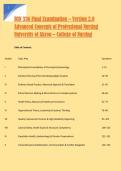
BSN 336 Final Examination – Version 2.0
Advanced Concepts of Professional Nursing
University of Akron – College of Nursing
Table of Contents
Section Topic Area Questions
I Philosophical Foundations of Nursing & Epistemology 1–15
II Advanced Nursing Theory & Metaparadigm Analysis 16–30
III Evidence-Based Practice: Advanced Appraisal & Translation 31–45
IV Ethical Decision-Making & Moral Distress in Complex Systems 46–60
V Health Policy, Advocacy & Healthcare Economics 61–75
VI Organizational Theory, Leadership & Systems Thinking 76–90
VII Quality Improvement Science & High-Reliability Organizing 91–105
VIII Cultural Safety, Health Equity & Structural Competency 106–120
IX Population Health, Epidemiology & Disaster Preparedness 121–135
X Interprofessional Collaboration, Communication & Conflict Navigation 136–150
,2
SECTION I: PHILOSOPHICAL FOUNDATIONS OF NURSING & EPISTEMOLOGY
This section examines the philosophical underpinnings of nursing knowledge, ways of knowing,
and the evolution of nursing as a distinct discipline. Questions address epistemology, ontology,
and the structure of nursing knowledge that distinguish baccalaureate-prepared nurses.
• Question 1: A nurse researcher is designing a study to explore the lived experience of patients
with chronic pain. Which philosophical paradigm most closely aligns with this research
approach?
• A) Positivism, emphasizing objective measurement and causal relationships
• B) .. Interpretivism, recognizing that reality is socially constructed and understanding
requires exploration of subjective meaning
• C) Critical theory, focusing on power structures and oppression
• D) Post-positivism, acknowledging that absolute truth is unattainable but pursuing
probabilistic knowledge
Rationale: Interpretivism (or constructivism) seeks to understand subjective experiences and
meanings, making it appropriate for exploring lived experiences. Positivism focuses on objective
measurement, while critical theory examines power dynamics.
• Question 2: According to Carper's fundamental patterns of knowing in nursing, which way of
knowing is demonstrated when a nurse recognizes a subtle change in a patient's condition
based on intuition and prior experience?
• A) Empirical knowing
• B) Ethical knowing
• C) .. Personal knowing
• D) Aesthetic knowing
Rationale: Personal knowing involves self-awareness and the therapeutic use of self, including
intuitive recognition. Aesthetic knowing relates to the art of nursing and perception of unique
patient situations. Empirical knowing is scientific knowledge, and ethical knowing addresses
moral obligations.
,3
• Question 3: A nursing student questions whether a traditional practice is supported by
evidence and seeks to understand the theoretical basis for the intervention. This student is
demonstrating which level of knowledge development?
• A) Knowledge acquisition through memorization
• B) .. Knowledge critique and synthesis, moving beyond simple acceptance to critical
analysis
• C) Knowledge application without questioning
• D) Knowledge rejection without evidence
Rationale: Baccalaureate education emphasizes critical thinking and the ability to critique
knowledge, not merely acquire it. This represents higher-order cognitive processing in
knowledge development.
• Question 4: The nursing metaparadigm consists of which four central concepts?
• A) Health, Illness, Cure, and Care
• B) .. Person, Environment, Health, and Nursing
• C) Patient, Provider, System, and Outcome
• D) Biology, Psychology, Sociology, and Spirituality
Rationale: The nursing metaparadigm—person, environment, health, and nursing—provides
the broadest conceptual framework for the discipline, distinguishing nursing from other health
professions.
• Question 5: A nurse who applies knowledge from sociology, psychology, and public health to
understand a patient's health behavior is demonstrating:
• A) Discipline-specific nursing knowledge only
• B) .. Interdisciplinary integration, recognizing that nursing draws upon multiple
knowledge domains
• C) Confusion about nursing's unique contribution
• D) Overstepping professional boundaries
, 4
Rationale: Nursing integrates knowledge from multiple disciplines to provide holistic care,
reflecting the discipline's eclectic and integrative nature.
• Question 6: Which epistemological stance asserts that knowledge is generated through the
interaction between the knower and the known, rejecting the separation of subject and object?
• A) Logical positivism
• B) .. Constructivism
• C) Empiricism
• D) Behaviorism
Rationale: Constructivism posits that knowledge is actively constructed through interaction
between the knower and the phenomenon, rather than passively received from an objective
external world.
• Question 7: A nurse who recognizes that their personal biases may influence patient
interactions and actively engages in self-reflection is demonstrating:
• A) Emotional intelligence
• B) .. Reflexivity, the critical examination of one's own assumptions and influence on
practice
• C) Cognitive dissonance
• D) Confirmation bias
Rationale: Reflexivity involves critical self-awareness and examination of how one's own
perspectives, values, and biases shape practice and interpretation.
• Question 8: The distinction between nursing as a "discipline" and nursing as a "profession" is
best understood as:
• A) Discipline and profession are synonymous terms
• B) .. A discipline refers to a field of study with a unique body of knowledge; a profession
refers to the application of that knowledge in practice with ethical standards
• C) A profession requires licensure; a discipline does not
BSN 336 Final Examination – Version 2.0
Advanced Concepts of Professional Nursing
University of Akron – College of Nursing
Table of Contents
Section Topic Area Questions
I Philosophical Foundations of Nursing & Epistemology 1–15
II Advanced Nursing Theory & Metaparadigm Analysis 16–30
III Evidence-Based Practice: Advanced Appraisal & Translation 31–45
IV Ethical Decision-Making & Moral Distress in Complex Systems 46–60
V Health Policy, Advocacy & Healthcare Economics 61–75
VI Organizational Theory, Leadership & Systems Thinking 76–90
VII Quality Improvement Science & High-Reliability Organizing 91–105
VIII Cultural Safety, Health Equity & Structural Competency 106–120
IX Population Health, Epidemiology & Disaster Preparedness 121–135
X Interprofessional Collaboration, Communication & Conflict Navigation 136–150
,2
SECTION I: PHILOSOPHICAL FOUNDATIONS OF NURSING & EPISTEMOLOGY
This section examines the philosophical underpinnings of nursing knowledge, ways of knowing,
and the evolution of nursing as a distinct discipline. Questions address epistemology, ontology,
and the structure of nursing knowledge that distinguish baccalaureate-prepared nurses.
• Question 1: A nurse researcher is designing a study to explore the lived experience of patients
with chronic pain. Which philosophical paradigm most closely aligns with this research
approach?
• A) Positivism, emphasizing objective measurement and causal relationships
• B) .. Interpretivism, recognizing that reality is socially constructed and understanding
requires exploration of subjective meaning
• C) Critical theory, focusing on power structures and oppression
• D) Post-positivism, acknowledging that absolute truth is unattainable but pursuing
probabilistic knowledge
Rationale: Interpretivism (or constructivism) seeks to understand subjective experiences and
meanings, making it appropriate for exploring lived experiences. Positivism focuses on objective
measurement, while critical theory examines power dynamics.
• Question 2: According to Carper's fundamental patterns of knowing in nursing, which way of
knowing is demonstrated when a nurse recognizes a subtle change in a patient's condition
based on intuition and prior experience?
• A) Empirical knowing
• B) Ethical knowing
• C) .. Personal knowing
• D) Aesthetic knowing
Rationale: Personal knowing involves self-awareness and the therapeutic use of self, including
intuitive recognition. Aesthetic knowing relates to the art of nursing and perception of unique
patient situations. Empirical knowing is scientific knowledge, and ethical knowing addresses
moral obligations.
,3
• Question 3: A nursing student questions whether a traditional practice is supported by
evidence and seeks to understand the theoretical basis for the intervention. This student is
demonstrating which level of knowledge development?
• A) Knowledge acquisition through memorization
• B) .. Knowledge critique and synthesis, moving beyond simple acceptance to critical
analysis
• C) Knowledge application without questioning
• D) Knowledge rejection without evidence
Rationale: Baccalaureate education emphasizes critical thinking and the ability to critique
knowledge, not merely acquire it. This represents higher-order cognitive processing in
knowledge development.
• Question 4: The nursing metaparadigm consists of which four central concepts?
• A) Health, Illness, Cure, and Care
• B) .. Person, Environment, Health, and Nursing
• C) Patient, Provider, System, and Outcome
• D) Biology, Psychology, Sociology, and Spirituality
Rationale: The nursing metaparadigm—person, environment, health, and nursing—provides
the broadest conceptual framework for the discipline, distinguishing nursing from other health
professions.
• Question 5: A nurse who applies knowledge from sociology, psychology, and public health to
understand a patient's health behavior is demonstrating:
• A) Discipline-specific nursing knowledge only
• B) .. Interdisciplinary integration, recognizing that nursing draws upon multiple
knowledge domains
• C) Confusion about nursing's unique contribution
• D) Overstepping professional boundaries
, 4
Rationale: Nursing integrates knowledge from multiple disciplines to provide holistic care,
reflecting the discipline's eclectic and integrative nature.
• Question 6: Which epistemological stance asserts that knowledge is generated through the
interaction between the knower and the known, rejecting the separation of subject and object?
• A) Logical positivism
• B) .. Constructivism
• C) Empiricism
• D) Behaviorism
Rationale: Constructivism posits that knowledge is actively constructed through interaction
between the knower and the phenomenon, rather than passively received from an objective
external world.
• Question 7: A nurse who recognizes that their personal biases may influence patient
interactions and actively engages in self-reflection is demonstrating:
• A) Emotional intelligence
• B) .. Reflexivity, the critical examination of one's own assumptions and influence on
practice
• C) Cognitive dissonance
• D) Confirmation bias
Rationale: Reflexivity involves critical self-awareness and examination of how one's own
perspectives, values, and biases shape practice and interpretation.
• Question 8: The distinction between nursing as a "discipline" and nursing as a "profession" is
best understood as:
• A) Discipline and profession are synonymous terms
• B) .. A discipline refers to a field of study with a unique body of knowledge; a profession
refers to the application of that knowledge in practice with ethical standards
• C) A profession requires licensure; a discipline does not