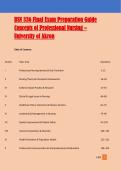
BSN 336 Final Exam Preparation Guide
Concepts of Professional Nursing –
University of Akron
Table of Contents
Section Topic Area Questions
I Professional Nursing Identity & Role Transition 1–15
II Nursing Theory & Conceptual Frameworks 16–30
III Evidence-Based Practice & Research 31–45
IV Ethical & Legal Issues in Nursing 46–60
V Healthcare Policy, Economics & Delivery Systems 61–75
VI Leadership & Management in Nursing 76–90
VII Quality Improvement & Patient Safety 91–105
VIII Cultural Competence & Diversity 106–120
IX Health Promotion & Population Health 121–135
X Professional Communication & Interprofessional Collaboration 136–150
L @G 1
,SECTION I: PROFESSIONAL NURSING IDENTITY & ROLE TRANSITION
NURS 336 establishes the foundation for baccalaureate-level practice and professional identity.
This section addresses the transition from RN to BSN and the development of professional
nursing identity.
• Question 1: A registered nurse returning to complete a BSN degree recognizes that the
primary distinction between associate-degree and baccalaureate-level nursing practice is:
• A) Baccalaureate nurses have more advanced technical skills
• B) Baccalaureate nurses are prepared to function as independent practitioners without
physician collaboration
• C) .. Baccalaureate education emphasizes critical thinking, leadership, and evidence-
based decision-making across broader healthcare contexts
• D) Baccalaureate nurses are eligible for higher salaries only
Rationale: The BSN curriculum expands beyond technical skills to include leadership, research
utilization, health policy, and population health—competencies essential for professional
nursing practice.
• Question 2: The University of Akron's RN to BSN program is designed primarily for which
population of learners?
• A) High school graduates seeking direct entry into nursing
• B) .. Registered nurses with an associate degree or diploma in nursing who seek
baccalaureate preparation
• C) Licensed practical nurses transitioning to registered nursing
• D) International medical graduates seeking nursing licensure
Rationale: The RN to BSN program specifically targets registered nurses who already hold an
associate degree or diploma and wish to advance their education to the baccalaureate level.
L @G 2
,• Question 3: Which of the following best describes the concept of "professional identity" in
nursing?
• A) Adherence to a specific set of technical procedures
• B) .. Internalization of nursing's core values, beliefs, and ethical standards that guide
professional behavior and decision-making
• C) Membership in a professional nursing organization
• D) Completion of continuing education credits annually
Rationale: Professional identity encompasses the internalization of nursing's values, ethics, and
standards, shaping how nurses perceive themselves and their role within the healthcare system.
• Question 4: A BSN-prepared nurse demonstrates the integration of theory into practice when:
• A) Following physician orders without question
• B) .. Using theoretical frameworks to guide clinical assessment, planning, and evaluation
of patient care
• C) Delegating all complex tasks to unlicensed assistive personnel
• D) Focusing exclusively on task completion rather than patient outcomes
Rationale: Theory-guided practice is a hallmark of baccalaureate nursing education, enabling
nurses to understand the "why" behind interventions and improve patient outcomes.
• Question 5: The American Nurses Association (ANA) Scope and Standards of Practice identifies
which of the following as a standard of professional nursing practice?
• A) Prescribing medications independently
• B) .. Assessment, diagnosis, outcomes identification, planning, implementation, and
evaluation
• C) Performing surgical procedures
• D) Interpreting diagnostic imaging results
Rationale: The nursing process (assessment, diagnosis, outcomes identification, planning,
implementation, and evaluation) is the foundation of professional nursing practice standards.
L @G 3
, • Question 6: A nurse who advocates for a patient's right to make informed healthcare
decisions is demonstrating which core nursing value?
• A) Beneficence
• B) Nonmaleficence
• C) .. Autonomy
• D) Justice
Rationale: Autonomy respects the patient's right to self-determination and informed decision-
making, a fundamental ethical principle in professional nursing.
• Question 7: The transition from novice to expert nurse, as described by Benner, involves:
• A) Memorization of all medical diagnoses
• B) .. Progression through stages from rule-based practice to intuitive, holistic clinical
judgment based on experience
• C) Obtaining advanced certifications
• D) Achieving a master's degree
Rationale: Benner's Novice to Expert model describes how nurses develop clinical judgment
through experience, moving from rule-based application to intuitive, holistic understanding.
• Question 8: Which competency is uniquely emphasized in BSN education compared to
associate-degree programs?
• A) Medication administration
• B) Wound care management
• C) .. Population health assessment and community-based interventions
• D) IV therapy insertion
Rationale: BSN education emphasizes population health, community assessment, and public
health nursing competencies beyond the individual patient focus.
L @G 4
Concepts of Professional Nursing –
University of Akron
Table of Contents
Section Topic Area Questions
I Professional Nursing Identity & Role Transition 1–15
II Nursing Theory & Conceptual Frameworks 16–30
III Evidence-Based Practice & Research 31–45
IV Ethical & Legal Issues in Nursing 46–60
V Healthcare Policy, Economics & Delivery Systems 61–75
VI Leadership & Management in Nursing 76–90
VII Quality Improvement & Patient Safety 91–105
VIII Cultural Competence & Diversity 106–120
IX Health Promotion & Population Health 121–135
X Professional Communication & Interprofessional Collaboration 136–150
L @G 1
,SECTION I: PROFESSIONAL NURSING IDENTITY & ROLE TRANSITION
NURS 336 establishes the foundation for baccalaureate-level practice and professional identity.
This section addresses the transition from RN to BSN and the development of professional
nursing identity.
• Question 1: A registered nurse returning to complete a BSN degree recognizes that the
primary distinction between associate-degree and baccalaureate-level nursing practice is:
• A) Baccalaureate nurses have more advanced technical skills
• B) Baccalaureate nurses are prepared to function as independent practitioners without
physician collaboration
• C) .. Baccalaureate education emphasizes critical thinking, leadership, and evidence-
based decision-making across broader healthcare contexts
• D) Baccalaureate nurses are eligible for higher salaries only
Rationale: The BSN curriculum expands beyond technical skills to include leadership, research
utilization, health policy, and population health—competencies essential for professional
nursing practice.
• Question 2: The University of Akron's RN to BSN program is designed primarily for which
population of learners?
• A) High school graduates seeking direct entry into nursing
• B) .. Registered nurses with an associate degree or diploma in nursing who seek
baccalaureate preparation
• C) Licensed practical nurses transitioning to registered nursing
• D) International medical graduates seeking nursing licensure
Rationale: The RN to BSN program specifically targets registered nurses who already hold an
associate degree or diploma and wish to advance their education to the baccalaureate level.
L @G 2
,• Question 3: Which of the following best describes the concept of "professional identity" in
nursing?
• A) Adherence to a specific set of technical procedures
• B) .. Internalization of nursing's core values, beliefs, and ethical standards that guide
professional behavior and decision-making
• C) Membership in a professional nursing organization
• D) Completion of continuing education credits annually
Rationale: Professional identity encompasses the internalization of nursing's values, ethics, and
standards, shaping how nurses perceive themselves and their role within the healthcare system.
• Question 4: A BSN-prepared nurse demonstrates the integration of theory into practice when:
• A) Following physician orders without question
• B) .. Using theoretical frameworks to guide clinical assessment, planning, and evaluation
of patient care
• C) Delegating all complex tasks to unlicensed assistive personnel
• D) Focusing exclusively on task completion rather than patient outcomes
Rationale: Theory-guided practice is a hallmark of baccalaureate nursing education, enabling
nurses to understand the "why" behind interventions and improve patient outcomes.
• Question 5: The American Nurses Association (ANA) Scope and Standards of Practice identifies
which of the following as a standard of professional nursing practice?
• A) Prescribing medications independently
• B) .. Assessment, diagnosis, outcomes identification, planning, implementation, and
evaluation
• C) Performing surgical procedures
• D) Interpreting diagnostic imaging results
Rationale: The nursing process (assessment, diagnosis, outcomes identification, planning,
implementation, and evaluation) is the foundation of professional nursing practice standards.
L @G 3
, • Question 6: A nurse who advocates for a patient's right to make informed healthcare
decisions is demonstrating which core nursing value?
• A) Beneficence
• B) Nonmaleficence
• C) .. Autonomy
• D) Justice
Rationale: Autonomy respects the patient's right to self-determination and informed decision-
making, a fundamental ethical principle in professional nursing.
• Question 7: The transition from novice to expert nurse, as described by Benner, involves:
• A) Memorization of all medical diagnoses
• B) .. Progression through stages from rule-based practice to intuitive, holistic clinical
judgment based on experience
• C) Obtaining advanced certifications
• D) Achieving a master's degree
Rationale: Benner's Novice to Expert model describes how nurses develop clinical judgment
through experience, moving from rule-based application to intuitive, holistic understanding.
• Question 8: Which competency is uniquely emphasized in BSN education compared to
associate-degree programs?
• A) Medication administration
• B) Wound care management
• C) .. Population health assessment and community-based interventions
• D) IV therapy insertion
Rationale: BSN education emphasizes population health, community assessment, and public
health nursing competencies beyond the individual patient focus.
L @G 4