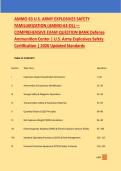
AMMO 63 U.S. ARMY EXPLOSIVES SAFETY
FAMILIARIZATION (AMMO-63-DL) —
COMPREHENSIVE EXAM QUESTION BANK Defense
Ammunition Center | U.S. Army Explosives Safety
Certification | 2026 Updated Standards
TABLE OF CONTENTS
Section Topic Area Questions
I Explosives Hazard Classification & Divisions 1–20
II Ammunition & Explosives Identification 21–30
III Storage Safety & Magazine Operations 31–50
IV Transportation Safety & Hazardous Materials 51–65
V Quantity-Distance (QD) Principles 66–80
VI Net Explosive Weight (NEW) Calculations 81–90
VII Electromagnetic Radiation (EMR) & Electro-Explosive Devices (EEDs) 91–100
VIII Standard Operating Procedures (SOPs) & Risk Management 101–115
IX Personal Protective Equipment (PPE) & Safety Protocols 116–125
L @G 1
,Section Topic Area Questions
X Regulatory Framework & References 126–135
XI Scenario-Based & Applied Safety Situations 136–150
SECTION I: EXPLOSIVES HAZARD CLASSIFICATION & DIVISIONS
1. Which of the following best describes Hazard Division (HD) 1.1 explosives?
• A) Explosives that present a mass fire hazard with minor blast effects
• B) Explosives that present a projection hazard but not a mass explosion hazard
• C) Explosives that present a mass explosion hazard affecting the entire load
instantaneously
• D) Explosives that present a moderate fire hazard with no significant blast
CorreCt Answer: C — HD 1.1 explosives are characterized by a mass explosion
hazard, meaning the entire explosive contents explode virtually instantaneously. This produces
severe structural damage to surrounding buildings and facilities. Options A and D describe HD
1.3 and HD 1.4 respectively, while option B describes HD 1.2 characteristics.
2. An ammunition item produces fragments and blast overpressure but does NOT mass-
detonate. What is its most likely hazard division?
• A) HD 1.1
• B) HD 1.2
• C) HD 1.3
• D) HD 1.4
CorreCt Answer: B — HD 1.2 explosives present a non-mass explosion, fragment-
producing hazard. They produce hazardous fragments and blast effects but do not mass-
L @G 2
,detonate like HD 1.1 items. HD 1.2 is further subdivided into 1.2.1, 1.2.2, and 1.2.3 based on
specific hazard characteristics.
3. A pyrotechnic device produces illumination through a chemical reaction at subsonic
speeds. This is classified as:
• A) High explosive
• B) Low explosive
• C) Blasting agent
• D) Primary explosive
CorreCt Answer: B — Pyrotechnics are examples of low explosives because they
undergo deflagration (subsonic combustion) rather than detonation (supersonic reaction). Low
explosives burn rapidly rather than detonate, producing gas and heat for effects like
illumination, signaling, or propulsion.
4. Which hazard division presents a mass fire hazard with minor blast or fragment effects?
• A) HD 1.1
• B) HD 1.2
• C) HD 1.3
• D) HD 1.4
CorreCt Answer: C — HD 1.3 is defined as presenting a mass fire hazard with minor
blast or fragment effects. These materials burn vigorously and may produce some blast or
fragmentation, but the primary hazard is fire rather than explosion.
5. Items classified as HD 1.4 present which type of hazard?
• A) Mass explosion hazard
• B) Projection hazard but not mass explosion
• C) Mass fire with minor blast
L @G 3
, • D) Moderate fire with no significant blast or fragment hazard
CorreCt Answer: D — HD 1.4 presents a moderate fire hazard with no significant
blast or fragment effects. The hazard is typically confined to the package, making these among
the least hazardous explosive items in storage and transportation.
6. What is the primary distinguishing characteristic between HD 1.1 and HD 1.2
explosives?
• A) The color of the fire symbol
• B) Whether a mass explosion hazard exists
• C) The type of packaging required
• D) The transportation mode restrictions
CorreCt Answer: B — HD 1.1 involves a mass explosion hazard where the entire
explosive content explodes as one, while HD 1.2 presents a projection/fragment hazard without
mass detonation. This fundamental difference drives storage, transportation, and quantity-
distance requirements.
7. All ammunition and explosives are assigned to which primary hazard class?
• A) Hazard Class 2
• B) Hazard Class 3
• C) Hazard Class 4
• D) Hazard Class 1
CorreCt Answer: D — Ammunition and explosives are always Hazard Class 1
materials. This class is further divided into divisions (1.1 through 1.6) based on the specific type
of hazard presented.
8. A substance that detonates when subjected to shock, friction, or heat and is used to
initiate other explosives is called a:
• A) Secondary explosive
L @G 4
FAMILIARIZATION (AMMO-63-DL) —
COMPREHENSIVE EXAM QUESTION BANK Defense
Ammunition Center | U.S. Army Explosives Safety
Certification | 2026 Updated Standards
TABLE OF CONTENTS
Section Topic Area Questions
I Explosives Hazard Classification & Divisions 1–20
II Ammunition & Explosives Identification 21–30
III Storage Safety & Magazine Operations 31–50
IV Transportation Safety & Hazardous Materials 51–65
V Quantity-Distance (QD) Principles 66–80
VI Net Explosive Weight (NEW) Calculations 81–90
VII Electromagnetic Radiation (EMR) & Electro-Explosive Devices (EEDs) 91–100
VIII Standard Operating Procedures (SOPs) & Risk Management 101–115
IX Personal Protective Equipment (PPE) & Safety Protocols 116–125
L @G 1
,Section Topic Area Questions
X Regulatory Framework & References 126–135
XI Scenario-Based & Applied Safety Situations 136–150
SECTION I: EXPLOSIVES HAZARD CLASSIFICATION & DIVISIONS
1. Which of the following best describes Hazard Division (HD) 1.1 explosives?
• A) Explosives that present a mass fire hazard with minor blast effects
• B) Explosives that present a projection hazard but not a mass explosion hazard
• C) Explosives that present a mass explosion hazard affecting the entire load
instantaneously
• D) Explosives that present a moderate fire hazard with no significant blast
CorreCt Answer: C — HD 1.1 explosives are characterized by a mass explosion
hazard, meaning the entire explosive contents explode virtually instantaneously. This produces
severe structural damage to surrounding buildings and facilities. Options A and D describe HD
1.3 and HD 1.4 respectively, while option B describes HD 1.2 characteristics.
2. An ammunition item produces fragments and blast overpressure but does NOT mass-
detonate. What is its most likely hazard division?
• A) HD 1.1
• B) HD 1.2
• C) HD 1.3
• D) HD 1.4
CorreCt Answer: B — HD 1.2 explosives present a non-mass explosion, fragment-
producing hazard. They produce hazardous fragments and blast effects but do not mass-
L @G 2
,detonate like HD 1.1 items. HD 1.2 is further subdivided into 1.2.1, 1.2.2, and 1.2.3 based on
specific hazard characteristics.
3. A pyrotechnic device produces illumination through a chemical reaction at subsonic
speeds. This is classified as:
• A) High explosive
• B) Low explosive
• C) Blasting agent
• D) Primary explosive
CorreCt Answer: B — Pyrotechnics are examples of low explosives because they
undergo deflagration (subsonic combustion) rather than detonation (supersonic reaction). Low
explosives burn rapidly rather than detonate, producing gas and heat for effects like
illumination, signaling, or propulsion.
4. Which hazard division presents a mass fire hazard with minor blast or fragment effects?
• A) HD 1.1
• B) HD 1.2
• C) HD 1.3
• D) HD 1.4
CorreCt Answer: C — HD 1.3 is defined as presenting a mass fire hazard with minor
blast or fragment effects. These materials burn vigorously and may produce some blast or
fragmentation, but the primary hazard is fire rather than explosion.
5. Items classified as HD 1.4 present which type of hazard?
• A) Mass explosion hazard
• B) Projection hazard but not mass explosion
• C) Mass fire with minor blast
L @G 3
, • D) Moderate fire with no significant blast or fragment hazard
CorreCt Answer: D — HD 1.4 presents a moderate fire hazard with no significant
blast or fragment effects. The hazard is typically confined to the package, making these among
the least hazardous explosive items in storage and transportation.
6. What is the primary distinguishing characteristic between HD 1.1 and HD 1.2
explosives?
• A) The color of the fire symbol
• B) Whether a mass explosion hazard exists
• C) The type of packaging required
• D) The transportation mode restrictions
CorreCt Answer: B — HD 1.1 involves a mass explosion hazard where the entire
explosive content explodes as one, while HD 1.2 presents a projection/fragment hazard without
mass detonation. This fundamental difference drives storage, transportation, and quantity-
distance requirements.
7. All ammunition and explosives are assigned to which primary hazard class?
• A) Hazard Class 2
• B) Hazard Class 3
• C) Hazard Class 4
• D) Hazard Class 1
CorreCt Answer: D — Ammunition and explosives are always Hazard Class 1
materials. This class is further divided into divisions (1.1 through 1.6) based on the specific type
of hazard presented.
8. A substance that detonates when subjected to shock, friction, or heat and is used to
initiate other explosives is called a:
• A) Secondary explosive
L @G 4