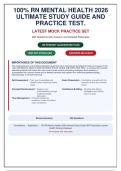
100% RN MENTAL HEALTH 2026
ULTIMATE STUDY GUIDE AND
PRACTICE TEST.
LATEST MOCK PRACTICE SET
200 Questions with Answers and Detailed Rationales
100 PERCENT GUARANTEED PASS
INSTANT DOWNLOAD ANSWERS INCLUDED
IMPORTANCE OF THIS DOCUMENT
This comprehensive examination preparation guide has been meticulously developed to help you succeed in the
100% RN MENTAL HEALTH 2026 ULTIMATE STUDY GUIDE AND PRACTICE TEST.. It contains 200 carefully
selected questions that reflect the most current exam content and testing strategies. Each question is
accompanied by a correct answer and a detailed rationale that explains the underlying pathophysiology,
pharmacology, or clinical reasoning.
Self-Assessment – Test your knowledge and Exam Preparation – Familiarize yourself with the
identify areas requiring further question format and content
study areas
Concept Reinforcement – Deepen your Confidence Building – Develop test-taking
understanding through strategies and reduce
evidence-based exam anxiety
rationales
Time Management – Practice answering
questions under simulated
exam conditions
Review Summary 200 Questions
Foundations - Application - 100 RN Mental Health 2026 Ultimate Study Guide AND Psychiatric-mental
Health Nursing Graduate
All answers with rationales
,Table of Contents
Content Area Questions Key Topics
100 RN Mental Health 2026 1-34 Disorder, Medication, Appropriate, Finding, Bipolar
Ultimate Study Guide AND
Psychiatric-mental Health
Nursing Graduate
Therapy 35-68 Disorder, Schizophrenia, Severe, Mechanism, Anxiety
Appropriate 69-102 Disorder, Behavior, Lithium, Intervention, Therapy
Schizophrenia 103-136 Disorder, Finding, Syndrome, Therapy, Prescribed
Intervention 137-170 Disorder, Nursing, Principle, Appropriate, Bipolar
Finding 171-200 Disorder, Evidence, Therapy, Treatment-resistant, Schizophrenia
TOTAL 200 All questions include answers and detailed rationales
,Section A - 100 RN Mental Health 2026 Ultimate Study
Guide AND Psychiatric-mental Health Nursing Graduate
Q1.
A client on long-term haloperidol develops akathisia. Which medication is most
appropriate to manage this side effect?
A. Benztropine B. Propranolol
C. Diphenhydramine D. Lorazepam
Correct: B - Propranolol
Rationale:Akathisia is a distressing extrapyramidal symptom characterized by restlessness.
Beta-blockers like propranolol are first-line for akathisia. Anticholinergics (benztropine,
diphenhydramine) are more effective for dystonia and parkinsonism, while benzodiazepines
may be adjunctive.
Q2.
Which of the following best describes the therapeutic action of cognitive-behavioral
therapy (CBT) in treating major depressive disorder?
A. It primarily focuses on uncovering B. It aims to identify and modify maladaptive
unconscious conflicts from childhood. thought patterns and behaviors.
C. It emphasizes the role of existential D. It relies on the therapeutic relationship to
anxiety in depression. provide a corrective emotional experience.
Correct: B - It aims to identify and modify maladaptive thought patterns and behaviors.
Rationale:CBT targets dysfunctional thoughts and behaviors that maintain depression.
Psychodynamic therapy focuses on unconscious conflicts, existential therapy on meaning,
and humanistic approaches on the therapeutic relationship. These are distinct theoretical
orientations.
Q3.
A client presents with sudden onset of severe anxiety, palpitations, and a fear of dying,
with no organic cause. Which medication is the first-line acute treatment for a panic
attack?
A. Alprazolam B. Sertraline
C. Propranolol D. Buspirone
Correct: A - Alprazolam
Page 3
, Section A - 100 RN Mental Health 2026 Ultimate Study Guide AND Psychiatric-mental Health Nursing Graduate
Rationale: Benzodiazepines like alprazolam provide rapid relief for acute panic attacks. SSRIs
(sertraline) are first-line for long-term prevention but take weeks. Propranolol is for
performance anxiety, and buspirone is for generalized anxiety and has delayed onset.
Q4.
Which of the following is a key distinguishing feature between delirium and dementia?
A. Delirium has an acute onset and B. Dementia is always reversible, while
fluctuating course, while dementia is chronic delirium is irreversible.
and progressive.
C. Delirium primarily affects memory, while D. Dementia is caused by medical
dementia affects attention. conditions, while delirium is always
psychological.
Correct: A - Delirium has an acute onset and fluctuating course, while dementia is chronic
and progressive.
Rationale:Delirium is acute, fluctuating, and often reversible, whereas dementia is chronic
and progressive. Delirium primarily affects attention, dementia affects memory. Both can have
medical causes, but delirium is a medical emergency.
Q5.
A client with bipolar disorder is prescribed lithium. Which laboratory value requires
immediate intervention?
A. Serum lithium 0.6 mEq/L B. Serum creatinine 1.2 mg/dL
C. Serum lithium 1.8 mEq/L D. Thyroid-stimulating hormone 2.5 mIU/L
Correct: C - Serum lithium 1.8 mEq/L
Rationale:Therapeutic lithium levels are 0.6-1.2 mEq/L; levels >1.5 are toxic and >2.0 can be
life-threatening. A level of 1.8 requires immediate intervention. The other values are within
normal limits.
Q6.
Which of the following is a core negative symptom of schizophrenia?
A. Hallucinations B. Delusions
C. Avolition D. Disorganized speech
Correct: C - Avolition
Page 4
ULTIMATE STUDY GUIDE AND
PRACTICE TEST.
LATEST MOCK PRACTICE SET
200 Questions with Answers and Detailed Rationales
100 PERCENT GUARANTEED PASS
INSTANT DOWNLOAD ANSWERS INCLUDED
IMPORTANCE OF THIS DOCUMENT
This comprehensive examination preparation guide has been meticulously developed to help you succeed in the
100% RN MENTAL HEALTH 2026 ULTIMATE STUDY GUIDE AND PRACTICE TEST.. It contains 200 carefully
selected questions that reflect the most current exam content and testing strategies. Each question is
accompanied by a correct answer and a detailed rationale that explains the underlying pathophysiology,
pharmacology, or clinical reasoning.
Self-Assessment – Test your knowledge and Exam Preparation – Familiarize yourself with the
identify areas requiring further question format and content
study areas
Concept Reinforcement – Deepen your Confidence Building – Develop test-taking
understanding through strategies and reduce
evidence-based exam anxiety
rationales
Time Management – Practice answering
questions under simulated
exam conditions
Review Summary 200 Questions
Foundations - Application - 100 RN Mental Health 2026 Ultimate Study Guide AND Psychiatric-mental
Health Nursing Graduate
All answers with rationales
,Table of Contents
Content Area Questions Key Topics
100 RN Mental Health 2026 1-34 Disorder, Medication, Appropriate, Finding, Bipolar
Ultimate Study Guide AND
Psychiatric-mental Health
Nursing Graduate
Therapy 35-68 Disorder, Schizophrenia, Severe, Mechanism, Anxiety
Appropriate 69-102 Disorder, Behavior, Lithium, Intervention, Therapy
Schizophrenia 103-136 Disorder, Finding, Syndrome, Therapy, Prescribed
Intervention 137-170 Disorder, Nursing, Principle, Appropriate, Bipolar
Finding 171-200 Disorder, Evidence, Therapy, Treatment-resistant, Schizophrenia
TOTAL 200 All questions include answers and detailed rationales
,Section A - 100 RN Mental Health 2026 Ultimate Study
Guide AND Psychiatric-mental Health Nursing Graduate
Q1.
A client on long-term haloperidol develops akathisia. Which medication is most
appropriate to manage this side effect?
A. Benztropine B. Propranolol
C. Diphenhydramine D. Lorazepam
Correct: B - Propranolol
Rationale:Akathisia is a distressing extrapyramidal symptom characterized by restlessness.
Beta-blockers like propranolol are first-line for akathisia. Anticholinergics (benztropine,
diphenhydramine) are more effective for dystonia and parkinsonism, while benzodiazepines
may be adjunctive.
Q2.
Which of the following best describes the therapeutic action of cognitive-behavioral
therapy (CBT) in treating major depressive disorder?
A. It primarily focuses on uncovering B. It aims to identify and modify maladaptive
unconscious conflicts from childhood. thought patterns and behaviors.
C. It emphasizes the role of existential D. It relies on the therapeutic relationship to
anxiety in depression. provide a corrective emotional experience.
Correct: B - It aims to identify and modify maladaptive thought patterns and behaviors.
Rationale:CBT targets dysfunctional thoughts and behaviors that maintain depression.
Psychodynamic therapy focuses on unconscious conflicts, existential therapy on meaning,
and humanistic approaches on the therapeutic relationship. These are distinct theoretical
orientations.
Q3.
A client presents with sudden onset of severe anxiety, palpitations, and a fear of dying,
with no organic cause. Which medication is the first-line acute treatment for a panic
attack?
A. Alprazolam B. Sertraline
C. Propranolol D. Buspirone
Correct: A - Alprazolam
Page 3
, Section A - 100 RN Mental Health 2026 Ultimate Study Guide AND Psychiatric-mental Health Nursing Graduate
Rationale: Benzodiazepines like alprazolam provide rapid relief for acute panic attacks. SSRIs
(sertraline) are first-line for long-term prevention but take weeks. Propranolol is for
performance anxiety, and buspirone is for generalized anxiety and has delayed onset.
Q4.
Which of the following is a key distinguishing feature between delirium and dementia?
A. Delirium has an acute onset and B. Dementia is always reversible, while
fluctuating course, while dementia is chronic delirium is irreversible.
and progressive.
C. Delirium primarily affects memory, while D. Dementia is caused by medical
dementia affects attention. conditions, while delirium is always
psychological.
Correct: A - Delirium has an acute onset and fluctuating course, while dementia is chronic
and progressive.
Rationale:Delirium is acute, fluctuating, and often reversible, whereas dementia is chronic
and progressive. Delirium primarily affects attention, dementia affects memory. Both can have
medical causes, but delirium is a medical emergency.
Q5.
A client with bipolar disorder is prescribed lithium. Which laboratory value requires
immediate intervention?
A. Serum lithium 0.6 mEq/L B. Serum creatinine 1.2 mg/dL
C. Serum lithium 1.8 mEq/L D. Thyroid-stimulating hormone 2.5 mIU/L
Correct: C - Serum lithium 1.8 mEq/L
Rationale:Therapeutic lithium levels are 0.6-1.2 mEq/L; levels >1.5 are toxic and >2.0 can be
life-threatening. A level of 1.8 requires immediate intervention. The other values are within
normal limits.
Q6.
Which of the following is a core negative symptom of schizophrenia?
A. Hallucinations B. Delusions
C. Avolition D. Disorganized speech
Correct: C - Avolition
Page 4