

ILTS Early Childhood Education (206) Exam
ILTS Early Childhood Education (206) Exam
Study online at https://quizlet.com/_8iqgzi
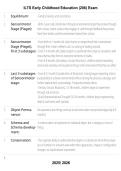
1. Equilibrium: -Family's balance and consistency
2. Sensorimotor -Birth-2 years old, Infants learn through environmental input they receive through
Stage (Piaget): their senses; motor actions they engage in; and through feedback they receive
from their bodies and the environment about their actions
3. Sensorimotor -From birth to 1 month old, infant learns to comprehend their environment
Stage (Piaget), through their inborn reflexes such as sucking or looking around.
First 3 substages: -From 1-4 months old, babies begin to coordinate their physical sensations with
new schemas they form to represent elements of reality.
-From 4-8 months (Secondary Circular Reactions), children repeat rewarding
actions but now they are focused on things in the environment that they can affect
4. Last 3 substages -From 8-12 month (Coordination of Reactions): having begun repeating actions
of Sensorimotor purposefully to achieve environmental effects during the previous substage and
stage: further explore their surroundings. Frequently imitate others
-(Tertiary Circular Reactions), 12-18 months, children begin to experiment
through rial and error.
-(Early Representational Thought) 18-24 months, children begin representing
objects and events with symbols
5. Object Perma- the awareness that things continue to exist even when not perceived (typically 8-9
nence: months)
6. Schema and -A schema does not represent an individual object, but a category or class of
Schema develop- things.
ment:
7. Conservation: -The cognitive ability to understand that objects or substances retain their proper-
ties of numbers or amounts even when their appearance, shape or configuration
changes. ex: liquid volume experiment
8.
2025/ 2026
, ILTS Early Childhood Education (206) Exam
ILTS Early Childhood Education (206) Exam
Study online at https://quizlet.com/_8iqgzi
Preoperational -(Piaget), 2-6 years children cannot yet perform mental operations nor manipu-
Stage: late information mentally.
9. Concrete Opera- -(Piaget) 6-7 years, children begin to think logically using cause and effect to
tional Stage: things they can see, feel or manipulate physically. However, they still struggle to
think abstractly.
10. Preoperational - (Piaget), children between 2-6 have begun using objects to represent other
Stage Continued: things through exploration of pretend/make-beleive play.
-Piaget termed pre operational children "egocentric" in that they literally cannot
adopt another point of view even concretely
11. Animism: -Develops in pre operational stage
-Assigning human beliefs, qualities, feelings and actions to inanimate objects
-Related to egocentrism in regard to everything revolving around oneself
12. Stages of Growth -Six stages
and Develop- -Scribble Stage (age 2-4): uncontrolled scribble, controlled scribble, naming
ment in Art: scribble to indicate representation
-Preschematic Stage (4-6 years old): Children begin to develop a visual schema
-Schematic Stage (7-9 years old): Drawings more reflect actualy physical propor-
tions and colors.
-Dawing Realism Stage (9-11 years old): Drawings become increasingly repre-
sentational.
-Pseudorealistic Stage (11-13 years old): Reflecting their abilities to reason
-Period of Decision stage (14+ years old): Reflecting their adolescent identity crisis
13. Music and Devel- -Music is a great aid to emotional development
opment: -Provide opportunities for guided musical experiences
-Growing musical appreciation goes hand in and with fundamental motor and
cognitive development, and social skills needed for language and school readi-
ness
2025/ 2026
, ILTS Early Childhood Education (206) Exam
ILTS Early Childhood Education (206) Exam
Study online at https://quizlet.com/_8iqgzi
14. Premathematic -Preschool children do not think the same way older people do. When it comes
Learning to problem solving, the depend upon how things look, feel, smell, and taste.
Experiences: Therefore, preschool children should be given concrete objects for problem
solving
15. Activities Assist- -Young children struggle reversing operations. They are also often egocentric,
ing Children De- seeing everything from their point of view. Adults can help them take others'
velop Cognitive perspectives through guessing games wherein they must give each other clues
Abilities: to guess persons/ objects and dramatic role-playing activities.
16. Gender Differ- -On average, preschool boys tend to be more muscular and more advanced in
ences in Motor gross motor abilities. Preschool girls tend to me more advanced in fine-motor
Development: abilities and small muscle activities.
17. Abilities in Per- -Babies usually establish the ability to see, hear, smell, taste and feel as well as
ceptual Develop- the ability to integrate such sensory information by the age of six months.
ment Occurring -Young children develop increasing precision in recognizing visual concepts like
in Infancy: size in shape in the ec years. This development allows children to identify accu-
rately the size of an object no matter what angle they perceive it.
18. Signs of Progress -Genetics, physiological maturation, nutrition and experience through practice
in Typical Motor combine to further preschoolers' motor skills development.
Development: -Motor skills development entails both learning new movements and gradually
integrating previously learned movements into smooth, continuous patters as in
learning to through a ball with skill.
19. Characteristics in -Observations of young children find that while a 2.5 year old can grasp a crayon
Art Reflecting and scribble with it, by the age of 4, they can draw a picture we recognize as a
Perceptual, Cog- human called "the tadpole person".
nitive and Motor -This development is enabled by greater development in motor control, eye-hand
Development: coordination, among other variables
20.
2025/ 2026
ILTS Early Childhood Education (206) Exam
Study online at https://quizlet.com/_8iqgzi
1. Equilibrium: -Family's balance and consistency
2. Sensorimotor -Birth-2 years old, Infants learn through environmental input they receive through
Stage (Piaget): their senses; motor actions they engage in; and through feedback they receive
from their bodies and the environment about their actions
3. Sensorimotor -From birth to 1 month old, infant learns to comprehend their environment
Stage (Piaget), through their inborn reflexes such as sucking or looking around.
First 3 substages: -From 1-4 months old, babies begin to coordinate their physical sensations with
new schemas they form to represent elements of reality.
-From 4-8 months (Secondary Circular Reactions), children repeat rewarding
actions but now they are focused on things in the environment that they can affect
4. Last 3 substages -From 8-12 month (Coordination of Reactions): having begun repeating actions
of Sensorimotor purposefully to achieve environmental effects during the previous substage and
stage: further explore their surroundings. Frequently imitate others
-(Tertiary Circular Reactions), 12-18 months, children begin to experiment
through rial and error.
-(Early Representational Thought) 18-24 months, children begin representing
objects and events with symbols
5. Object Perma- the awareness that things continue to exist even when not perceived (typically 8-9
nence: months)
6. Schema and -A schema does not represent an individual object, but a category or class of
Schema develop- things.
ment:
7. Conservation: -The cognitive ability to understand that objects or substances retain their proper-
ties of numbers or amounts even when their appearance, shape or configuration
changes. ex: liquid volume experiment
8.
2025/ 2026
, ILTS Early Childhood Education (206) Exam
ILTS Early Childhood Education (206) Exam
Study online at https://quizlet.com/_8iqgzi
Preoperational -(Piaget), 2-6 years children cannot yet perform mental operations nor manipu-
Stage: late information mentally.
9. Concrete Opera- -(Piaget) 6-7 years, children begin to think logically using cause and effect to
tional Stage: things they can see, feel or manipulate physically. However, they still struggle to
think abstractly.
10. Preoperational - (Piaget), children between 2-6 have begun using objects to represent other
Stage Continued: things through exploration of pretend/make-beleive play.
-Piaget termed pre operational children "egocentric" in that they literally cannot
adopt another point of view even concretely
11. Animism: -Develops in pre operational stage
-Assigning human beliefs, qualities, feelings and actions to inanimate objects
-Related to egocentrism in regard to everything revolving around oneself
12. Stages of Growth -Six stages
and Develop- -Scribble Stage (age 2-4): uncontrolled scribble, controlled scribble, naming
ment in Art: scribble to indicate representation
-Preschematic Stage (4-6 years old): Children begin to develop a visual schema
-Schematic Stage (7-9 years old): Drawings more reflect actualy physical propor-
tions and colors.
-Dawing Realism Stage (9-11 years old): Drawings become increasingly repre-
sentational.
-Pseudorealistic Stage (11-13 years old): Reflecting their abilities to reason
-Period of Decision stage (14+ years old): Reflecting their adolescent identity crisis
13. Music and Devel- -Music is a great aid to emotional development
opment: -Provide opportunities for guided musical experiences
-Growing musical appreciation goes hand in and with fundamental motor and
cognitive development, and social skills needed for language and school readi-
ness
2025/ 2026
, ILTS Early Childhood Education (206) Exam
ILTS Early Childhood Education (206) Exam
Study online at https://quizlet.com/_8iqgzi
14. Premathematic -Preschool children do not think the same way older people do. When it comes
Learning to problem solving, the depend upon how things look, feel, smell, and taste.
Experiences: Therefore, preschool children should be given concrete objects for problem
solving
15. Activities Assist- -Young children struggle reversing operations. They are also often egocentric,
ing Children De- seeing everything from their point of view. Adults can help them take others'
velop Cognitive perspectives through guessing games wherein they must give each other clues
Abilities: to guess persons/ objects and dramatic role-playing activities.
16. Gender Differ- -On average, preschool boys tend to be more muscular and more advanced in
ences in Motor gross motor abilities. Preschool girls tend to me more advanced in fine-motor
Development: abilities and small muscle activities.
17. Abilities in Per- -Babies usually establish the ability to see, hear, smell, taste and feel as well as
ceptual Develop- the ability to integrate such sensory information by the age of six months.
ment Occurring -Young children develop increasing precision in recognizing visual concepts like
in Infancy: size in shape in the ec years. This development allows children to identify accu-
rately the size of an object no matter what angle they perceive it.
18. Signs of Progress -Genetics, physiological maturation, nutrition and experience through practice
in Typical Motor combine to further preschoolers' motor skills development.
Development: -Motor skills development entails both learning new movements and gradually
integrating previously learned movements into smooth, continuous patters as in
learning to through a ball with skill.
19. Characteristics in -Observations of young children find that while a 2.5 year old can grasp a crayon
Art Reflecting and scribble with it, by the age of 4, they can draw a picture we recognize as a
Perceptual, Cog- human called "the tadpole person".
nitive and Motor -This development is enabled by greater development in motor control, eye-hand
Development: coordination, among other variables
20.
2025/ 2026

