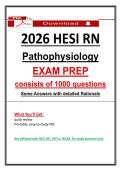
2026 HESI RN
Pathophysiology
EXAM PREP
consists of 1000 questions
Some Answers with detailed Rationale
What You’ll Get:
quick review
Printable, easy-to-study PDF
Not affiliated with HESI, ATI, VATI or NCLEX. For study purposes only.
,PREVIEW QUESTIONS BELOW
GET THE COMPLETE PDF
AFTER PURCHASE
“ If you require further clarification
or in need of any study resources,
feel free to Message me.
”
,A man who was recently diagnosed with Huntington's disease asks the nurse if
his adolescent son should be tested for the disease. What response is best for
the nurse to provide?
a) Autosomal dominant disorders, such as Huntington's, cannot be inherited from
the parent.
b) Genetic counseling should be obtained prior to undertaking any genetic
testing procedure.
c) Testing is needed in adolescents because of the risk of passing the gene to
each offspring.
d) Positive genetic testing may contribute to insurance discrimination that denies
coverage.
b) Genetic counseling should be obtained prior to undertaking any genetic testing
procedure.
-
Genetic counseling provides clients and families with facts to assist them in making
informed decisions before any genetic testing procedure is undertaken. It also ensures
that the client has voluntarily opted for the testing and not coerced and is also able to
weigh the risks and benefits of knowing the result.
After talking with the healthcare provider, a male client continues to have
questions about the results of a prostatic surface antigen (PSA) screening test
and asks the nurse how the PSA levels become elevated. The nurse should
explain which pathophysiological mechanism?
a) As the prostate gland enlarges, its cells contribute more PSA in the circulating
blood.
b) The PSA levels normally rise and fall, so multiple testings over time are
necessary.
c) Low PSA levels indicate that the prostate gland is not functioning properly.
d) The PSA blood test is used to determine dosage for Viagra prescriptions.
a) As the prostate gland enlarges, its cells contribute more PSA in the circulating blood.
-
PSA is a glycoprotein found in prostatic epithelial cells, and elevations are used as a
specific tumor markers. Elevations in PSA are related to gland volume, i.e., benign
prostatic hypertrophy, prostatitis, and cancer of the prostate, indicating (tumor) cell load.
PSA levels are also used to monitor response to therapy.
,When observing a client for symptoms of a large bowel obstruction, the nurse
should assess for which finding?
a) Distention of the lower abdomen.
b) Nausea with profuse vomiting.
c) Upper abdominal discomfort.
d) Fluid and electrolyte imbalances.
a) Distention of the lower abdomen.
-
Among findings characteristic of a large bowel obstruction is the distention of the lower
abdomen.The other options are findings associated with small bowel obstruction.
Which rationale best supports an older client's risk of complications related to a
dysrhythmia?
a) An older client usually lives alone and cannot summon help when symptoms
appear.
b) An older clients is more likely to eat high-fat diets which predisposes to heart
disease.
c) Cardiac symptoms, such as confusion, are more difficult to recognize in an
older client.
d) An older client is intolerant of decreased cardiac output which may cause
dizziness and falls.
d) An older client is intolerant of decreased cardiac output which may cause dizziness
and falls.
-
In an older client, cardiac output is decreased and a loss of contractility and elasticity
reduces systemic and cerebral blood flow, so dysrhythmias, such as bradycardia or
tachycardia is poorly tolerated, and increases the client's risk for syncope, falls,
transient ischemic attacks, and possibly dementia.
Which healthcare practice is most important for the nurse to teach a
postmenopausal client?
a) Wear layers of clothes if experiencing hot flashes.
b) Use a water-soluble lubricant for vaginal dryness.
c) Consume adequate foods rich in calcium.
d) Participate in stimulating mental exercises.
,c) Consume adequate foods rich in calcium.
-
Bone density loss associated with osteoporosis increases at a more rapid rate when
estrogen levels begin to fall, so the most important healthcare practice during
menopause is ensuring an adequate calcium intake to help maintain bone density and
prevent osteoporosis.
Which signs and symptoms are associated with arterial insufficiency?
a) Pallor, intermittent claudication.
b) Pedal edema, brown pigmentation.
c) Blanched skin, lower extremity ulcers.
d) Peripheral neuropathy, cold extremities.
a) Pallor, intermittent claudication.
-
Pallor and intermittent claudication are signs related to stage II of peripheral vascular
disease, which results in arterial insufficiency.
A deficiency of intrinsic factor should alert the nurse to assess a client's history
for which condition?
a) Emphysema.
b) Hemophilia.
c) Pernicious anemia.
d) Oxalic acid toxicity.
c) Pernicious anemia.
-
Pernicious anemia is a type of anemia due to failure of absorption of cobalamin (Vit
B12). The most common cause is lack of intrinsic factor, a glucoprotein produced by the
parietal cells of the gastric lining.
A client is brought to the Emergency Center after a snow-skiing accident. Which
intervention is most important for the nurse to implement?
a) Review the electrocardiogram tracing.
b) Obtain blood for coagulation studies.
c) Apply a warming blanket.
d) Provide heated PO fluids.
a) Review the electrocardiogram tracing.
-
,While airway, breathing, and circulation are priorities in client assessment and
treatment,continuous cardiac monitoring is also indicated because hypothermic clients
have an increased risk for dysrhythmias.
A client who is receiving a whole blood transfusion develops chills, fever, and a
headache 30 minutes after the transfusion is started. The nurse should recognize
these symptoms as characteristic of what reaction?
a) A mild allergic reaction.
b) A febrile transfusion reaction.
c) An anaphylactic transfusion reaction.
d) An acute hemolytic transfusion reaction.
b) A febrile transfusion reaction.
-
Symptoms of a febrile reaction include sudden chills, fever, headache, flushing and
muscle pain. The symptoms and onset are not characterristic of the other options.
The nurse is teaching a client with maple syrup urine disease (MSUD), an
autosomal recessive disorder, about the inheritance pattern. Which information
should the nurse provide?
a) This recessive disorder is carried only on the X chromosome.
b) Occurrences mainly affect males and heterozygous females.
c) Both genes of a pair must be abnormal for the disorder to occur.
d) One copy of the abnormal gene is required for this disorder.
c) Both genes of a pair must be abnormal for the disorder to occur.
-
Maple syrup urine disease (MSUD) is a type of autosomal recessive inheritance
disorder in which both genes of a pair must be abnormal for the disorder to be
expressed.
The parents of a child with hemophilia A ask the nurse about their probability of
having another child with hemophilia A. Which information is the basis for the
nurse's response? (Select all that apply.)
a) Autosomal dominance occurs with this disorder.
b) Sons of female carriers have a 50% chance of inheriting hemophilia.
c) Men with hemophilia have sons who also manifest the disease.
,d) The disease occurs in daughters of men with hemophilia.
e) Hemophilia is an X-linked recessive disorder.
b) Sons of female carriers have a 50% chance of inheriting hemophilia.
e) Hemophilia is an X-linked recessive disorder.
-
Hemophilia is an inherited disease that manifests in male children whose mother is a
carrier. With each pregnancy there is a 50% chance that a male child will inherit the
defective gene and manifest hemophilia A, which is an X-linked recessive disorder.
Hemophilia A is not an autosomal dominance disorder and it is inherited by male
offspring of female carriers . Daughters do not manifest the disease, but have a 50%
chance of being a carrier.
The nurse reviews the complete blood count (CBC) findings of an adolescent with
acute myelogenous leukemia (AML). The hemoglobin is 13.8 g/dl, hematocrit is
36.7%, white blood cell count is 8,200 mm 3 , and platelet count is 115,000 mm 3 .
Based on these findings, what is the priority nursing diagnosis for this client's
plan of care?
a) Impaired gas exchange.
b) Risk for infection.
c) Risk for injury.
d) Risk for activity intolerance.
c) Risk for injury.
-
A client with AML is at risk for anemia, neutropenia, and thrombocytopenia. These CBC
findings indicate that the platelet count is low (normal 250,000 to 400,000 mm3), which
places this client at an increased risk for injury, usually manifested as bruising or
bleeding.
A middle-aged male client asks the nurse what findings from his digital rectal
examination (DRE) prompted the healthcare provider to prescribe a repeat serum
prostatic surface antigen (PSA) level. What information should the nurse
provide?
a) A uniformly enlarged prostate is benign prostatic hypertrophy that occurs with
aging.
b) The spongy or elastic texture of the prostate is normal and requires no further
testing.
c) An infection is usually present when the prostate indents when a finger is
,pressed on it.
d) Stony, irregular nodules palpated on the prostate should be further evaluated.
d) Stony, irregular nodules palpated on the prostate should be further evaluated.
-
PSA levels are prescribed to screen for prostatic cancer which is often detected by DRE
and manifested as small, hard, or stony, irregularly-shaped nodules on the surface of
the prostate. Although PSA levels are prescribed for routine screening, the findings
suggestive of BPH normal texture or infection do not suggest cancer of the prostate
which requires further evaluation.
Several hours after surgical repair of an abdominal aortic aneurysm (AAA), the
client develops left flank pain. The nurse determines the client's urinary output is
20 ml/hr for the past 2 hours. The nurse should conclude that these findings
support which complication?
a) Infection.
b) Hypovolemia.
c) Intestinal ischemia.
d) Renal artery embolization.
d) Renal artery embolization.
-
Postoperative complications of surgical repair of AAA are related to the location of
resection, graft, or stent placement along the abdominal aorta. Embolization of a
fragment of thrombus or plaque from the aorta into a renal artery can compromise blood
flow in one of the renal arteries, resulting in renal ischemia that precipitates unilateral
flank pain.
Muscular Dystrophy is characterized by which pathophysiological condition?
a) Stressed induced tremor and trembling.
b) Cardiac damage.
c) Seizure activity.
d) Skeletal muscle degeneration.
d) Skeletal muscle degeneration.
-
Skeletal muscle degeneration is a classic symptom of Muscular Dystrophy. The other
options are not classic or exclusive to Muscular Dystrophy.
,Physical examination of a comatose client reveals decorticate posturing. Which
statement is accurate regarding this client's status based upon this finding?
a) A cerebral infectious process is causing the posturing.
b) Severe dysfunction of the cerebral cortex has occurred.
c) There is a probable dysfunction of the midbrain.
d) The client is exhibiting signs of a brain tumor.
b) Severe dysfunction of the cerebral cortex has occurred.
-
Decorticate posturing (adduction of arms at shoulders, flexion of arms on chest with
wrists flexed and hands fisted and extension and adduction of extremities) is seen with
severe dysfunction of the cerebral cortex.
The nurse is caring for a client who had an excision of a malignant pituitary
tumor. Which findings should the nurse document that indicate the client is
developing syndrome of inappropriate antidiuretic hormone (SIADH)?
a) Hypernatremia and periorbial edema.
b) Muscle spasticity and hypertension.
c) Weight gain with low serum sodium.
d) Increased urinary output and thirst.
c) Weight gain with low serum sodium.
-
SIADH most frequently occurs when cancer cells manufacture and release ADH, which
is manifested by water retention causing weight gain and hyponatremia. Other
manifestations include oliguria, weakness, not anorexia, nausea, vomiting, personality
changes, seizures, decrease in reflexes, and coma.
A mother is crying as she holds and rocks her child with tetanus who is having
muscular spasms and crying. After administering diazepam (Valium) to the child,
what action should the nurse implement?
a) Lay the child down and ask the mother to stay near the child in the crib.
b) Encourage the mother to take a break and leave the room to stop crying.
c) Keep all light sources off and close the window blinds to the room.
d) Use calm, reassurance and understanding to comfort the mother.
a) Lay the child down and ask the mother to stay near the child in the crib.
-
, Controlling environmental stimulation such as noise, light, or tactile stimuli helps reduce
CNS irritability related to acute tetanus. The mother should be instructed to minimize
handling of the child during episodes of muscle spasticity and to stay calmly near the
child. The mother's presence with the child provides security and support to the child.
Which reaction should the nurse identify in a client who is responding to
stimulation of the sympathetic nervous system?
a) Pupil constriction.
b) Increased heart rate.
c) Bronchial constriction.
d) Decreased blood pressure.
b) Increased heart rate.
-
Any stressor that is perceived as threatening to homeostasis acts to stimulate the
sympathetic nervous system and manifests as a flight-or-fight response, which includes
an increase in heart rate. The other options are responses of the parasympathetic
nervous system.
A 26-year-old male client with Hodgkin's disease is scheduled to undergo
radiation therapy. The client expresses concern about the effect of radiation on
his ability to have children. What information should the nurse provide?
a) The radiation therapy causes the inability to have an erection.
b) Radiation therapy with chemotherapy causes temporary infertility.
c) Permanent sterility occurs in male clients who receive radiation.
d) The client should restrict sexual activity during radiotherapy.
c) Permanent sterility occurs in male clients who receive radiation.
-
Low sperm count and loss of motility are seen in males with Hodgkin's disease before
any therapy. Radiotherapy often results in permanent aspermia, or sterility.The other
options are inaccurate.
A client with a fractured right radius reports severe, diffuse pain that has not
responded to the prescribed analgesics. The pain is greater with passive
movement of the limb than with active movement by the client. The nurse
recognizes that the client is most likely exhibiting symptoms of which condition?
a) Acute compartment syndrome.
b) Fat embolism syndrome.
Pathophysiology
EXAM PREP
consists of 1000 questions
Some Answers with detailed Rationale
What You’ll Get:
quick review
Printable, easy-to-study PDF
Not affiliated with HESI, ATI, VATI or NCLEX. For study purposes only.
,PREVIEW QUESTIONS BELOW
GET THE COMPLETE PDF
AFTER PURCHASE
“ If you require further clarification
or in need of any study resources,
feel free to Message me.
”
,A man who was recently diagnosed with Huntington's disease asks the nurse if
his adolescent son should be tested for the disease. What response is best for
the nurse to provide?
a) Autosomal dominant disorders, such as Huntington's, cannot be inherited from
the parent.
b) Genetic counseling should be obtained prior to undertaking any genetic
testing procedure.
c) Testing is needed in adolescents because of the risk of passing the gene to
each offspring.
d) Positive genetic testing may contribute to insurance discrimination that denies
coverage.
b) Genetic counseling should be obtained prior to undertaking any genetic testing
procedure.
-
Genetic counseling provides clients and families with facts to assist them in making
informed decisions before any genetic testing procedure is undertaken. It also ensures
that the client has voluntarily opted for the testing and not coerced and is also able to
weigh the risks and benefits of knowing the result.
After talking with the healthcare provider, a male client continues to have
questions about the results of a prostatic surface antigen (PSA) screening test
and asks the nurse how the PSA levels become elevated. The nurse should
explain which pathophysiological mechanism?
a) As the prostate gland enlarges, its cells contribute more PSA in the circulating
blood.
b) The PSA levels normally rise and fall, so multiple testings over time are
necessary.
c) Low PSA levels indicate that the prostate gland is not functioning properly.
d) The PSA blood test is used to determine dosage for Viagra prescriptions.
a) As the prostate gland enlarges, its cells contribute more PSA in the circulating blood.
-
PSA is a glycoprotein found in prostatic epithelial cells, and elevations are used as a
specific tumor markers. Elevations in PSA are related to gland volume, i.e., benign
prostatic hypertrophy, prostatitis, and cancer of the prostate, indicating (tumor) cell load.
PSA levels are also used to monitor response to therapy.
,When observing a client for symptoms of a large bowel obstruction, the nurse
should assess for which finding?
a) Distention of the lower abdomen.
b) Nausea with profuse vomiting.
c) Upper abdominal discomfort.
d) Fluid and electrolyte imbalances.
a) Distention of the lower abdomen.
-
Among findings characteristic of a large bowel obstruction is the distention of the lower
abdomen.The other options are findings associated with small bowel obstruction.
Which rationale best supports an older client's risk of complications related to a
dysrhythmia?
a) An older client usually lives alone and cannot summon help when symptoms
appear.
b) An older clients is more likely to eat high-fat diets which predisposes to heart
disease.
c) Cardiac symptoms, such as confusion, are more difficult to recognize in an
older client.
d) An older client is intolerant of decreased cardiac output which may cause
dizziness and falls.
d) An older client is intolerant of decreased cardiac output which may cause dizziness
and falls.
-
In an older client, cardiac output is decreased and a loss of contractility and elasticity
reduces systemic and cerebral blood flow, so dysrhythmias, such as bradycardia or
tachycardia is poorly tolerated, and increases the client's risk for syncope, falls,
transient ischemic attacks, and possibly dementia.
Which healthcare practice is most important for the nurse to teach a
postmenopausal client?
a) Wear layers of clothes if experiencing hot flashes.
b) Use a water-soluble lubricant for vaginal dryness.
c) Consume adequate foods rich in calcium.
d) Participate in stimulating mental exercises.
,c) Consume adequate foods rich in calcium.
-
Bone density loss associated with osteoporosis increases at a more rapid rate when
estrogen levels begin to fall, so the most important healthcare practice during
menopause is ensuring an adequate calcium intake to help maintain bone density and
prevent osteoporosis.
Which signs and symptoms are associated with arterial insufficiency?
a) Pallor, intermittent claudication.
b) Pedal edema, brown pigmentation.
c) Blanched skin, lower extremity ulcers.
d) Peripheral neuropathy, cold extremities.
a) Pallor, intermittent claudication.
-
Pallor and intermittent claudication are signs related to stage II of peripheral vascular
disease, which results in arterial insufficiency.
A deficiency of intrinsic factor should alert the nurse to assess a client's history
for which condition?
a) Emphysema.
b) Hemophilia.
c) Pernicious anemia.
d) Oxalic acid toxicity.
c) Pernicious anemia.
-
Pernicious anemia is a type of anemia due to failure of absorption of cobalamin (Vit
B12). The most common cause is lack of intrinsic factor, a glucoprotein produced by the
parietal cells of the gastric lining.
A client is brought to the Emergency Center after a snow-skiing accident. Which
intervention is most important for the nurse to implement?
a) Review the electrocardiogram tracing.
b) Obtain blood for coagulation studies.
c) Apply a warming blanket.
d) Provide heated PO fluids.
a) Review the electrocardiogram tracing.
-
,While airway, breathing, and circulation are priorities in client assessment and
treatment,continuous cardiac monitoring is also indicated because hypothermic clients
have an increased risk for dysrhythmias.
A client who is receiving a whole blood transfusion develops chills, fever, and a
headache 30 minutes after the transfusion is started. The nurse should recognize
these symptoms as characteristic of what reaction?
a) A mild allergic reaction.
b) A febrile transfusion reaction.
c) An anaphylactic transfusion reaction.
d) An acute hemolytic transfusion reaction.
b) A febrile transfusion reaction.
-
Symptoms of a febrile reaction include sudden chills, fever, headache, flushing and
muscle pain. The symptoms and onset are not characterristic of the other options.
The nurse is teaching a client with maple syrup urine disease (MSUD), an
autosomal recessive disorder, about the inheritance pattern. Which information
should the nurse provide?
a) This recessive disorder is carried only on the X chromosome.
b) Occurrences mainly affect males and heterozygous females.
c) Both genes of a pair must be abnormal for the disorder to occur.
d) One copy of the abnormal gene is required for this disorder.
c) Both genes of a pair must be abnormal for the disorder to occur.
-
Maple syrup urine disease (MSUD) is a type of autosomal recessive inheritance
disorder in which both genes of a pair must be abnormal for the disorder to be
expressed.
The parents of a child with hemophilia A ask the nurse about their probability of
having another child with hemophilia A. Which information is the basis for the
nurse's response? (Select all that apply.)
a) Autosomal dominance occurs with this disorder.
b) Sons of female carriers have a 50% chance of inheriting hemophilia.
c) Men with hemophilia have sons who also manifest the disease.
,d) The disease occurs in daughters of men with hemophilia.
e) Hemophilia is an X-linked recessive disorder.
b) Sons of female carriers have a 50% chance of inheriting hemophilia.
e) Hemophilia is an X-linked recessive disorder.
-
Hemophilia is an inherited disease that manifests in male children whose mother is a
carrier. With each pregnancy there is a 50% chance that a male child will inherit the
defective gene and manifest hemophilia A, which is an X-linked recessive disorder.
Hemophilia A is not an autosomal dominance disorder and it is inherited by male
offspring of female carriers . Daughters do not manifest the disease, but have a 50%
chance of being a carrier.
The nurse reviews the complete blood count (CBC) findings of an adolescent with
acute myelogenous leukemia (AML). The hemoglobin is 13.8 g/dl, hematocrit is
36.7%, white blood cell count is 8,200 mm 3 , and platelet count is 115,000 mm 3 .
Based on these findings, what is the priority nursing diagnosis for this client's
plan of care?
a) Impaired gas exchange.
b) Risk for infection.
c) Risk for injury.
d) Risk for activity intolerance.
c) Risk for injury.
-
A client with AML is at risk for anemia, neutropenia, and thrombocytopenia. These CBC
findings indicate that the platelet count is low (normal 250,000 to 400,000 mm3), which
places this client at an increased risk for injury, usually manifested as bruising or
bleeding.
A middle-aged male client asks the nurse what findings from his digital rectal
examination (DRE) prompted the healthcare provider to prescribe a repeat serum
prostatic surface antigen (PSA) level. What information should the nurse
provide?
a) A uniformly enlarged prostate is benign prostatic hypertrophy that occurs with
aging.
b) The spongy or elastic texture of the prostate is normal and requires no further
testing.
c) An infection is usually present when the prostate indents when a finger is
,pressed on it.
d) Stony, irregular nodules palpated on the prostate should be further evaluated.
d) Stony, irregular nodules palpated on the prostate should be further evaluated.
-
PSA levels are prescribed to screen for prostatic cancer which is often detected by DRE
and manifested as small, hard, or stony, irregularly-shaped nodules on the surface of
the prostate. Although PSA levels are prescribed for routine screening, the findings
suggestive of BPH normal texture or infection do not suggest cancer of the prostate
which requires further evaluation.
Several hours after surgical repair of an abdominal aortic aneurysm (AAA), the
client develops left flank pain. The nurse determines the client's urinary output is
20 ml/hr for the past 2 hours. The nurse should conclude that these findings
support which complication?
a) Infection.
b) Hypovolemia.
c) Intestinal ischemia.
d) Renal artery embolization.
d) Renal artery embolization.
-
Postoperative complications of surgical repair of AAA are related to the location of
resection, graft, or stent placement along the abdominal aorta. Embolization of a
fragment of thrombus or plaque from the aorta into a renal artery can compromise blood
flow in one of the renal arteries, resulting in renal ischemia that precipitates unilateral
flank pain.
Muscular Dystrophy is characterized by which pathophysiological condition?
a) Stressed induced tremor and trembling.
b) Cardiac damage.
c) Seizure activity.
d) Skeletal muscle degeneration.
d) Skeletal muscle degeneration.
-
Skeletal muscle degeneration is a classic symptom of Muscular Dystrophy. The other
options are not classic or exclusive to Muscular Dystrophy.
,Physical examination of a comatose client reveals decorticate posturing. Which
statement is accurate regarding this client's status based upon this finding?
a) A cerebral infectious process is causing the posturing.
b) Severe dysfunction of the cerebral cortex has occurred.
c) There is a probable dysfunction of the midbrain.
d) The client is exhibiting signs of a brain tumor.
b) Severe dysfunction of the cerebral cortex has occurred.
-
Decorticate posturing (adduction of arms at shoulders, flexion of arms on chest with
wrists flexed and hands fisted and extension and adduction of extremities) is seen with
severe dysfunction of the cerebral cortex.
The nurse is caring for a client who had an excision of a malignant pituitary
tumor. Which findings should the nurse document that indicate the client is
developing syndrome of inappropriate antidiuretic hormone (SIADH)?
a) Hypernatremia and periorbial edema.
b) Muscle spasticity and hypertension.
c) Weight gain with low serum sodium.
d) Increased urinary output and thirst.
c) Weight gain with low serum sodium.
-
SIADH most frequently occurs when cancer cells manufacture and release ADH, which
is manifested by water retention causing weight gain and hyponatremia. Other
manifestations include oliguria, weakness, not anorexia, nausea, vomiting, personality
changes, seizures, decrease in reflexes, and coma.
A mother is crying as she holds and rocks her child with tetanus who is having
muscular spasms and crying. After administering diazepam (Valium) to the child,
what action should the nurse implement?
a) Lay the child down and ask the mother to stay near the child in the crib.
b) Encourage the mother to take a break and leave the room to stop crying.
c) Keep all light sources off and close the window blinds to the room.
d) Use calm, reassurance and understanding to comfort the mother.
a) Lay the child down and ask the mother to stay near the child in the crib.
-
, Controlling environmental stimulation such as noise, light, or tactile stimuli helps reduce
CNS irritability related to acute tetanus. The mother should be instructed to minimize
handling of the child during episodes of muscle spasticity and to stay calmly near the
child. The mother's presence with the child provides security and support to the child.
Which reaction should the nurse identify in a client who is responding to
stimulation of the sympathetic nervous system?
a) Pupil constriction.
b) Increased heart rate.
c) Bronchial constriction.
d) Decreased blood pressure.
b) Increased heart rate.
-
Any stressor that is perceived as threatening to homeostasis acts to stimulate the
sympathetic nervous system and manifests as a flight-or-fight response, which includes
an increase in heart rate. The other options are responses of the parasympathetic
nervous system.
A 26-year-old male client with Hodgkin's disease is scheduled to undergo
radiation therapy. The client expresses concern about the effect of radiation on
his ability to have children. What information should the nurse provide?
a) The radiation therapy causes the inability to have an erection.
b) Radiation therapy with chemotherapy causes temporary infertility.
c) Permanent sterility occurs in male clients who receive radiation.
d) The client should restrict sexual activity during radiotherapy.
c) Permanent sterility occurs in male clients who receive radiation.
-
Low sperm count and loss of motility are seen in males with Hodgkin's disease before
any therapy. Radiotherapy often results in permanent aspermia, or sterility.The other
options are inaccurate.
A client with a fractured right radius reports severe, diffuse pain that has not
responded to the prescribed analgesics. The pain is greater with passive
movement of the limb than with active movement by the client. The nurse
recognizes that the client is most likely exhibiting symptoms of which condition?
a) Acute compartment syndrome.
b) Fat embolism syndrome.