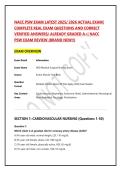
NACC PSW EXAM LATEST 2025/ 2026 ACTUAL EXAM|
COMPLETE REAL EXAM QUESTIONS AND CORRECT
VERIFIED ANSWERS/ ALREADY GRADED A+| NACC
PSW EXAM REVIEW (BRAND NEW!!)
EXAM OVERVIEW
Exam Detail Information
Exam Name HESI Medical-Surgical Nursing Exam
Source Evolve Elsevier Test Bank
Question
Multiple Choice, Select All That Apply, NGN Case Studies
Format
Key Content Cardiovascular, Respiratory, Endocrine, Renal, Gastrointestinal, Neurological,
Areas Musculoskeletal, Oncology, Prioritization
SECTION 1: CARDIOVASCULAR NURSING (Questions 1-50)
Question 1:
Which client is at greatest risk for coronary artery disease (CAD)?
A) 45-year-old male, normal weight, LDL 110 mg/dL
B) 65-year-old female, obese, LDL 188 mg/dL
C) 50-year-old female, physically active, HDL 65 mg/dL
D) 55-year-old male, non-smoker, HDL 55 mg/dL
,Answer: B
Rationale: Advanced age, obesity, and elevated LDL cholesterol are significant CAD risk
factors, placing this client at highest risk . The other options have fewer modifiable risk
factors.
Question 2:
A client with stable angina experiences chest pain that does not resolve after
taking three nitroglycerin tablets. What should the nurse advise?
A) Continue taking nitroglycerin every 5 minutes
B) Drive to the nearest hospital immediately
C) Chew a tablet of aspirin 325 mg while waiting for emergency services
D) Call a friend for assistance instead of emergency services
Answer: C
Rationale: Chest pain unresponsive to three sublingual nitroglycerin tablets requires
emergency medical attention. Chewing a 325 mg aspirin while waiting for emergency
services is recommended because aspirin reduces platelet aggregation and improves
outcomes in acute coronary syndromes .
Question 3:
A client who underwent cardiac stent placement 4 days ago arrives at the
emergency department reporting sudden onset chest pressure and shortness of
breath. Which action should the nurse take next?
A) Administer prescribed nitroglycerin sublingually
B) Obtain a 12-lead electrocardiogram (ECG) and begin continuous cardiac monitoring
,C) Give oxygen at 2 liters per minute via nasal cannula
D) Prepare the client for immediate cardiac catheterization
Answer: B
Rationale: A client with sudden chest pressure and shortness of breath after recent
stenting is at high risk for acute stent thrombosis or myocardial infarction (MI).
Immediate acquisition of a 12-lead ECG is critical to assess for ischemic changes and to
prioritize timely reperfusion therapy. Continuous cardiac monitoring is essential to
detect arrhythmias .
Question 4:
A client is receiving Cilostazol (Pletal) for peripheral arterial disease causing
intermittent claudication. The nurse determines this medication is effective when
the client reports:
A) "I am having fewer aches and pains."
B) "I do not have headaches anymore."
C) "My leg pain has decreased when I walk."
D) "My blood pressure has improved."
Answer: C
Rationale: Cilostazol is a phosphodiesterase inhibitor that improves walking distance in
clients with peripheral arterial disease. Effectiveness is measured by reduced symptoms
of intermittent claudication, such as decreased leg pain during ambulation .
Question 5:
The client admitted with peripheral vascular disease (PVD) asks why her legs hurt
when she walks. The nurse responds based on the knowledge that the main
, characteristic of PVD is:
A) Increased venous return
B) Decreased blood flow
C) Elevated oxygen saturation levels
D) Enhanced capillary permeability
Answer: B
Rationale: Peripheral vascular disease is characterized by decreased arterial blood flow
to the extremities, leading to ischemia, pain, and impaired healing. Intermittent
claudication (leg pain with activity that resolves at rest) is a classic symptom .
Question 6:
A client is scheduled for an arteriogram. The nurse explains that this diagnostic
test:
A) Confirms the diagnosis by showing distal pulses
B) Identifies the site of obstruction and collateral circulation
C) Measures arterial oxygen pressure
D) Evaluates venous valve competence
Answer: B
Rationale: An arteriogram uses contrast dye to visualize the arterial lumen, defining
occlusion sites and alternative circulatory routes. This information guides treatment
planning for clients with peripheral vascular disease .
Question 7:
Which of the following is a non-modifiable risk factor for atherosclerosis?
A) Diabetes
COMPLETE REAL EXAM QUESTIONS AND CORRECT
VERIFIED ANSWERS/ ALREADY GRADED A+| NACC
PSW EXAM REVIEW (BRAND NEW!!)
EXAM OVERVIEW
Exam Detail Information
Exam Name HESI Medical-Surgical Nursing Exam
Source Evolve Elsevier Test Bank
Question
Multiple Choice, Select All That Apply, NGN Case Studies
Format
Key Content Cardiovascular, Respiratory, Endocrine, Renal, Gastrointestinal, Neurological,
Areas Musculoskeletal, Oncology, Prioritization
SECTION 1: CARDIOVASCULAR NURSING (Questions 1-50)
Question 1:
Which client is at greatest risk for coronary artery disease (CAD)?
A) 45-year-old male, normal weight, LDL 110 mg/dL
B) 65-year-old female, obese, LDL 188 mg/dL
C) 50-year-old female, physically active, HDL 65 mg/dL
D) 55-year-old male, non-smoker, HDL 55 mg/dL
,Answer: B
Rationale: Advanced age, obesity, and elevated LDL cholesterol are significant CAD risk
factors, placing this client at highest risk . The other options have fewer modifiable risk
factors.
Question 2:
A client with stable angina experiences chest pain that does not resolve after
taking three nitroglycerin tablets. What should the nurse advise?
A) Continue taking nitroglycerin every 5 minutes
B) Drive to the nearest hospital immediately
C) Chew a tablet of aspirin 325 mg while waiting for emergency services
D) Call a friend for assistance instead of emergency services
Answer: C
Rationale: Chest pain unresponsive to three sublingual nitroglycerin tablets requires
emergency medical attention. Chewing a 325 mg aspirin while waiting for emergency
services is recommended because aspirin reduces platelet aggregation and improves
outcomes in acute coronary syndromes .
Question 3:
A client who underwent cardiac stent placement 4 days ago arrives at the
emergency department reporting sudden onset chest pressure and shortness of
breath. Which action should the nurse take next?
A) Administer prescribed nitroglycerin sublingually
B) Obtain a 12-lead electrocardiogram (ECG) and begin continuous cardiac monitoring
,C) Give oxygen at 2 liters per minute via nasal cannula
D) Prepare the client for immediate cardiac catheterization
Answer: B
Rationale: A client with sudden chest pressure and shortness of breath after recent
stenting is at high risk for acute stent thrombosis or myocardial infarction (MI).
Immediate acquisition of a 12-lead ECG is critical to assess for ischemic changes and to
prioritize timely reperfusion therapy. Continuous cardiac monitoring is essential to
detect arrhythmias .
Question 4:
A client is receiving Cilostazol (Pletal) for peripheral arterial disease causing
intermittent claudication. The nurse determines this medication is effective when
the client reports:
A) "I am having fewer aches and pains."
B) "I do not have headaches anymore."
C) "My leg pain has decreased when I walk."
D) "My blood pressure has improved."
Answer: C
Rationale: Cilostazol is a phosphodiesterase inhibitor that improves walking distance in
clients with peripheral arterial disease. Effectiveness is measured by reduced symptoms
of intermittent claudication, such as decreased leg pain during ambulation .
Question 5:
The client admitted with peripheral vascular disease (PVD) asks why her legs hurt
when she walks. The nurse responds based on the knowledge that the main
, characteristic of PVD is:
A) Increased venous return
B) Decreased blood flow
C) Elevated oxygen saturation levels
D) Enhanced capillary permeability
Answer: B
Rationale: Peripheral vascular disease is characterized by decreased arterial blood flow
to the extremities, leading to ischemia, pain, and impaired healing. Intermittent
claudication (leg pain with activity that resolves at rest) is a classic symptom .
Question 6:
A client is scheduled for an arteriogram. The nurse explains that this diagnostic
test:
A) Confirms the diagnosis by showing distal pulses
B) Identifies the site of obstruction and collateral circulation
C) Measures arterial oxygen pressure
D) Evaluates venous valve competence
Answer: B
Rationale: An arteriogram uses contrast dye to visualize the arterial lumen, defining
occlusion sites and alternative circulatory routes. This information guides treatment
planning for clients with peripheral vascular disease .
Question 7:
Which of the following is a non-modifiable risk factor for atherosclerosis?
A) Diabetes