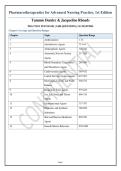
Pharmacotherapeutics for Advanced Nursing Practice, 1st Edition
Tammie Demler & Jacqueline Rhoads
PRACTICE TEST BANK | 1,000 QUESTIONS | 14 CHAPTERS
Chapter Coverage and Question Ranges
Chapter Topic Question Range
1 Antihistamines 1-72
2 Anti-Infective Agents 73-144
3 Antineoplastic Agents 145-216
4 Autonomic Nervous System 217-288
Agents
5 Blood Formation, Coagulation, 289-360
and Thrombosis Agents
6 Cardiovascular Agents 361-432
7 Central Nervous System Agents 433-503
8 Electrolytic, Caloric, and Water 504-574
Balance
9 Respiratory Tract Agents 575-645
10 Eye, Ear, Nose, and Throat 646-716
Agents
11 Gastrointestinal Agents 717-787
12 Hormones and Synthetic 788-858
Substitutes
13 Skin and Mucous Membrane 859-929
Agents
14 Smooth Muscle Relaxants 930-1000
Page 1
,Chapter 1: Antihistamines | Questions 1-72
1. In the context of this chapter, which statement best describes a drug's therapeutic effect?
A. The intended beneficial response
B. Any unexpected harmful response
C. The rate of renal excretion
D. The trade name assigned by a manufacturer
Correct Answer: A | Rationale: A therapeutic effect is the intended beneficial clinical response to a
medication. Option A is the best answer because “The intended beneficial response” directly applies the
concept, priority, or action tested in the stem. The other choices either address a different concept or are less
appropriate for this specific situation. Applying this principle helps the advanced-practice clinician connect
drug selection, monitoring, and patient safety.
2. A medication with a narrow therapeutic index generally requires which approach?
A. Automatic doubling of the first dose
B. Administration only by the intravenous route
C. Closer monitoring of response and, when indicated, serum levels
D. Less monitoring because toxicity is unlikely
Correct Answer: C | Rationale: A narrow therapeutic index means the effective and toxic concentrations
are relatively close, so careful monitoring is important. Option C is the best answer because “Closer
monitoring of response and, when indicated, serum levels” directly applies the concept, priority, or action
tested in the stem. The other choices either address a different concept or are less appropriate for this specific
situation. Applying this principle helps the advanced-practice clinician connect drug selection, monitoring,
and patient safety.
3. Which action most directly reduces preventable medication harm?
A. Verifying the patient, drug, dose, route, time, and relevant clinical data
B. Relying on memory rather than current references
C. Administering all medications before assessment
D. Using abbreviations whenever possible
Correct Answer: A | Rationale: Systematic verification and patient assessment are core safeguards against
medication errors. Option A is the best answer because “Verifying the patient, drug, dose, route, time, and
relevant clinical data” directly applies the concept, priority, or action tested in the stem. The other choices
either address a different concept or are less appropriate for this specific situation. Applying this principle
helps the advanced-practice clinician connect drug selection, monitoring, and patient safety.
Page 2
,4. In a clinical conference covering Antihistamines, the advanced nursing student is asked to choose
the best answer. Select the best-supported response. In the context of this chapter, which statement
best describes a drug's therapeutic effect?
A. Any unexpected harmful response
B. The trade name assigned by a manufacturer
C. The intended beneficial response
D. The rate of renal excretion
Correct Answer: C | Rationale: A therapeutic effect is the intended beneficial clinical response to a
medication. Option C is the best answer because “The intended beneficial response” directly applies the
concept, priority, or action tested in the stem. The other choices either address a different concept or are less
appropriate for this specific situation. Applying this principle helps the advanced-practice clinician connect
drug selection, monitoring, and patient safety.
5. During an applied-learning exercise on Antihistamines, the advanced practice nurse selects the best
response to this item. Identify the most appropriate answer. A medication with a narrow therapeutic
index generally requires which approach?
A. Automatic doubling of the first dose
B. Less monitoring because toxicity is unlikely
C. Administration only by the intravenous route
D. Closer monitoring of response and, when indicated, serum levels
Correct Answer: D | Rationale: A narrow therapeutic index means the effective and toxic concentrations
are relatively close, so careful monitoring is important. Option D is the best answer because “Closer
monitoring of response and, when indicated, serum levels” directly applies the concept, priority, or action
tested in the stem. The other choices either address a different concept or are less appropriate for this specific
situation. Applying this principle helps the advanced-practice clinician connect drug selection, monitoring,
and patient safety.
6. During a teaching session on Antihistamines, the nurse practitioner student is asked to select the
best answer. Choose the single best response. Which action most directly reduces preventable
medication harm?
A. Verifying the patient, drug, dose, route, time, and relevant clinical data
B. Relying on memory rather than current references
C. Administering all medications before assessment
D. Using abbreviations whenever possible
Correct Answer: A | Rationale: Systematic verification and patient assessment are core safeguards against
medication errors. Option A is the best answer because “Verifying the patient, drug, dose, route, time, and
Page 3
, relevant clinical data” directly applies the concept, priority, or action tested in the stem. The other choices
either address a different concept or are less appropriate for this specific situation. Applying this principle
helps the advanced-practice clinician connect drug selection, monitoring, and patient safety.
7. While preparing for a case involving Antihistamines, the prescriber reviews this question. Focus on
the safest and most clinically appropriate response. In the context of this chapter, which statement
best describes a drug's therapeutic effect?
A. The rate of renal excretion
B. Any unexpected harmful response
C. The intended beneficial response
D. The trade name assigned by a manufacturer
Correct Answer: C | Rationale: A therapeutic effect is the intended beneficial clinical response to a
medication. Option C is the best answer because “The intended beneficial response” directly applies the
concept, priority, or action tested in the stem. The other choices either address a different concept or are less
appropriate for this specific situation. Applying this principle helps the advanced-practice clinician connect
drug selection, monitoring, and patient safety.
8. In preparation for clinical decision-making involving Antihistamines, the advanced nursing student
reviews this question. Select the response that best fits the situation. A medication with a narrow
therapeutic index generally requires which approach?
A. Closer monitoring of response and, when indicated, serum levels
B. Automatic doubling of the first dose
C. Administration only by the intravenous route
D. Less monitoring because toxicity is unlikely
Correct Answer: A | Rationale: A narrow therapeutic index means the effective and toxic concentrations
are relatively close, so careful monitoring is important. Option A is the best answer because “Closer
monitoring of response and, when indicated, serum levels” directly applies the concept, priority, or action
tested in the stem. The other choices either address a different concept or are less appropriate for this specific
situation. Applying this principle helps the advanced-practice clinician connect drug selection, monitoring,
and patient safety.
9. While preparing for practice involving Antihistamines, the advanced practice nurse reviews the
following item. Apply the chapter concepts carefully. Which action most directly reduces preventable
medication harm?
A. Relying on memory rather than current references
B. Administering all medications before assessment
C. Using abbreviations whenever possible
Page 4
Tammie Demler & Jacqueline Rhoads
PRACTICE TEST BANK | 1,000 QUESTIONS | 14 CHAPTERS
Chapter Coverage and Question Ranges
Chapter Topic Question Range
1 Antihistamines 1-72
2 Anti-Infective Agents 73-144
3 Antineoplastic Agents 145-216
4 Autonomic Nervous System 217-288
Agents
5 Blood Formation, Coagulation, 289-360
and Thrombosis Agents
6 Cardiovascular Agents 361-432
7 Central Nervous System Agents 433-503
8 Electrolytic, Caloric, and Water 504-574
Balance
9 Respiratory Tract Agents 575-645
10 Eye, Ear, Nose, and Throat 646-716
Agents
11 Gastrointestinal Agents 717-787
12 Hormones and Synthetic 788-858
Substitutes
13 Skin and Mucous Membrane 859-929
Agents
14 Smooth Muscle Relaxants 930-1000
Page 1
,Chapter 1: Antihistamines | Questions 1-72
1. In the context of this chapter, which statement best describes a drug's therapeutic effect?
A. The intended beneficial response
B. Any unexpected harmful response
C. The rate of renal excretion
D. The trade name assigned by a manufacturer
Correct Answer: A | Rationale: A therapeutic effect is the intended beneficial clinical response to a
medication. Option A is the best answer because “The intended beneficial response” directly applies the
concept, priority, or action tested in the stem. The other choices either address a different concept or are less
appropriate for this specific situation. Applying this principle helps the advanced-practice clinician connect
drug selection, monitoring, and patient safety.
2. A medication with a narrow therapeutic index generally requires which approach?
A. Automatic doubling of the first dose
B. Administration only by the intravenous route
C. Closer monitoring of response and, when indicated, serum levels
D. Less monitoring because toxicity is unlikely
Correct Answer: C | Rationale: A narrow therapeutic index means the effective and toxic concentrations
are relatively close, so careful monitoring is important. Option C is the best answer because “Closer
monitoring of response and, when indicated, serum levels” directly applies the concept, priority, or action
tested in the stem. The other choices either address a different concept or are less appropriate for this specific
situation. Applying this principle helps the advanced-practice clinician connect drug selection, monitoring,
and patient safety.
3. Which action most directly reduces preventable medication harm?
A. Verifying the patient, drug, dose, route, time, and relevant clinical data
B. Relying on memory rather than current references
C. Administering all medications before assessment
D. Using abbreviations whenever possible
Correct Answer: A | Rationale: Systematic verification and patient assessment are core safeguards against
medication errors. Option A is the best answer because “Verifying the patient, drug, dose, route, time, and
relevant clinical data” directly applies the concept, priority, or action tested in the stem. The other choices
either address a different concept or are less appropriate for this specific situation. Applying this principle
helps the advanced-practice clinician connect drug selection, monitoring, and patient safety.
Page 2
,4. In a clinical conference covering Antihistamines, the advanced nursing student is asked to choose
the best answer. Select the best-supported response. In the context of this chapter, which statement
best describes a drug's therapeutic effect?
A. Any unexpected harmful response
B. The trade name assigned by a manufacturer
C. The intended beneficial response
D. The rate of renal excretion
Correct Answer: C | Rationale: A therapeutic effect is the intended beneficial clinical response to a
medication. Option C is the best answer because “The intended beneficial response” directly applies the
concept, priority, or action tested in the stem. The other choices either address a different concept or are less
appropriate for this specific situation. Applying this principle helps the advanced-practice clinician connect
drug selection, monitoring, and patient safety.
5. During an applied-learning exercise on Antihistamines, the advanced practice nurse selects the best
response to this item. Identify the most appropriate answer. A medication with a narrow therapeutic
index generally requires which approach?
A. Automatic doubling of the first dose
B. Less monitoring because toxicity is unlikely
C. Administration only by the intravenous route
D. Closer monitoring of response and, when indicated, serum levels
Correct Answer: D | Rationale: A narrow therapeutic index means the effective and toxic concentrations
are relatively close, so careful monitoring is important. Option D is the best answer because “Closer
monitoring of response and, when indicated, serum levels” directly applies the concept, priority, or action
tested in the stem. The other choices either address a different concept or are less appropriate for this specific
situation. Applying this principle helps the advanced-practice clinician connect drug selection, monitoring,
and patient safety.
6. During a teaching session on Antihistamines, the nurse practitioner student is asked to select the
best answer. Choose the single best response. Which action most directly reduces preventable
medication harm?
A. Verifying the patient, drug, dose, route, time, and relevant clinical data
B. Relying on memory rather than current references
C. Administering all medications before assessment
D. Using abbreviations whenever possible
Correct Answer: A | Rationale: Systematic verification and patient assessment are core safeguards against
medication errors. Option A is the best answer because “Verifying the patient, drug, dose, route, time, and
Page 3
, relevant clinical data” directly applies the concept, priority, or action tested in the stem. The other choices
either address a different concept or are less appropriate for this specific situation. Applying this principle
helps the advanced-practice clinician connect drug selection, monitoring, and patient safety.
7. While preparing for a case involving Antihistamines, the prescriber reviews this question. Focus on
the safest and most clinically appropriate response. In the context of this chapter, which statement
best describes a drug's therapeutic effect?
A. The rate of renal excretion
B. Any unexpected harmful response
C. The intended beneficial response
D. The trade name assigned by a manufacturer
Correct Answer: C | Rationale: A therapeutic effect is the intended beneficial clinical response to a
medication. Option C is the best answer because “The intended beneficial response” directly applies the
concept, priority, or action tested in the stem. The other choices either address a different concept or are less
appropriate for this specific situation. Applying this principle helps the advanced-practice clinician connect
drug selection, monitoring, and patient safety.
8. In preparation for clinical decision-making involving Antihistamines, the advanced nursing student
reviews this question. Select the response that best fits the situation. A medication with a narrow
therapeutic index generally requires which approach?
A. Closer monitoring of response and, when indicated, serum levels
B. Automatic doubling of the first dose
C. Administration only by the intravenous route
D. Less monitoring because toxicity is unlikely
Correct Answer: A | Rationale: A narrow therapeutic index means the effective and toxic concentrations
are relatively close, so careful monitoring is important. Option A is the best answer because “Closer
monitoring of response and, when indicated, serum levels” directly applies the concept, priority, or action
tested in the stem. The other choices either address a different concept or are less appropriate for this specific
situation. Applying this principle helps the advanced-practice clinician connect drug selection, monitoring,
and patient safety.
9. While preparing for practice involving Antihistamines, the advanced practice nurse reviews the
following item. Apply the chapter concepts carefully. Which action most directly reduces preventable
medication harm?
A. Relying on memory rather than current references
B. Administering all medications before assessment
C. Using abbreviations whenever possible
Page 4