
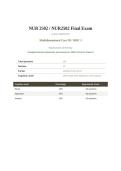
NUR 2502 / NUR2502 Final Exam
(Latest 2026/2027)
Multidimensional Care III / MDC 3
Rasmussen University
Complete Review Questions and Answers | 100% Correct | Grade A
Total Questions 100
Sections 10
Format Multiple Choice (A-D)
Cognitive Levels 25% Recall, 50% Application, 25% Analysis
Cognitive Level Percentage Approximate Count
Recall 25% ~25 questions
Application 50% ~50 questions
Analysis 25% ~25 questions
,Section 1: Cardiovascular Disorders (Hypertension, Heart Failure, CAD, Dysrhythmias,
& Valvular Disorders)
Q1: A nurse is caring for a client with hypertension whose blood pressure reads 188/122 mmHg. The
client reports a severe headache and blurred vision. Which intervention should the nurse anticipate
implementing first?
A. Administer oral antihypertensive medication and recheck BP in 30 minutes
B. **[CORRECT]** Prepare for IV antihypertensive therapy such as Labetalol or Nicardipine
C. Encourage the client to practice relaxation techniques and rest in a quiet room
D. Obtain a 12-lead ECG and schedule a follow-up appointment within one week
Correct Answer: B
Rationale: A blood pressure greater than 180/120 mmHg with signs of target organ damage (headache, blurred
vision) constitutes a hypertensive crisis requiring immediate IV antihypertensive therapy. Labetalol and
Nicardipine are first-line IV agents. Oral medications and relaxation techniques are insufficient for hypertensive
crisis. An ECG is important but does not take priority over lowering BP to prevent end-organ damage such as
stroke or myocardial infarction.
Q2: A nurse is providing discharge teaching to a client with heart failure. Which statement by the client
indicates an understanding of fluid management?
A. "I will drink at least 3 liters of water daily to stay hydrated."
B. "I will weigh myself once a month to track my weight."
C. "I will limit my fluid intake to 1.5 to 2 liters per day and weigh myself daily." **[CORRECT]**
D. "I will use salt substitutes to season my food instead of regular salt."
Correct Answer: C
Rationale: Heart failure discharge teaching includes fluid restriction of 1.5 to 2 L/day to prevent volume overload
and daily weight monitoring (a 2-3 lb gain indicates fluid retention requiring provider notification). Salt
substitutes are contraindicated because they often contain potassium, which can cause hyperkalemia when
combined with ACE inhibitors. Drinking 3 liters daily would worsen fluid overload, and monthly weighing is too
infrequent to detect fluid retention early.
Q3: A client with left-sided heart failure presents with dyspnea, orthopnea, and crackles bilaterally. Which
additional finding should the nurse expect?
A. Jugular venous distention and dependent peripheral edema
B. **[CORRECT]** An S3 gallop and a persistent dry cough
C. Hepatomegaly and ascites
D. Weight gain of 5 lbs over the past month with a normal respiratory rate
Correct Answer: B
Rationale: Left-sided heart failure causes pulmonary congestion leading to dyspnea, orthopnea, paroxysmal
nocturnal dyspnea (PND), crackles, and an S3 gallop. A persistent cough may develop from pulmonary fluid
backup. JVD, peripheral edema, hepatomegaly, and ascites are manifestations of right-sided heart failure due
to systemic venous congestion. Weight gain occurs in both but the respiratory findings are specific to left-sided
failure.
Q4: A nurse is assessing a client with right-sided heart failure. Which clinical manifestation is most
consistent with this condition?
A. Pink frothy sputum and bilateral crackles on auscultation
B. Impaired gas exchange and decreased oxygen saturation
NUR 2502 Final Exam Review | Page 2
, C. **[CORRECT]** Jugular venous distention and bilateral ankle edema
D. Paroxysmal nocturnal dyspnea and orthopnea
Correct Answer: C
Rationale: Right-sided heart failure results in systemic venous congestion, producing jugular venous distention
(JVD), peripheral edema (especially dependent/ankle edema), hepatomegaly, ascites, weight gain, and
anorexia. Pink frothy sputum, crackles, impaired gas exchange, PND, and orthopnea are all left-sided heart
failure manifestations caused by pulmonary congestion.
Q5: A client is taking Digoxin for heart failure. Before administering the scheduled dose, the nurse
assesses the apical pulse and finds it to be 56 bpm. Which action should the nurse take?
A. Administer the dose and reassess the heart rate in 30 minutes
B. **[CORRECT]** Hold the medication and notify the healthcare provider immediately
C. Give half the prescribed dose and monitor for signs of toxicity
D. Administer the dose with a glass of orange juice to increase potassium levels
Correct Answer: B
Rationale: Digoxin should be held if the apical pulse is below 60 bpm because of the risk of digoxin toxicity,
which causes bradycardia, nausea, vomiting, and visual changes (halos, yellow-green vision). The therapeutic
range is 0.8-2.0 ng/mL. Giving the dose, even at half strength, could worsen bradycardia. Orange juice has
minimal potassium and is not an appropriate intervention for this situation.
Q6: A nurse is reviewing the laboratory results of a client taking Digoxin. The serum digoxin level is 2.5
ng/mL. Which finding should the nurse anticipate?
A. Increased urine output and decreased blood pressure
B. **[CORRECT]** Nausea, vomiting, and visual disturbances such as halos around lights
C. Tachycardia and a bounding peripheral pulse
D. Hyperreflexia and muscle twitching
Correct Answer: B
Rationale: A digoxin level of 2.5 ng/mL exceeds the therapeutic range of 0.8-2.0 ng/mL and indicates digoxin
toxicity. Classic signs include nausea, vomiting, anorexia, visual disturbances (blurred vision, halos,
yellow-green color perception), and bradycardia (not tachycardia). Hyperreflexia and muscle twitching are
associated with electrolyte imbalances such as hypocalcemia or hypermagnesemia, not digoxin toxicity.
Q7: A nurse is teaching a client with heart failure about sodium restriction. Which instruction should the
nurse include?
A. "Limit your sodium intake to 4 grams per day."
B. "Consume no more than 2 grams of sodium per day." **[CORRECT]**
C. "Avoid adding salt at the table but you can use it freely in cooking."
D. "Replace table salt with sea salt, which has less sodium."
Correct Answer: B
Rationale: The recommended sodium restriction for heart failure clients is 2 grams per day to reduce fluid
retention and decrease cardiac workload. Four grams daily is excessive. Salt used in cooking contributes
equally to sodium intake as table salt, so limiting only table salt is insufficient. Sea salt contains the same
amount of sodium as table salt by weight and is not an acceptable substitute.
Q8: A client with aortic stenosis reports episodes of dizziness and fainting during physical activity. Which
additional manifestation should the nurse expect to find during assessment?
A. A diastolic decrescendo murmur heard at the left sternal border
B. A holosystolic murmur radiating to the axilla
NUR 2502 Final Exam Review | Page 3
(Latest 2026/2027)
Multidimensional Care III / MDC 3
Rasmussen University
Complete Review Questions and Answers | 100% Correct | Grade A
Total Questions 100
Sections 10
Format Multiple Choice (A-D)
Cognitive Levels 25% Recall, 50% Application, 25% Analysis
Cognitive Level Percentage Approximate Count
Recall 25% ~25 questions
Application 50% ~50 questions
Analysis 25% ~25 questions
,Section 1: Cardiovascular Disorders (Hypertension, Heart Failure, CAD, Dysrhythmias,
& Valvular Disorders)
Q1: A nurse is caring for a client with hypertension whose blood pressure reads 188/122 mmHg. The
client reports a severe headache and blurred vision. Which intervention should the nurse anticipate
implementing first?
A. Administer oral antihypertensive medication and recheck BP in 30 minutes
B. **[CORRECT]** Prepare for IV antihypertensive therapy such as Labetalol or Nicardipine
C. Encourage the client to practice relaxation techniques and rest in a quiet room
D. Obtain a 12-lead ECG and schedule a follow-up appointment within one week
Correct Answer: B
Rationale: A blood pressure greater than 180/120 mmHg with signs of target organ damage (headache, blurred
vision) constitutes a hypertensive crisis requiring immediate IV antihypertensive therapy. Labetalol and
Nicardipine are first-line IV agents. Oral medications and relaxation techniques are insufficient for hypertensive
crisis. An ECG is important but does not take priority over lowering BP to prevent end-organ damage such as
stroke or myocardial infarction.
Q2: A nurse is providing discharge teaching to a client with heart failure. Which statement by the client
indicates an understanding of fluid management?
A. "I will drink at least 3 liters of water daily to stay hydrated."
B. "I will weigh myself once a month to track my weight."
C. "I will limit my fluid intake to 1.5 to 2 liters per day and weigh myself daily." **[CORRECT]**
D. "I will use salt substitutes to season my food instead of regular salt."
Correct Answer: C
Rationale: Heart failure discharge teaching includes fluid restriction of 1.5 to 2 L/day to prevent volume overload
and daily weight monitoring (a 2-3 lb gain indicates fluid retention requiring provider notification). Salt
substitutes are contraindicated because they often contain potassium, which can cause hyperkalemia when
combined with ACE inhibitors. Drinking 3 liters daily would worsen fluid overload, and monthly weighing is too
infrequent to detect fluid retention early.
Q3: A client with left-sided heart failure presents with dyspnea, orthopnea, and crackles bilaterally. Which
additional finding should the nurse expect?
A. Jugular venous distention and dependent peripheral edema
B. **[CORRECT]** An S3 gallop and a persistent dry cough
C. Hepatomegaly and ascites
D. Weight gain of 5 lbs over the past month with a normal respiratory rate
Correct Answer: B
Rationale: Left-sided heart failure causes pulmonary congestion leading to dyspnea, orthopnea, paroxysmal
nocturnal dyspnea (PND), crackles, and an S3 gallop. A persistent cough may develop from pulmonary fluid
backup. JVD, peripheral edema, hepatomegaly, and ascites are manifestations of right-sided heart failure due
to systemic venous congestion. Weight gain occurs in both but the respiratory findings are specific to left-sided
failure.
Q4: A nurse is assessing a client with right-sided heart failure. Which clinical manifestation is most
consistent with this condition?
A. Pink frothy sputum and bilateral crackles on auscultation
B. Impaired gas exchange and decreased oxygen saturation
NUR 2502 Final Exam Review | Page 2
, C. **[CORRECT]** Jugular venous distention and bilateral ankle edema
D. Paroxysmal nocturnal dyspnea and orthopnea
Correct Answer: C
Rationale: Right-sided heart failure results in systemic venous congestion, producing jugular venous distention
(JVD), peripheral edema (especially dependent/ankle edema), hepatomegaly, ascites, weight gain, and
anorexia. Pink frothy sputum, crackles, impaired gas exchange, PND, and orthopnea are all left-sided heart
failure manifestations caused by pulmonary congestion.
Q5: A client is taking Digoxin for heart failure. Before administering the scheduled dose, the nurse
assesses the apical pulse and finds it to be 56 bpm. Which action should the nurse take?
A. Administer the dose and reassess the heart rate in 30 minutes
B. **[CORRECT]** Hold the medication and notify the healthcare provider immediately
C. Give half the prescribed dose and monitor for signs of toxicity
D. Administer the dose with a glass of orange juice to increase potassium levels
Correct Answer: B
Rationale: Digoxin should be held if the apical pulse is below 60 bpm because of the risk of digoxin toxicity,
which causes bradycardia, nausea, vomiting, and visual changes (halos, yellow-green vision). The therapeutic
range is 0.8-2.0 ng/mL. Giving the dose, even at half strength, could worsen bradycardia. Orange juice has
minimal potassium and is not an appropriate intervention for this situation.
Q6: A nurse is reviewing the laboratory results of a client taking Digoxin. The serum digoxin level is 2.5
ng/mL. Which finding should the nurse anticipate?
A. Increased urine output and decreased blood pressure
B. **[CORRECT]** Nausea, vomiting, and visual disturbances such as halos around lights
C. Tachycardia and a bounding peripheral pulse
D. Hyperreflexia and muscle twitching
Correct Answer: B
Rationale: A digoxin level of 2.5 ng/mL exceeds the therapeutic range of 0.8-2.0 ng/mL and indicates digoxin
toxicity. Classic signs include nausea, vomiting, anorexia, visual disturbances (blurred vision, halos,
yellow-green color perception), and bradycardia (not tachycardia). Hyperreflexia and muscle twitching are
associated with electrolyte imbalances such as hypocalcemia or hypermagnesemia, not digoxin toxicity.
Q7: A nurse is teaching a client with heart failure about sodium restriction. Which instruction should the
nurse include?
A. "Limit your sodium intake to 4 grams per day."
B. "Consume no more than 2 grams of sodium per day." **[CORRECT]**
C. "Avoid adding salt at the table but you can use it freely in cooking."
D. "Replace table salt with sea salt, which has less sodium."
Correct Answer: B
Rationale: The recommended sodium restriction for heart failure clients is 2 grams per day to reduce fluid
retention and decrease cardiac workload. Four grams daily is excessive. Salt used in cooking contributes
equally to sodium intake as table salt, so limiting only table salt is insufficient. Sea salt contains the same
amount of sodium as table salt by weight and is not an acceptable substitute.
Q8: A client with aortic stenosis reports episodes of dizziness and fainting during physical activity. Which
additional manifestation should the nurse expect to find during assessment?
A. A diastolic decrescendo murmur heard at the left sternal border
B. A holosystolic murmur radiating to the axilla
NUR 2502 Final Exam Review | Page 3

