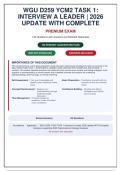
WGU D259 YCM2 TASK 1:
INTERVIEW A LEADER | 2026
UPDATE WITH COMPLETE
PRENIUM EXAM
140 Questions with Answers and Detailed Rationales
100 PERCENT GUARANTEED PASS
INSTANT DOWNLOAD ANSWERS INCLUDED
IMPORTANCE OF THIS DOCUMENT
This comprehensive examination preparation guide has been meticulously developed to help you succeed in the
WGU D259 YCM2 TASK 1: INTERVIEW A LEADER | 2026 UPDATE WITH COMPLETE SOLUTIONS.. It
contains 140 carefully selected questions that reflect the most current exam content and testing strategies. Each
question is accompanied by a correct answer and a detailed rationale that explains the underlying
pathophysiology, pharmacology, or clinical reasoning.
Self-Assessment – Test your knowledge and Exam Preparation – Familiarize yourself with the
identify areas requiring further question format and content
study areas
Concept Reinforcement – Deepen your Confidence Building – Develop test-taking
understanding through strategies and reduce
evidence-based exam anxiety
rationales
Time Management – Practice answering
questions under simulated
exam conditions
Review Summary 140 Questions
Foundations - Application - WGU D259 YCM2 TASK 1 Interview A Leader 2026 Update WITH Complete
Solutions Leadership AND Organizational Strategy Graduate
All answers with rationales
,Table of Contents
Content Area Questions Key Topics
Leadership Theories AND 1-24 Leader, Approach, Interview, Likely, Change
Styles
Organizational Culture AND 25-48 Leader, Interview, Model, Directly, Describes
Change Management
Strategic Planning AND 49-72 Leader, Interview, Model, Framework, Approach
Decision Making
Communication AND 73-96 Leader, Interview, Approach, Model, Change
Collaboration
Ethical AND Legal 97-120 Leader, Approach, Interview, Culture, Conflict
Considerations
Quality Improvement AND 121-140 Leader, Interview, Directly, Describes, Change
Patient Safety
TOTAL 140 All questions include answers and detailed rationales
,Section A - Leadership Theories AND Styles
Q1.
In a multinational corporation, a leader uses a transformational approach to inspire a
newly merged team. Which synthesis of leadership theories best explains the potential
conflict between the leader's idealized influence and the team's need for individualized
consideration?
A. Transformational leadership's focus on B. Idealized influence and individualized
collective identity undermines individualized consideration are mutually reinforcing, so no
consideration, creating a paradox that conflict arises in practice.
requires situational adaptation.
C. The conflict is best resolved by shifting to D. The leader should prioritize idealized
transactional leadership to clarify influence and delegate individualized
expectations and rewards. consideration to team leads.
Correct: A - Transformational leadership's focus on collective identity undermines
individualized consideration, creating a paradox that requires situational adaptation.
Rationale:Transformational leadership balances collective vision (idealized influence) with
personal development (individualized consideration). In a merger, these can conflict as
unifying goals may overshadow individual needs. The correct answer identifies this paradox
and the need for situational adaptation. Option B ignores the tension, C misapplies
transactional leadership, and D abdicates a core leadership responsibility.
Q2.
A leader faces an ethical dilemma where following the organization's policy would harm a
stakeholder group. Using a deontological framework, which decision path is most
appropriate?
A. Weigh the consequences to determine B. Follow the policy strictly because duties
the greatest good for the greatest number. and rules define ethical action.
C. Choose the action that best aligns with D. Consult the organization's code of ethics
the leader's personal virtues. and follow its explicit guidelines.
Correct: B - Follow the policy strictly because duties and rules define ethical action.
Rationale:Deontology emphasizes duty and adherence to rules regardless of consequences.
Thus, following policy is the deontological choice. A is consequentialist, C is virtue ethics, and
D may incorporate multiple frameworks but does not specifically reflect deontology.
Q3.
During a rapid organizational restructuring, a leader applies Kotter's 8-step model. Which
step, if omitted, is most likely to cause the change effort to fail despite strong urgency and
Page 3
, Section A - Leadership Theories AND Styles
a clear vision?
A. Forming a powerful guiding coalition. B. Creating short-term wins.
C. Anchoring new approaches in the culture. D. Empowering broad-based action.
Correct: C - Anchoring new approaches in the culture.
Rationale:Kotter's model emphasizes that without anchoring changes in culture, they are not
sustainable; even successful short-term wins can be reversed. While all steps are important,
anchoring is the final step that institutionalizes change. Omitting it means the change is not
durable, leading to long-term failure.
Q4.
A leader needs to communicate a complex strategic pivot to a diverse workforce. Which
communication strategy best ensures both understanding and buy-in?
A. Use a single, detailed email to ensure B. Conduct town halls with Q&A sessions
consistency and accuracy. and follow-up written summaries.
C. Delegate communication to line D. Create a video message and share it on
managers to personalize the message. the intranet for on-demand viewing.
Correct: B - Conduct town halls with Q&A sessions and follow-up written summaries.
Rationale:Town halls allow two-way communication, addressing concerns and building trust,
while written summaries reinforce the message. A single email lacks engagement, delegation
may lead to inconsistent messaging, and a video alone is passive. The combination of live
interaction and documentation is most effective.
Q5.
In a systems thinking approach, a leader identifies that increasing production speed
increases defect rates. Which intervention addresses the underlying systemic structure
rather than a symptomatic fix?
A. Increase quality inspections to catch B. Redesign the production process to
defects. balance speed and quality.
C. Incentivize workers to be more careful. D. Reduce production speed to a
conservative level.
Correct: B - Redesign the production process to balance speed and quality.
Rationale:Systems thinking focuses on underlying structures and feedback loops.
Redesigning the process addresses the root cause of the trade-off, whereas inspections,
incentives, or speed reduction are symptomatic fixes that do not change the fundamental
structure. B is the only option that alters the system's design.
Page 4
INTERVIEW A LEADER | 2026
UPDATE WITH COMPLETE
PRENIUM EXAM
140 Questions with Answers and Detailed Rationales
100 PERCENT GUARANTEED PASS
INSTANT DOWNLOAD ANSWERS INCLUDED
IMPORTANCE OF THIS DOCUMENT
This comprehensive examination preparation guide has been meticulously developed to help you succeed in the
WGU D259 YCM2 TASK 1: INTERVIEW A LEADER | 2026 UPDATE WITH COMPLETE SOLUTIONS.. It
contains 140 carefully selected questions that reflect the most current exam content and testing strategies. Each
question is accompanied by a correct answer and a detailed rationale that explains the underlying
pathophysiology, pharmacology, or clinical reasoning.
Self-Assessment – Test your knowledge and Exam Preparation – Familiarize yourself with the
identify areas requiring further question format and content
study areas
Concept Reinforcement – Deepen your Confidence Building – Develop test-taking
understanding through strategies and reduce
evidence-based exam anxiety
rationales
Time Management – Practice answering
questions under simulated
exam conditions
Review Summary 140 Questions
Foundations - Application - WGU D259 YCM2 TASK 1 Interview A Leader 2026 Update WITH Complete
Solutions Leadership AND Organizational Strategy Graduate
All answers with rationales
,Table of Contents
Content Area Questions Key Topics
Leadership Theories AND 1-24 Leader, Approach, Interview, Likely, Change
Styles
Organizational Culture AND 25-48 Leader, Interview, Model, Directly, Describes
Change Management
Strategic Planning AND 49-72 Leader, Interview, Model, Framework, Approach
Decision Making
Communication AND 73-96 Leader, Interview, Approach, Model, Change
Collaboration
Ethical AND Legal 97-120 Leader, Approach, Interview, Culture, Conflict
Considerations
Quality Improvement AND 121-140 Leader, Interview, Directly, Describes, Change
Patient Safety
TOTAL 140 All questions include answers and detailed rationales
,Section A - Leadership Theories AND Styles
Q1.
In a multinational corporation, a leader uses a transformational approach to inspire a
newly merged team. Which synthesis of leadership theories best explains the potential
conflict between the leader's idealized influence and the team's need for individualized
consideration?
A. Transformational leadership's focus on B. Idealized influence and individualized
collective identity undermines individualized consideration are mutually reinforcing, so no
consideration, creating a paradox that conflict arises in practice.
requires situational adaptation.
C. The conflict is best resolved by shifting to D. The leader should prioritize idealized
transactional leadership to clarify influence and delegate individualized
expectations and rewards. consideration to team leads.
Correct: A - Transformational leadership's focus on collective identity undermines
individualized consideration, creating a paradox that requires situational adaptation.
Rationale:Transformational leadership balances collective vision (idealized influence) with
personal development (individualized consideration). In a merger, these can conflict as
unifying goals may overshadow individual needs. The correct answer identifies this paradox
and the need for situational adaptation. Option B ignores the tension, C misapplies
transactional leadership, and D abdicates a core leadership responsibility.
Q2.
A leader faces an ethical dilemma where following the organization's policy would harm a
stakeholder group. Using a deontological framework, which decision path is most
appropriate?
A. Weigh the consequences to determine B. Follow the policy strictly because duties
the greatest good for the greatest number. and rules define ethical action.
C. Choose the action that best aligns with D. Consult the organization's code of ethics
the leader's personal virtues. and follow its explicit guidelines.
Correct: B - Follow the policy strictly because duties and rules define ethical action.
Rationale:Deontology emphasizes duty and adherence to rules regardless of consequences.
Thus, following policy is the deontological choice. A is consequentialist, C is virtue ethics, and
D may incorporate multiple frameworks but does not specifically reflect deontology.
Q3.
During a rapid organizational restructuring, a leader applies Kotter's 8-step model. Which
step, if omitted, is most likely to cause the change effort to fail despite strong urgency and
Page 3
, Section A - Leadership Theories AND Styles
a clear vision?
A. Forming a powerful guiding coalition. B. Creating short-term wins.
C. Anchoring new approaches in the culture. D. Empowering broad-based action.
Correct: C - Anchoring new approaches in the culture.
Rationale:Kotter's model emphasizes that without anchoring changes in culture, they are not
sustainable; even successful short-term wins can be reversed. While all steps are important,
anchoring is the final step that institutionalizes change. Omitting it means the change is not
durable, leading to long-term failure.
Q4.
A leader needs to communicate a complex strategic pivot to a diverse workforce. Which
communication strategy best ensures both understanding and buy-in?
A. Use a single, detailed email to ensure B. Conduct town halls with Q&A sessions
consistency and accuracy. and follow-up written summaries.
C. Delegate communication to line D. Create a video message and share it on
managers to personalize the message. the intranet for on-demand viewing.
Correct: B - Conduct town halls with Q&A sessions and follow-up written summaries.
Rationale:Town halls allow two-way communication, addressing concerns and building trust,
while written summaries reinforce the message. A single email lacks engagement, delegation
may lead to inconsistent messaging, and a video alone is passive. The combination of live
interaction and documentation is most effective.
Q5.
In a systems thinking approach, a leader identifies that increasing production speed
increases defect rates. Which intervention addresses the underlying systemic structure
rather than a symptomatic fix?
A. Increase quality inspections to catch B. Redesign the production process to
defects. balance speed and quality.
C. Incentivize workers to be more careful. D. Reduce production speed to a
conservative level.
Correct: B - Redesign the production process to balance speed and quality.
Rationale:Systems thinking focuses on underlying structures and feedback loops.
Redesigning the process addresses the root cause of the trade-off, whereas inspections,
incentives, or speed reduction are symptomatic fixes that do not change the fundamental
structure. B is the only option that alters the system's design.
Page 4