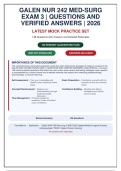
GALEN NUR 242 MED-SURG
EXAM 3 | QUESTIONS AND
VERIFIED ANSWERS | 2026
LATEST MOCK PRACTICE SET
148 Questions with Answers and Detailed Rationales
100 PERCENT GUARANTEED PASS
INSTANT DOWNLOAD ANSWERS INCLUDED
IMPORTANCE OF THIS DOCUMENT
This comprehensive examination preparation guide has been meticulously developed to help you succeed in the
GALEN NUR 242 MED-SURG EXAM 3 | QUESTIONS AND VERIFIED ANSWERS | 2026 UPDATE.. It contains
148 carefully selected questions that reflect the most current exam content and testing strategies. Each question
is accompanied by a correct answer and a detailed rationale that explains the underlying pathophysiology,
pharmacology, or clinical reasoning.
Self-Assessment – Test your knowledge and Exam Preparation – Familiarize yourself with the
identify areas requiring further question format and content
study areas
Concept Reinforcement – Deepen your Confidence Building – Develop test-taking
understanding through strategies and reduce
evidence-based exam anxiety
rationales
Time Management – Practice answering
questions under simulated
exam conditions
Review Summary 148 Questions
Foundations - Application - Galen NUR 242 Med-surg 3 AND 2026 Update Medical-surgical Nursing
Undergraduate YEAR 3 Upper Division Nursing
All answers with rationales
,Table of Contents
Content Area Questions Key Topics
Cardiovascular Disorders 1-25 Acute, Finding, Disease, Kidney, Syndrome
Respiratory Disorders 26-50 Finding, Develops, Acute, Kidney, Pulmonary
Renal AND Urinary Disorders 51-75 Finding, Indicates, Acute, Appropriate, Laboratory
Gastrointestinal Disorders 76-100 Acute, Medication, Appropriate, Kidney, Intervention
Endocrine Disorders 101-125 Finding, Acute, Intervention, Kidney, Develops
Neurological Disorders 126-148 Finding, Acute, Intervention, Kidney, Disease
TOTAL 148 All questions include answers and detailed rationales
,Section A - Cardiovascular Disorders
Q1.
In a patient with acute decompensated heart failure and concurrent chronic kidney
disease, which combination of findings would most likely indicate the need for
ultrafiltration rather than standard diuretic therapy?
A. Elevated B-type natriuretic peptide and B. Diuretic resistance with persistent fluid
pulmonary edema on chest x-ray overload despite high-dose loop diuretics
C. Jugular venous distention and peripheral D. Reduced ejection fraction and elevated
edema with normal serum creatinine troponin levels
Correct: B - Diuretic resistance with persistent fluid overload despite high-dose loop
diuretics
Rationale:Ultrafiltration is indicated for patients with diuretic resistance, where high-dose loop
diuretics fail to relieve congestion. Elevated BNP and pulmonary edema (A) are common but
not specific indications for ultrafiltration. Normal renal function (C) and reduced EF with
troponin elevation (D) do not directly address diuretic resistance.
Q2.
A patient on a continuous heparin infusion for acute coronary syndrome develops a
sudden drop in platelet count from 200,000 to 50,000/µL. Which antibody test is most
specific for confirming the diagnosis of heparin-induced thrombocytopenia (HIT)?
A. Anti-platelet factor 4/heparin antibody B. Serotonin release assay (SRA)
ELISA
C. Complete blood count with manual D. Peripheral blood smear for schistocytes
platelet review
Correct: B - Serotonin release assay (SRA)
Rationale:The serotonin release assay (SRA) is the functional gold standard for HIT,
measuring platelet activation in response to heparin-PF4 complexes. The ELISA (A) is
sensitive but less specific. Platelet count (C) and schistocytes (D) are supportive or indicate
other conditions like TTP.
Q3.
Which assessment finding in a patient with syndrome of inappropriate antidiuretic
hormone (SIADH) would indicate that the condition is becoming more severe and requires
immediate intervention?
A. Serum sodium of 130 mEq/L with mild B. Urine osmolality of 600 mOsm/kg with
headache serum osmolality of 260 mOsm/kg
Page 3
, Section A - Cardiovascular Disorders
C. Serum sodium of 118 mEq/L with D. Weight gain of 2 kg over 24 hours without
confusion and seizures edema
Correct: C - Serum sodium of 118 mEq/L with confusion and seizures
Rationale:Severe hyponatremia (<120 mEq/L) with neurologic symptoms like confusion and
seizures indicates cerebral edema and requires emergent treatment. A sodium of 130 (A) is
mild; urine/serum osmolality (B) supports diagnosis but not severity. Weight gain (D) is a sign
of fluid retention but not acute severity.
Q4.
A patient with cirrhosis and ascites is being evaluated for spontaneous bacterial
peritonitis (SBP). Which ascitic fluid analysis result is most consistent with this
diagnosis?
A. Polymorphonuclear (PMN) count of 150 B. PMN count of 500 cells/mm³ and positive
cells/mm³ and negative culture culture for E. coli
C. PMN count of 100 cells/mm³ and total D. PMN count of 50 cells/mm³ and
protein of 2.5 g/dL serum-ascites albumin gradient of 1.5 g/dL
Correct: B - PMN count of 500 cells/mm³ and positive culture for E. coli
Rationale:SBP is diagnosed with an ascitic PMN count "e250 cells/mm³, often with a positive
monomicrobial culture. A PMN count of 500 with E. coli is diagnostic. PMN <250 (A, C, D) do
not meet criteria; SAAG >1.1 indicates portal hypertension, not infection.
Q5.
A patient with chronic kidney disease stage 4 is prescribed an ACE inhibitor and a loop
diuretic. Which laboratory finding would warrant withholding the ACE inhibitor and
notifying the provider?
A. Serum potassium of 5.2 mEq/L B. Serum creatinine increase of 0.3 mg/dL
from baseline
C. Blood urea nitrogen of 40 mg/dL D. Glomerular filtration rate of 25
mL/min/1.73m²
Correct: A - Serum potassium of 5.2 mEq/L
Rationale:Hyperkalemia (K+ >5.0) is a serious side effect of ACE inhibitors, especially in
CKD. An increase in creatinine up to 30% is acceptable and not a reason to withhold. BUN
elevation and GFR of 25 are common in CKD and not immediate contraindications.
Q6.
Which ventilatory parameter change would indicate the need to adjust the ventilator
settings in a patient with acute respiratory distress syndrome (ARDS) who is on
Page 4
EXAM 3 | QUESTIONS AND
VERIFIED ANSWERS | 2026
LATEST MOCK PRACTICE SET
148 Questions with Answers and Detailed Rationales
100 PERCENT GUARANTEED PASS
INSTANT DOWNLOAD ANSWERS INCLUDED
IMPORTANCE OF THIS DOCUMENT
This comprehensive examination preparation guide has been meticulously developed to help you succeed in the
GALEN NUR 242 MED-SURG EXAM 3 | QUESTIONS AND VERIFIED ANSWERS | 2026 UPDATE.. It contains
148 carefully selected questions that reflect the most current exam content and testing strategies. Each question
is accompanied by a correct answer and a detailed rationale that explains the underlying pathophysiology,
pharmacology, or clinical reasoning.
Self-Assessment – Test your knowledge and Exam Preparation – Familiarize yourself with the
identify areas requiring further question format and content
study areas
Concept Reinforcement – Deepen your Confidence Building – Develop test-taking
understanding through strategies and reduce
evidence-based exam anxiety
rationales
Time Management – Practice answering
questions under simulated
exam conditions
Review Summary 148 Questions
Foundations - Application - Galen NUR 242 Med-surg 3 AND 2026 Update Medical-surgical Nursing
Undergraduate YEAR 3 Upper Division Nursing
All answers with rationales
,Table of Contents
Content Area Questions Key Topics
Cardiovascular Disorders 1-25 Acute, Finding, Disease, Kidney, Syndrome
Respiratory Disorders 26-50 Finding, Develops, Acute, Kidney, Pulmonary
Renal AND Urinary Disorders 51-75 Finding, Indicates, Acute, Appropriate, Laboratory
Gastrointestinal Disorders 76-100 Acute, Medication, Appropriate, Kidney, Intervention
Endocrine Disorders 101-125 Finding, Acute, Intervention, Kidney, Develops
Neurological Disorders 126-148 Finding, Acute, Intervention, Kidney, Disease
TOTAL 148 All questions include answers and detailed rationales
,Section A - Cardiovascular Disorders
Q1.
In a patient with acute decompensated heart failure and concurrent chronic kidney
disease, which combination of findings would most likely indicate the need for
ultrafiltration rather than standard diuretic therapy?
A. Elevated B-type natriuretic peptide and B. Diuretic resistance with persistent fluid
pulmonary edema on chest x-ray overload despite high-dose loop diuretics
C. Jugular venous distention and peripheral D. Reduced ejection fraction and elevated
edema with normal serum creatinine troponin levels
Correct: B - Diuretic resistance with persistent fluid overload despite high-dose loop
diuretics
Rationale:Ultrafiltration is indicated for patients with diuretic resistance, where high-dose loop
diuretics fail to relieve congestion. Elevated BNP and pulmonary edema (A) are common but
not specific indications for ultrafiltration. Normal renal function (C) and reduced EF with
troponin elevation (D) do not directly address diuretic resistance.
Q2.
A patient on a continuous heparin infusion for acute coronary syndrome develops a
sudden drop in platelet count from 200,000 to 50,000/µL. Which antibody test is most
specific for confirming the diagnosis of heparin-induced thrombocytopenia (HIT)?
A. Anti-platelet factor 4/heparin antibody B. Serotonin release assay (SRA)
ELISA
C. Complete blood count with manual D. Peripheral blood smear for schistocytes
platelet review
Correct: B - Serotonin release assay (SRA)
Rationale:The serotonin release assay (SRA) is the functional gold standard for HIT,
measuring platelet activation in response to heparin-PF4 complexes. The ELISA (A) is
sensitive but less specific. Platelet count (C) and schistocytes (D) are supportive or indicate
other conditions like TTP.
Q3.
Which assessment finding in a patient with syndrome of inappropriate antidiuretic
hormone (SIADH) would indicate that the condition is becoming more severe and requires
immediate intervention?
A. Serum sodium of 130 mEq/L with mild B. Urine osmolality of 600 mOsm/kg with
headache serum osmolality of 260 mOsm/kg
Page 3
, Section A - Cardiovascular Disorders
C. Serum sodium of 118 mEq/L with D. Weight gain of 2 kg over 24 hours without
confusion and seizures edema
Correct: C - Serum sodium of 118 mEq/L with confusion and seizures
Rationale:Severe hyponatremia (<120 mEq/L) with neurologic symptoms like confusion and
seizures indicates cerebral edema and requires emergent treatment. A sodium of 130 (A) is
mild; urine/serum osmolality (B) supports diagnosis but not severity. Weight gain (D) is a sign
of fluid retention but not acute severity.
Q4.
A patient with cirrhosis and ascites is being evaluated for spontaneous bacterial
peritonitis (SBP). Which ascitic fluid analysis result is most consistent with this
diagnosis?
A. Polymorphonuclear (PMN) count of 150 B. PMN count of 500 cells/mm³ and positive
cells/mm³ and negative culture culture for E. coli
C. PMN count of 100 cells/mm³ and total D. PMN count of 50 cells/mm³ and
protein of 2.5 g/dL serum-ascites albumin gradient of 1.5 g/dL
Correct: B - PMN count of 500 cells/mm³ and positive culture for E. coli
Rationale:SBP is diagnosed with an ascitic PMN count "e250 cells/mm³, often with a positive
monomicrobial culture. A PMN count of 500 with E. coli is diagnostic. PMN <250 (A, C, D) do
not meet criteria; SAAG >1.1 indicates portal hypertension, not infection.
Q5.
A patient with chronic kidney disease stage 4 is prescribed an ACE inhibitor and a loop
diuretic. Which laboratory finding would warrant withholding the ACE inhibitor and
notifying the provider?
A. Serum potassium of 5.2 mEq/L B. Serum creatinine increase of 0.3 mg/dL
from baseline
C. Blood urea nitrogen of 40 mg/dL D. Glomerular filtration rate of 25
mL/min/1.73m²
Correct: A - Serum potassium of 5.2 mEq/L
Rationale:Hyperkalemia (K+ >5.0) is a serious side effect of ACE inhibitors, especially in
CKD. An increase in creatinine up to 30% is acceptable and not a reason to withhold. BUN
elevation and GFR of 25 are common in CKD and not immediate contraindications.
Q6.
Which ventilatory parameter change would indicate the need to adjust the ventilator
settings in a patient with acute respiratory distress syndrome (ARDS) who is on
Page 4