CHAPTER 6
Development of Language and
Symbol Use
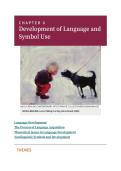
NICOLA BEALING, Lucas Talking to a Dog (oil on board, 2006)
Language Development
The Process of Language Acquisition
Theoretical Issues in Language Development
Nonlinguistic Symbols and Development
THEMES
, NATURE AND NURTURE
THE ACTIVE CHILD
THE SOCIOCULTURAL CONTEXT
INDIVIDUAL DIFFERENCES
“Woof.” (age 11 months, referring to neighbour’s dog)
“Hot.” (age 14 months, referring to stove, matches, candles, light reflecting
off shiny surfaces, and so forth)
“Read me.” (age 21 months, requesting a story)
“Why I don’t have a dog?” (age 27 months)
“If you give me some candy, I’ll be your best friend. I’ll be your two best friends.”
(age 48 months)
“Granna, we went to Cagoshin [Chicago].” (age 65 months)
“It was, like, ya know, totally awesome, dude.” (age 192 months)
Each of these utterances, produced by a single child acquiring
English (Clore, 1981), reflects the capacity that most sets humans
apart from other species: the creative and flexible use of symbols. We
use symbols to represent our thoughts, feelings, and knowledge, and
to communicate them to others. Our ability to use symbols frees us
from the present, enabling us to learn from the generations of people
who preceded us and to contemplate the future. In this chapter, we
will focus primarily on the acquisition of the preeminent human
symbol system: language. We will then discuss children’s
understanding and creation of nonlinguistic symbols, such as
pictures and models.
symbols
systems for representing our thoughts, feelings, and knowledge, and for communicating
,them to other people
The dominant theme will once again be the relative contributions of
nature and nurture. The sociocultural context is another prominent
theme as we examine language acquisition across cultures and
communities. A third recurring theme is individual differences, both in
terms of the range of typical language development and as we
consider developmental language disorders. The active child theme
also puts in repeated appearances, as infants and young children
learn to use symbols to communicate.
, These children are intent on mastering one of the many important symbol systems in
the modern world.
Development of Language and
Symbol Use
NICOLA BEALING, Lucas Talking to a Dog (oil on board, 2006)
Language Development
The Process of Language Acquisition
Theoretical Issues in Language Development
Nonlinguistic Symbols and Development
THEMES
, NATURE AND NURTURE
THE ACTIVE CHILD
THE SOCIOCULTURAL CONTEXT
INDIVIDUAL DIFFERENCES
“Woof.” (age 11 months, referring to neighbour’s dog)
“Hot.” (age 14 months, referring to stove, matches, candles, light reflecting
off shiny surfaces, and so forth)
“Read me.” (age 21 months, requesting a story)
“Why I don’t have a dog?” (age 27 months)
“If you give me some candy, I’ll be your best friend. I’ll be your two best friends.”
(age 48 months)
“Granna, we went to Cagoshin [Chicago].” (age 65 months)
“It was, like, ya know, totally awesome, dude.” (age 192 months)
Each of these utterances, produced by a single child acquiring
English (Clore, 1981), reflects the capacity that most sets humans
apart from other species: the creative and flexible use of symbols. We
use symbols to represent our thoughts, feelings, and knowledge, and
to communicate them to others. Our ability to use symbols frees us
from the present, enabling us to learn from the generations of people
who preceded us and to contemplate the future. In this chapter, we
will focus primarily on the acquisition of the preeminent human
symbol system: language. We will then discuss children’s
understanding and creation of nonlinguistic symbols, such as
pictures and models.
symbols
systems for representing our thoughts, feelings, and knowledge, and for communicating
,them to other people
The dominant theme will once again be the relative contributions of
nature and nurture. The sociocultural context is another prominent
theme as we examine language acquisition across cultures and
communities. A third recurring theme is individual differences, both in
terms of the range of typical language development and as we
consider developmental language disorders. The active child theme
also puts in repeated appearances, as infants and young children
learn to use symbols to communicate.
, These children are intent on mastering one of the many important symbol systems in
the modern world.