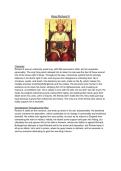
King Richard II
Character
Richard II was an extremely weak king, with little persuasion skills, and an unpopular
personality. The only thing which allowed him to retain his role was the fear of those around
him of the divine right of kings. Throughout the play, it becomes evident that he strongly
believes in his divine right to rule, and anyone who disagrees is criticising God. He is
immature, poetic, and lavish. His decisions are rash, made on the fly, which makes him
multiple enemies including Bullingbrook and the nobles. He becomes more human to the
audience as he loses his power, stripping him of his righteousness, and revealing an
insecure, unconfident man. He is clearly in love with his wife, but we don’t see her much. He
treats his subjects extremely poorly, taxing them highly, and stealing their lands upon their
death (even his uncle, John of Gaunt). His friends don’t really like him, they really just stay
loyal because it gives them influences and riches. The only one of his friends who seems to
really support him is Aumerle.
Development Throughout the Play
Richard II starts as the monarch, and ends up alone in his cell, assassinated. His banished
cousin oversees his deposition, which contributes to his change in personality and emotional
downfall. His nobles turn against him very quickly, as soon as he returns to England from
overseeing the wars in Ireland. Initially, he retains some support and goes into hiding, but
ultimately the only person left on his side is Aumerle, whose own father is against Richard.
Bullingbrook attempts to treat Richard well in his arrest and deposition, but Richard sees it
all as an attack. He’s sent to prison, where he goes insane in solitude, until an assassin is
sent by someone attempting to gain the new king’s favour.
, Loyalty is a key theme in ‘Richard II’. Initially, the characters are loyal to Richard out of
religious reverence for the divine right of kings - not because of familial relations, or quality
leadership. The lack of familial loyalty in Richard II is then highlighted when Bullingbrook
begins to gain power, as the various relatives of Richard and Bullingbrook switch sides,
siding with the more powerful of the two. This displays the conflict between familial and
political loyalty in Richard II, as characters ignore family in favour of power and stability.
Loyalty through the Divine Right of Kings
The people of England accept Richard as their King, despite his poor decision making, due
to his role as “God’s anointed minister”, God’s regent on Earth. This means that few criticise
his rulership, becoming flattering sycophants in order to hold power, or out of belief that
“heaven guards the right” to Richard’s kingship. However, this loyalty proves both
counterproductive and fickle. Sycophantic, unearned loyalty, like exhibited by Bushy, Bagot,
and Green, means that Richard is unaware of the brewing discontent in his country.
Shakespeare highlights the extent of this discontent, to which Richard is thoroughly blind, by
having common people - gardeners - criticise England; “our sea-walled garden, the whole
land, is full of weeds”. Richard’s ignorance of this growing discontent contributes towards the
ease at which he is deposed, as very quickly Bullingbrook gains the support of the
peasantry, with Richard even lamenting how popular Bullingbrook is with the commonfolk.
Unearned loyalty also proves fickle in Richard II, as those who’d previously supported
Richard, like Lord Northumberland, Lord Ross, and Henry Percy, quickly switch allegiance
when Bullingbrook proves powerful. The loyalty that Richard enjoys through the divine right
of kings is tenuous and counterproductive.
Familial vs Political Loyalty
There is tension in Richard II between familial and political loyalty, particularly in the
characters of John of Gaunt (the Duke of Lancaster) and the Duke of York (Edmund of
Langley). Initially, Gaunt supports Richard, accepting Richard’s rule despite some discontent
when Richard banishes Bullingbrook for “six winters”, when Gaunt believes that he will soon
die. When Richard responds that Gaunt has time, Gaunt replies; “not a minute, king, that
thou canst give.” However, when he is dying, Gaunt vocally criticises Richard’s rulership, as
well as giving an omen that “thou diest, though I the sicker be”. Richard does not heed
Gaunt’s warnings that “thou liest in reputation sick”, contributing to his lack of preparedness
for Bullingbrook’s return. Gaunt prioritises political loyalty over loyalty to his nephew; he
accuses Richard of being “landlord of England art thou now, not king”. Similarly, the Duke of
York switches from Richard’s side to Bullingbrook’s. Both of these men are of equal relation
to him (nephews), so his switch is less valuable when examining the tension between
familial and political loyalty. However, his true aim throughout the play is stability and
prosperity for England, regardless of whom he must support. Thus, despite his initial
disagreements that “I am no traitor’s uncle”, he switches sides to Bullingbrook. Later, he
sacrifices loyalty to his son, Aumerle, in exchange for loyalty to the new King Henry IV, as his
son is implicated in the “Oxford plot”. Despite the Duchess of York’s pleas that “is he not
thine own?” York still criminalises him, bringing him before Bullingbrook for justice, and to
protect Bullingbrook from the Oxford Plot. Here, it is evident that York’s political loyalty to the
individual whom he believed would bring the most stability and prosperity to England clearly
overpowers his loyalty to his son and wife.
Character
Richard II was an extremely weak king, with little persuasion skills, and an unpopular
personality. The only thing which allowed him to retain his role was the fear of those around
him of the divine right of kings. Throughout the play, it becomes evident that he strongly
believes in his divine right to rule, and anyone who disagrees is criticising God. He is
immature, poetic, and lavish. His decisions are rash, made on the fly, which makes him
multiple enemies including Bullingbrook and the nobles. He becomes more human to the
audience as he loses his power, stripping him of his righteousness, and revealing an
insecure, unconfident man. He is clearly in love with his wife, but we don’t see her much. He
treats his subjects extremely poorly, taxing them highly, and stealing their lands upon their
death (even his uncle, John of Gaunt). His friends don’t really like him, they really just stay
loyal because it gives them influences and riches. The only one of his friends who seems to
really support him is Aumerle.
Development Throughout the Play
Richard II starts as the monarch, and ends up alone in his cell, assassinated. His banished
cousin oversees his deposition, which contributes to his change in personality and emotional
downfall. His nobles turn against him very quickly, as soon as he returns to England from
overseeing the wars in Ireland. Initially, he retains some support and goes into hiding, but
ultimately the only person left on his side is Aumerle, whose own father is against Richard.
Bullingbrook attempts to treat Richard well in his arrest and deposition, but Richard sees it
all as an attack. He’s sent to prison, where he goes insane in solitude, until an assassin is
sent by someone attempting to gain the new king’s favour.
, Loyalty is a key theme in ‘Richard II’. Initially, the characters are loyal to Richard out of
religious reverence for the divine right of kings - not because of familial relations, or quality
leadership. The lack of familial loyalty in Richard II is then highlighted when Bullingbrook
begins to gain power, as the various relatives of Richard and Bullingbrook switch sides,
siding with the more powerful of the two. This displays the conflict between familial and
political loyalty in Richard II, as characters ignore family in favour of power and stability.
Loyalty through the Divine Right of Kings
The people of England accept Richard as their King, despite his poor decision making, due
to his role as “God’s anointed minister”, God’s regent on Earth. This means that few criticise
his rulership, becoming flattering sycophants in order to hold power, or out of belief that
“heaven guards the right” to Richard’s kingship. However, this loyalty proves both
counterproductive and fickle. Sycophantic, unearned loyalty, like exhibited by Bushy, Bagot,
and Green, means that Richard is unaware of the brewing discontent in his country.
Shakespeare highlights the extent of this discontent, to which Richard is thoroughly blind, by
having common people - gardeners - criticise England; “our sea-walled garden, the whole
land, is full of weeds”. Richard’s ignorance of this growing discontent contributes towards the
ease at which he is deposed, as very quickly Bullingbrook gains the support of the
peasantry, with Richard even lamenting how popular Bullingbrook is with the commonfolk.
Unearned loyalty also proves fickle in Richard II, as those who’d previously supported
Richard, like Lord Northumberland, Lord Ross, and Henry Percy, quickly switch allegiance
when Bullingbrook proves powerful. The loyalty that Richard enjoys through the divine right
of kings is tenuous and counterproductive.
Familial vs Political Loyalty
There is tension in Richard II between familial and political loyalty, particularly in the
characters of John of Gaunt (the Duke of Lancaster) and the Duke of York (Edmund of
Langley). Initially, Gaunt supports Richard, accepting Richard’s rule despite some discontent
when Richard banishes Bullingbrook for “six winters”, when Gaunt believes that he will soon
die. When Richard responds that Gaunt has time, Gaunt replies; “not a minute, king, that
thou canst give.” However, when he is dying, Gaunt vocally criticises Richard’s rulership, as
well as giving an omen that “thou diest, though I the sicker be”. Richard does not heed
Gaunt’s warnings that “thou liest in reputation sick”, contributing to his lack of preparedness
for Bullingbrook’s return. Gaunt prioritises political loyalty over loyalty to his nephew; he
accuses Richard of being “landlord of England art thou now, not king”. Similarly, the Duke of
York switches from Richard’s side to Bullingbrook’s. Both of these men are of equal relation
to him (nephews), so his switch is less valuable when examining the tension between
familial and political loyalty. However, his true aim throughout the play is stability and
prosperity for England, regardless of whom he must support. Thus, despite his initial
disagreements that “I am no traitor’s uncle”, he switches sides to Bullingbrook. Later, he
sacrifices loyalty to his son, Aumerle, in exchange for loyalty to the new King Henry IV, as his
son is implicated in the “Oxford plot”. Despite the Duchess of York’s pleas that “is he not
thine own?” York still criminalises him, bringing him before Bullingbrook for justice, and to
protect Bullingbrook from the Oxford Plot. Here, it is evident that York’s political loyalty to the
individual whom he believed would bring the most stability and prosperity to England clearly
overpowers his loyalty to his son and wife.