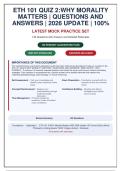
ETH 101 QUIZ 2:WHY MORALITY
MATTERS | QUESTIONS AND
ANSWERS | 2026 UPDATE | 100%
LATEST MOCK PRACTICE SET
140 Questions with Answers and Detailed Rationales
100 PERCENT GUARANTEED PASS
INSTANT DOWNLOAD ANSWERS INCLUDED
IMPORTANCE OF THIS DOCUMENT
This comprehensive examination preparation guide has been meticulously developed to help you succeed in the
ETH 101 QUIZ 2:WHY MORALITY MATTERS | QUESTIONS AND ANSWERS | 2026 UPDATE | 100%
CORRECT.. It contains 140 carefully selected questions that reflect the most current exam content and testing
strategies. Each question is accompanied by a correct answer and a detailed rationale that explains the
underlying pathophysiology, pharmacology, or clinical reasoning.
Self-Assessment – Test your knowledge and Exam Preparation – Familiarize yourself with the
identify areas requiring further question format and content
study areas
Concept Reinforcement – Deepen your Confidence Building – Develop test-taking
understanding through strategies and reduce
evidence-based exam anxiety
rationales
Time Management – Practice answering
questions under simulated
exam conditions
Review Summary 140 Questions
Foundations - Application - ETH 101 2 WHY Morality Matters AND 2026 Update 100 Correct Ethics Moral
Philosophy Undergraduate YEAR 3 Upper-division / Graduate
All answers with rationales
,Table of Contents
Content Area Questions Key Topics
Introduction TO Ethics AND 1-24 Moral, Theory, Metaethical, Explains, Position
Moral Reasoning
THE Nature OF Morality AND 25-48 Moral, Argues, Ethics, Context, Psychology
Ethical Relativism
Moral Obligations AND 49-72 Moral, Directly, Study, Illustrates, Framework
Duties
Consequentialist Theories 73-96 Moral, Lives, Argues, Policy, Principle
Utilitarianism
Deontological Theories 97-120 Moral, Theory, Ethical, Against, Researcher
Kantian Ethics
Virtue Ethics AND Character 121-140 Moral, According, Theory, Ethical, Framework
TOTAL 140 All questions include answers and detailed rationales
,Section A - Introduction TO Ethics AND Moral Reasoning
Q1.
Which metaethical position best explains the practical authority of moral reasons,
according to the latest debate between internalism and externalism about moral
motivation?
A. Externalism, because moral reasons are B. Internalism, because moral judgments
objective and bind regardless of an agent's necessarily motivate rational agents
desires
C. Amoralism, because moral reasons lack D. Error theory, because moral reasons are
practical authority without sanctions merely projections of emotion
Correct: B - Internalism, because moral judgments necessarily motivate rational agents
Rationale:Internalism holds that moral judgments necessarily provide reasons for action,
explaining morality's practical grip. Externalism allows for amoralists, weakening the
necessity. Error theory denies objective reasons, and amoralism rejects authority, so B best
captures the practical authority.
Q2.
In a high-stakes corporate decision, a manager uses cost-benefit analysis that maximizes
shareholder profit but violates a core stakeholder trust. Which ethical theory would most
likely condemn this action as inherently wrong, regardless of outcomes?
A. Rule utilitarianism B. Kantian deontology
C. Ethical egoism D. Act utilitarianism
Correct: B - Kantian deontology
Rationale:Kantian deontology emphasizes duties and respect for persons, judging actions by
their intrinsic rightness, not consequences. Utilitarian approaches (A, D) and egoism (C) are
consequentialist or self-interested, potentially permitting the action if net benefits are positive.
Q3.
Recent research in moral psychology suggests that people often make moral judgments
based on quick intuitive responses, then rationalize them. Which philosophical position is
most challenged by this 'dual-process' account?
A. Moral rationalism B. Moral sentimentalism
C. Moral relativism D. Moral pluralism
Correct: A - Moral rationalism
Page 3
, Section A - Introduction TO Ethics AND Moral Reasoning
Rationale: Moral rationalism holds that moral judgments are products of reason, but
dual-process findings show intuition often precedes reasoning, undermining rationalism.
Sentimentalism (B) aligns with emotion, relativism (C) and pluralism (D) are not directly about
the source of judgment.
Q4.
A philosopher argues that moral progress is impossible because moral truths are relative
to cultural frameworks. Which metaethical view does this argument presuppose?
A. Moral objectivism B. Moral skepticism
C. Moral relativism D. Moral realism
Correct: C - Moral relativism
Rationale:Moral relativism denies universal truths, making cross-cultural moral progress
incoherent. Objectivism (A) and realism (D) would allow progress toward objective truths.
Skepticism (B) doubts moral knowledge, but the argument specifically relies on relativity.
Q5.
In a medical ethics consultation, a patient refuses a life-saving blood transfusion on
religious grounds. A utilitarian physician argues that overriding the refusal saves the
patient's life and benefits the family. Which principle is most directly violated by
overriding the refusal?
A. Beneficence B. Non-maleficence
C. Autonomy D. Justice
Correct: C - Autonomy
Rationale:Autonomy respects a patient's right to self-determination, including refusal of
treatment. Overriding it violates autonomy, even if beneficence (A) and non-maleficence (B)
are served. Justice (D) concerns fair distribution, not individual refusal.
Q6.
Which of the following best describes the 'is-ought problem' and its implication for moral
justification?
A. It shows that moral facts can be derived B. It shows that no set of descriptive
from descriptive facts premises can entail a normative conclusion
without a normative premise
C. It proves that moral judgments are D. It demonstrates that moral reasons are
meaningless subjective
Correct: B - It shows that no set of descriptive premises can entail a normative conclusion
Page 4
MATTERS | QUESTIONS AND
ANSWERS | 2026 UPDATE | 100%
LATEST MOCK PRACTICE SET
140 Questions with Answers and Detailed Rationales
100 PERCENT GUARANTEED PASS
INSTANT DOWNLOAD ANSWERS INCLUDED
IMPORTANCE OF THIS DOCUMENT
This comprehensive examination preparation guide has been meticulously developed to help you succeed in the
ETH 101 QUIZ 2:WHY MORALITY MATTERS | QUESTIONS AND ANSWERS | 2026 UPDATE | 100%
CORRECT.. It contains 140 carefully selected questions that reflect the most current exam content and testing
strategies. Each question is accompanied by a correct answer and a detailed rationale that explains the
underlying pathophysiology, pharmacology, or clinical reasoning.
Self-Assessment – Test your knowledge and Exam Preparation – Familiarize yourself with the
identify areas requiring further question format and content
study areas
Concept Reinforcement – Deepen your Confidence Building – Develop test-taking
understanding through strategies and reduce
evidence-based exam anxiety
rationales
Time Management – Practice answering
questions under simulated
exam conditions
Review Summary 140 Questions
Foundations - Application - ETH 101 2 WHY Morality Matters AND 2026 Update 100 Correct Ethics Moral
Philosophy Undergraduate YEAR 3 Upper-division / Graduate
All answers with rationales
,Table of Contents
Content Area Questions Key Topics
Introduction TO Ethics AND 1-24 Moral, Theory, Metaethical, Explains, Position
Moral Reasoning
THE Nature OF Morality AND 25-48 Moral, Argues, Ethics, Context, Psychology
Ethical Relativism
Moral Obligations AND 49-72 Moral, Directly, Study, Illustrates, Framework
Duties
Consequentialist Theories 73-96 Moral, Lives, Argues, Policy, Principle
Utilitarianism
Deontological Theories 97-120 Moral, Theory, Ethical, Against, Researcher
Kantian Ethics
Virtue Ethics AND Character 121-140 Moral, According, Theory, Ethical, Framework
TOTAL 140 All questions include answers and detailed rationales
,Section A - Introduction TO Ethics AND Moral Reasoning
Q1.
Which metaethical position best explains the practical authority of moral reasons,
according to the latest debate between internalism and externalism about moral
motivation?
A. Externalism, because moral reasons are B. Internalism, because moral judgments
objective and bind regardless of an agent's necessarily motivate rational agents
desires
C. Amoralism, because moral reasons lack D. Error theory, because moral reasons are
practical authority without sanctions merely projections of emotion
Correct: B - Internalism, because moral judgments necessarily motivate rational agents
Rationale:Internalism holds that moral judgments necessarily provide reasons for action,
explaining morality's practical grip. Externalism allows for amoralists, weakening the
necessity. Error theory denies objective reasons, and amoralism rejects authority, so B best
captures the practical authority.
Q2.
In a high-stakes corporate decision, a manager uses cost-benefit analysis that maximizes
shareholder profit but violates a core stakeholder trust. Which ethical theory would most
likely condemn this action as inherently wrong, regardless of outcomes?
A. Rule utilitarianism B. Kantian deontology
C. Ethical egoism D. Act utilitarianism
Correct: B - Kantian deontology
Rationale:Kantian deontology emphasizes duties and respect for persons, judging actions by
their intrinsic rightness, not consequences. Utilitarian approaches (A, D) and egoism (C) are
consequentialist or self-interested, potentially permitting the action if net benefits are positive.
Q3.
Recent research in moral psychology suggests that people often make moral judgments
based on quick intuitive responses, then rationalize them. Which philosophical position is
most challenged by this 'dual-process' account?
A. Moral rationalism B. Moral sentimentalism
C. Moral relativism D. Moral pluralism
Correct: A - Moral rationalism
Page 3
, Section A - Introduction TO Ethics AND Moral Reasoning
Rationale: Moral rationalism holds that moral judgments are products of reason, but
dual-process findings show intuition often precedes reasoning, undermining rationalism.
Sentimentalism (B) aligns with emotion, relativism (C) and pluralism (D) are not directly about
the source of judgment.
Q4.
A philosopher argues that moral progress is impossible because moral truths are relative
to cultural frameworks. Which metaethical view does this argument presuppose?
A. Moral objectivism B. Moral skepticism
C. Moral relativism D. Moral realism
Correct: C - Moral relativism
Rationale:Moral relativism denies universal truths, making cross-cultural moral progress
incoherent. Objectivism (A) and realism (D) would allow progress toward objective truths.
Skepticism (B) doubts moral knowledge, but the argument specifically relies on relativity.
Q5.
In a medical ethics consultation, a patient refuses a life-saving blood transfusion on
religious grounds. A utilitarian physician argues that overriding the refusal saves the
patient's life and benefits the family. Which principle is most directly violated by
overriding the refusal?
A. Beneficence B. Non-maleficence
C. Autonomy D. Justice
Correct: C - Autonomy
Rationale:Autonomy respects a patient's right to self-determination, including refusal of
treatment. Overriding it violates autonomy, even if beneficence (A) and non-maleficence (B)
are served. Justice (D) concerns fair distribution, not individual refusal.
Q6.
Which of the following best describes the 'is-ought problem' and its implication for moral
justification?
A. It shows that moral facts can be derived B. It shows that no set of descriptive
from descriptive facts premises can entail a normative conclusion
without a normative premise
C. It proves that moral judgments are D. It demonstrates that moral reasons are
meaningless subjective
Correct: B - It shows that no set of descriptive premises can entail a normative conclusion
Page 4