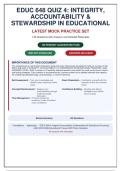
EDUC 648 QUIZ 4: INTEGRITY,
ACCOUNTABILITY &
STEWARDSHIP IN EDUCATIONAL
LATEST MOCK PRACTICE SET
140 Questions with Answers and Detailed Rationales
100 PERCENT GUARANTEED PASS
INSTANT DOWNLOAD ANSWERS INCLUDED
IMPORTANCE OF THIS DOCUMENT
This comprehensive examination preparation guide has been meticulously developed to help you succeed in the
EDUC 648 QUIZ 4: INTEGRITY, ACCOUNTABILITY & STEWARDSHIP IN EDUCATIONAL FINANCING | AND
ANSWERS | 30/30 | 2026. It contains 140 carefully selected questions that reflect the most current exam content
and testing strategies. Each question is accompanied by a correct answer and a detailed rationale that explains
the underlying pathophysiology, pharmacology, or clinical reasoning.
Self-Assessment – Test your knowledge and Exam Preparation – Familiarize yourself with the
identify areas requiring further question format and content
study areas
Concept Reinforcement – Deepen your Confidence Building – Develop test-taking
understanding through strategies and reduce
evidence-based exam anxiety
rationales
Time Management – Practice answering
questions under simulated
exam conditions
Review Summary 140 Questions
Foundations - Application - EDUC 648 4 Integrity Accountability & Stewardship IN Educational Financing
AND 30/30 2026 Educational Finance AND Policy Graduate
All answers with rationales
,Table of Contents
Content Area Questions Key Topics
Foundations OF Educational 1-24 School, District, Federal, Funds, Funding
Finance
Legal AND Ethical 25-48 School, District, Funds, State, Considering
Frameworks IN Education
Financial Integrity AND Fraud 49-72 School, Financial, Principle, District S, Federal
Prevention
Accountability Systems AND 73-96 Funding, School, District, University S, Higher
Reporting
Stewardship OF Public 97-120 School, District, State, University S, Reported
Funds
Budgeting AND Resource 121-140 School, District, Funds, Federal, Balance
Allocation
TOTAL 140 All questions include answers and detailed rationales
,Section A - Foundations OF Educational Finance
Q1.
A university's endowment manager directs a portion of the portfolio to a fund managed by
a board member's spouse. Which ethical principle is most directly compromised?
A. Prudent investor rule B. Duty of loyalty
C. Stewardship theory D. Public trust doctrine
Correct: B - Duty of loyalty
Rationale:The duty of loyalty requires fiduciaries to act in the best interest of the institution,
avoiding conflicts of interest. The scenario presents a clear conflict, compromising loyalty. The
prudent investor rule concerns investment prudence, not conflict. Stewardship theory and
public trust doctrine are broader concepts.
Q2.
In a school district, the finance officer discovers that a vendor overbilled by $50,000. The
officer is instructed to ignore it. Which internal control component is most lacking?
A. Risk assessment B. Control activities
C. Information and communication D. Monitoring activities
Correct: D - Monitoring activities
Rationale:Monitoring activities involve ongoing evaluations to ensure controls operate as
intended. Ignoring an overbilling indicates a failure to monitor transactions. Risk assessment
would identify potential overbilling, but the issue is the lack of follow-up. Control activities are
procedures, and communication is about sharing info.
Q3.
Which scenario best illustrates the application of the 'prudent person rule' in educational
endowment management?
A. Investing in high-risk startups to B. Diversifying investments across asset
maximize returns classes to balance risk
C. Concentrating investments in a single D. Avoiding all investments to preserve
blue-chip stock principal
Correct: B - Diversifying investments across asset classes to balance risk
Page 3
, Section A - Foundations OF Educational Finance
Rationale: The prudent person rule requires fiduciaries to act with care, skill, and caution,
typically involving diversification to manage risk. Diversifying across asset classes aligns with
this principle. High-risk startups are speculative, concentration increases risk, and avoiding all
investments is overly conservative and not prudent.
Q4.
A charter school receives federal funds and uses them for religious instruction. Which
federal law is most directly violated?
A. Every Student Succeeds Act (ESSA) B. Title IX
C. Uniform Grant Guidance (2 CFR Part D. Family Educational Rights and Privacy
200) Act (FERPA)
Correct: C - Uniform Grant Guidance (2 CFR Part 200)
Rationale:Uniform Grant Guidance mandates that federal funds be used for allowable
purposes and prohibits supplanting. Using funds for religious instruction is unallowable. ESSA
governs K-12 programs, Title IX addresses sex discrimination, and FERPA protects student
privacy.
Q5.
When a university's financial statements are audited, which type of opinion indicates the
most serious concern about the accuracy of financial reporting?
A. Unmodified opinion B. Qualified opinion
C. Adverse opinion D. Disclaimer of opinion
Correct: C - Adverse opinion
Rationale:An adverse opinion states that financial statements are materially misstated and
do not conform to GAAP, indicating the most serious concern. A qualified opinion notes
exceptions but not pervasive misstatements. A disclaimer indicates inability to obtain
sufficient evidence, not necessarily misstatements.
Q6.
A school district's superintendent proposes to use capital improvement funds to cover
teacher salaries. What is the most likely consequence?
A. No consequence if the budget is B. A violation of fiscal accountability and
balanced potential legal action
C. Automatic approval by the state D. Increased flexibility in resource allocation
education department
Correct: B - A violation of fiscal accountability and potential legal action
Page 4
ACCOUNTABILITY &
STEWARDSHIP IN EDUCATIONAL
LATEST MOCK PRACTICE SET
140 Questions with Answers and Detailed Rationales
100 PERCENT GUARANTEED PASS
INSTANT DOWNLOAD ANSWERS INCLUDED
IMPORTANCE OF THIS DOCUMENT
This comprehensive examination preparation guide has been meticulously developed to help you succeed in the
EDUC 648 QUIZ 4: INTEGRITY, ACCOUNTABILITY & STEWARDSHIP IN EDUCATIONAL FINANCING | AND
ANSWERS | 30/30 | 2026. It contains 140 carefully selected questions that reflect the most current exam content
and testing strategies. Each question is accompanied by a correct answer and a detailed rationale that explains
the underlying pathophysiology, pharmacology, or clinical reasoning.
Self-Assessment – Test your knowledge and Exam Preparation – Familiarize yourself with the
identify areas requiring further question format and content
study areas
Concept Reinforcement – Deepen your Confidence Building – Develop test-taking
understanding through strategies and reduce
evidence-based exam anxiety
rationales
Time Management – Practice answering
questions under simulated
exam conditions
Review Summary 140 Questions
Foundations - Application - EDUC 648 4 Integrity Accountability & Stewardship IN Educational Financing
AND 30/30 2026 Educational Finance AND Policy Graduate
All answers with rationales
,Table of Contents
Content Area Questions Key Topics
Foundations OF Educational 1-24 School, District, Federal, Funds, Funding
Finance
Legal AND Ethical 25-48 School, District, Funds, State, Considering
Frameworks IN Education
Financial Integrity AND Fraud 49-72 School, Financial, Principle, District S, Federal
Prevention
Accountability Systems AND 73-96 Funding, School, District, University S, Higher
Reporting
Stewardship OF Public 97-120 School, District, State, University S, Reported
Funds
Budgeting AND Resource 121-140 School, District, Funds, Federal, Balance
Allocation
TOTAL 140 All questions include answers and detailed rationales
,Section A - Foundations OF Educational Finance
Q1.
A university's endowment manager directs a portion of the portfolio to a fund managed by
a board member's spouse. Which ethical principle is most directly compromised?
A. Prudent investor rule B. Duty of loyalty
C. Stewardship theory D. Public trust doctrine
Correct: B - Duty of loyalty
Rationale:The duty of loyalty requires fiduciaries to act in the best interest of the institution,
avoiding conflicts of interest. The scenario presents a clear conflict, compromising loyalty. The
prudent investor rule concerns investment prudence, not conflict. Stewardship theory and
public trust doctrine are broader concepts.
Q2.
In a school district, the finance officer discovers that a vendor overbilled by $50,000. The
officer is instructed to ignore it. Which internal control component is most lacking?
A. Risk assessment B. Control activities
C. Information and communication D. Monitoring activities
Correct: D - Monitoring activities
Rationale:Monitoring activities involve ongoing evaluations to ensure controls operate as
intended. Ignoring an overbilling indicates a failure to monitor transactions. Risk assessment
would identify potential overbilling, but the issue is the lack of follow-up. Control activities are
procedures, and communication is about sharing info.
Q3.
Which scenario best illustrates the application of the 'prudent person rule' in educational
endowment management?
A. Investing in high-risk startups to B. Diversifying investments across asset
maximize returns classes to balance risk
C. Concentrating investments in a single D. Avoiding all investments to preserve
blue-chip stock principal
Correct: B - Diversifying investments across asset classes to balance risk
Page 3
, Section A - Foundations OF Educational Finance
Rationale: The prudent person rule requires fiduciaries to act with care, skill, and caution,
typically involving diversification to manage risk. Diversifying across asset classes aligns with
this principle. High-risk startups are speculative, concentration increases risk, and avoiding all
investments is overly conservative and not prudent.
Q4.
A charter school receives federal funds and uses them for religious instruction. Which
federal law is most directly violated?
A. Every Student Succeeds Act (ESSA) B. Title IX
C. Uniform Grant Guidance (2 CFR Part D. Family Educational Rights and Privacy
200) Act (FERPA)
Correct: C - Uniform Grant Guidance (2 CFR Part 200)
Rationale:Uniform Grant Guidance mandates that federal funds be used for allowable
purposes and prohibits supplanting. Using funds for religious instruction is unallowable. ESSA
governs K-12 programs, Title IX addresses sex discrimination, and FERPA protects student
privacy.
Q5.
When a university's financial statements are audited, which type of opinion indicates the
most serious concern about the accuracy of financial reporting?
A. Unmodified opinion B. Qualified opinion
C. Adverse opinion D. Disclaimer of opinion
Correct: C - Adverse opinion
Rationale:An adverse opinion states that financial statements are materially misstated and
do not conform to GAAP, indicating the most serious concern. A qualified opinion notes
exceptions but not pervasive misstatements. A disclaimer indicates inability to obtain
sufficient evidence, not necessarily misstatements.
Q6.
A school district's superintendent proposes to use capital improvement funds to cover
teacher salaries. What is the most likely consequence?
A. No consequence if the budget is B. A violation of fiscal accountability and
balanced potential legal action
C. Automatic approval by the state D. Increased flexibility in resource allocation
education department
Correct: B - A violation of fiscal accountability and potential legal action
Page 4