
• ¿Documento equivocado? Cámbialo gratis
  • Escrito por estudiantes que aprobaron
  • Inmediatamente disponible después del pago
  • Leer en línea o como PDF
Vender
¿Dónde estudias?
Tu idioma
Document preview thumbnail
Vista previa 4 fuera de 567 páginas
Examen

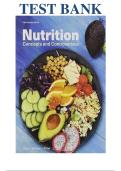
Test Bank for Nutrition: Concepts and Controversies, 5th Canadian Edition by Sizer, Whitney & Piché – Complete Chapters 1–15 with 500+ Verified Questions, Answers & Detailed Rationales for Nutrition, Nursing & Health Sciences Exams (2025–2027)

Document preview thumbnail
Vista previa 4 fuera de 567 páginas

Ace your nutrition exams with this comprehensive test bank for "Nutrition: Concepts and Controversies, 5th Canadian Edition" by Frances Sizer, Ellie Whitney, and Leonard Piché. Published by Nelson Education (ISBN-13: 978-0176892869), this essential academic resource is specifically designed for nutrition, dietetics, nursing, health sciences, and kinesiology students who need to master the science of nutrition and its application to health. This test bank features over 500 exam-style questions spanning all 15 chapters of the 5th Canadian Edition, with verified correct answers and detailed rationales that explain both correct and incorrect options. The content is updated for the 2025–2027 academic cycle and includes multiple question formats such as multiple-choice, true/false, short-answer, and case-based questions designed to mirror real exam structures used in colleges and universities. The test bank covers foundational nutrition science through current dietary controversies, helping students strengthen conceptual understanding, apply nutrition knowledge critically, and improve academic performance. What's Included: Over 500 practice questions covering all major nutrition topics Verified correct answers with detailed rationales Chapter-by-chapter organization covering all 15 chapters of the 5th Canadian Edition Multiple question formats including multiple-choice, true/false, short-answer, and case-based questions Comprehensive coverage of nutrition science, dietary guidelines, and current controversies Comprehensive coverage across all 15 chapters: Chapter 1: Food Choices and Human Health – Food selection factors, the six classes of nutrients, energy from food, nutrition and health promotion, and understanding nutrition information Chapter 2: Nutrition Tools – Standards and Guidelines – Dietary Reference Intakes (DRIs), Daily Values, food labels, and Canada's Food Guide Chapter 3: The Remarkable Body – Digestion, absorption, transport, and metabolism of nutrients; the body's physiological systems Chapter 4: The Carbohydrates: Sugar, Starch, Glycogen, and Fibre – Carbohydrate types, digestion, health effects, and dietary recommendations Chapter 5: The Lipids: Fats, Oils, Phospholipids, and Sterols – Lipid types, functions, digestion, and cardiovascular health Chapter 6: The Proteins and Amino Acids – Protein structure, functions, digestion, and dietary protein needs Chapter 7: The Vitamins – Fat-soluble and water-soluble vitamins, functions, deficiencies, and toxicities Chapter 8: Water and Minerals – Fluid balance, major minerals, trace minerals, and electrolyte balance Chapter 9: Energy Balance and Healthy Body Weight – Energy balance, weight management, obesity, and eating disorders Chapter 10: Nutrients, Physical Activity, and the Body's Responses – Nutrition for exercise, athletic performance, and physical activity Chapter 11: Chronic Disease Prevention – Diet and cardiovascular disease, diabetes, cancer, and metabolic health Chapter 12: Food Safety and Food Biotechnology – Foodborne illness prevention, food additives, GMOs, and organic food Chapter 13: Life Cycle Nutrition – Mother and Infant – Pregnancy, lactation, and infant nutrition Chapter 14: Child, Teen, and Older Adult – Nutrition across the lifespan, childhood, adolescence, and aging Chapter 15: Hunger and the Global Environment – Global food issues, food insecurity, and sustainability Sample Questions Include: How many Calories does 1 gram of alcohol provide? – Answer: 7 – Alcohol provides 7 kcal per gram, making it a source of energy but not an essential nutrient. How many Calories are in a food containing 20 grams of carbohydrate, 8 grams protein, and 5 grams of fat? – Answer: 157 Calories – Calculation: (20g carbs × 4 kcal) + (8g protein × 4 kcal) + (5g fat × 9 kcal) = 80 + 32 + 45 = 157 Calories. What class of compound gives hot peppers their burning taste? – Answer: Nonnutrient – The burning sensation from capsaicin in peppers is caused by nonnutrient compounds, not essential nutrients. When given to severely ill people unable to eat ordinary food, what are elemental diets designed to do? – Answer: Support life – Elemental diets provide basic, easily absorbed nutrients to sustain life in patients who cannot consume regular food. Key Features: Verified Answers with Detailed Rationales – Every question includes the correct answer and explanations to reinforce learning and clarify common misconceptions Updated for 2025–2027 – Reflects the latest nutrition science and dietary guidelines Aligned with Canadian Content – Mapped directly to the 5th Canadian Edition with Canadian dietary guidelines and food standards Chapter-by-Chapter Organization – Covering all 15 chapters for targeted review Multiple Question Formats – Includes multiple-choice, true/false, short-answer, and case-based questions A+ Graded Content – 100% verified solutions for exam success

Vista previa del contenido

TEST BANK

,TEST BANK FOR NUTRITION: CONCEPTS AND CONTROVERSIES, 5TH
EDITION,SIZER

Chapter 1 Food Choices and Human Health

MULTICHOICE

1. Which of the following conditions is the most responsive to nutrition?

(A) diabetes

(B) iron deficiency anemia

(C) sickle cell disease

(D) heart disease

Answer : (B)

2. What is the name for the study of environmental influences on genetic expression?

(A) epigenetics

(B) genetic counselling

(C) nutritional nucleic acid pool

(D) genetic metabolics

Answer : (A)

3. The integration of nutrition, genomic science, and molecular biology has launched a newarea
of study. What is this area of study called?

(A) nutrition genetics

(B) nutritional genomics

(C) nutritional molecular science

(D) nutritional science

Answer : (B)

4. How many classes of nutrients are there?

(A) 2

(B) 4

(C) 6

,(D) 8

Answer : (C)

5. Which of the following nutrients is considered organic?

(A) minerals

(B) carbohydrate

(C) water

(D) alcohol

Answer : (B)

6. Which of the following nutrients yields energy and also provides materials that form
structures and working parts of body tissues?

(A) proteins

(B) vitamins

(C) fats

(D) proteins

Answer : (D)

7. Which of the following nutrients is energy-yielding?

(A) carbohydrates

(B) vitamins

(C) water

(D) minerals

Answer : (A)

8. Which of the following statements best defines an "essential" nutrient?

(A) It is necessary for good health and proper functioning of the body.

(B) It can be obtained only from the diet.

(C) It can be manufactured by the body from raw materials.

, (D) It can be manufactured by the body itself.

Answer : (B)

9. Which of the following nutrients is the most energy-rich?

(A) fat

(B) protein

(C) minerals

(D) carbohydrate

Answer : (A)

10. Which of the following units do food scientists use to measure food energy?

(A) units of mass

(B) kilocalories

(C) kilograms

(D) grams

Answer : (B)

11. Which of the following characteristics applies to alcohol?

(A) It contributes no Calories.

(B) It interferes with repair of body tissues.

(C) It is a nutrient.

(D) It is non-toxic to the body.

Answer : (B)

12. How many Calories are there in 1 gram of carbohydrate or protein?

(A) 2

(B) 4

(C) 7

(D) 9

Libro relacionado
 image
Frances Sizer, Leonard Piché, Ellie Whitney Nutrition
Editorial: 2020 ISBN: 9780176892869 Edición: Desconocido

Información del documento

Subido en
14 de agosto de 2026
Número de páginas
567
Escrito en
2026/2027
Tipo
Examen
Contiene
Preguntas y respuestas
$19.49

¿Documento equivocado? Cámbialo gratis Dentro de los 14 días posteriores a la compra y antes de descargarlo, puedes elegir otro documento. Puedes gastar el importe de nuevo.
Escrito por estudiantes que aprobaron
Inmediatamente disponible después del pago
Leer en línea o como PDF

Seller avatar
Los indicadores de reputación están sujetos a la cantidad de artículos vendidos por una tarifa y las reseñas que ha recibido por esos documentos. Hay tres niveles: Bronce, Plata y Oro. Cuanto mayor reputación, más podrás confiar en la calidad del trabajo del vendedor.
Vendido
17
Seguidores
2
Artículos
585
Última venta
4 días hace


Por qué los estudiantes eligen Stuvia

Creado por compañeros estudiantes, verificado por reseñas

Calidad en la que puedes confiar: escrito por estudiantes que aprobaron y evaluado por otros que han usado estos resúmenes.

¿No estás satisfecho? Elige otro documento

¡No te preocupes! Puedes elegir directamente otro documento que se ajuste mejor a lo que buscas.

Paga como quieras, empieza a estudiar al instante

Sin suscripción, sin compromisos. Paga como estés acostumbrado con tarjeta de crédito y descarga tu documento PDF inmediatamente.

Student with book image

“Comprado, descargado y aprobado. Así de fácil puede ser.”

Alisha Student

Preguntas frecuentes
