

Escrito por estudiantes que aprobaron Inmediatamente disponible después del pago Leer en línea o como PDF ¿Documento equivocado? Cámbialo gratis 4,6 TrustPilot
logo-home
Document preview thumbnail
Vista previa 2 fuera de 8 páginas
Examen

CALT Exam 2026/2027 Questions & Answers | 50+ Questions | Orton-Gillingham, Dyslexia, CTOPP, Phonological Awareness & MSLE

Document preview thumbnail
Vista previa 2 fuera de 8 páginas

This CALT Exam 2026/2027 study resource contains 50+ exam-focused questions and verified answers covering high-value concepts for Certified Academic Language Therapist preparation. The material concentrates on the Orton-Gillingham Approach, Multisensory Structured Language Education (MSLE), dyslexia, literacy assessment, phonological and phonemic awareness, decoding and encoding, fluency, vocabulary, morphology, orthographic awareness, phonics, and the structure of language. The document defines Orton-Gillingham instruction as multisensory, sequential, incremental, cumulative, individualized, phonics-based, and explicit, while MSLE instruction is presented as explicit, direct, cumulative, intensive, language-structure focused, and simultaneously visual, auditory, and kinesthetic-tactile. Assessment is a particularly important component of this resource. Students review the CTOPP (Comprehensive Test of Phonological Processing), which assesses phonological awareness, phonological memory, and rapid naming; TOWRE-2, which addresses sight-word and phonemic-decoding efficiency; DIBELS measures for monitoring early literacy development; AimsWeb benchmark and progress monitoring; Brigance assessments; and the WJ-IV Tests of Cognitive Abilities. These topics make the document useful for understanding how literacy professionals identify reading difficulties, monitor progress, and connect assessment findings with diagnostic and prescriptive instruction. The document also provides concentrated review of foundational reading skills. Topics include decoding print through grapheme-phoneme correspondence, encoding sounds into written symbols, segmenting, blending, phoneme deletion, sight words, nonsense words, high-frequency words, automaticity, letter and word recognition, and the Multidimensional Fluency Scale. Vocabulary instruction is organized around Tier 1 basic vocabulary, Tier 2 high-frequency and multiple-meaning academic vocabulary, and Tier 3 domain-specific terminology. Language structure and linguistic terminology receive additional attention through morphemes, graphemes, phonemes, diphthongs, morphology, syntax, phonetics, phonology, semantics, and pragmatics. The resource distinguishes phonemic awareness—the ability to identify and manipulate individual phonemes—from broader phonological awareness involving rhyme, alliteration, words, syllables, and onset-rime units. Orthographic awareness, oral-language skills, metacognition, spelling conventions, diacritical markings such as the macron, breve, and circumflex, and onset-rime relationships are also included. Dyslexia preparation includes common signs involving rhyming, rote memorization, letter recognition, reading, decoding, encoding, sound-letter association, word retrieval, handwriting, spelling, foreign-language learning, vocabulary, written expression, and following spoken instructions. The material additionally reviews Section 504 and IDEA, connecting literacy intervention with educational protections and Free Appropriate Public Education for eligible students with disabilities. This document is particularly relevant for CALT certification candidates, Academic Language Therapists, dyslexia therapists, structured literacy practitioners, reading specialists, literacy interventionists, special education teachers, educational diagnosticians, elementary educators, and students studying reading science, dyslexia intervention, literacy education, language development, or special education. It is especially useful for learners who need a concise question-and-answer review of Orton-Gillingham/MSLE principles and common literacy assessments before an exam. The uploaded document does not identify a university or formal course code, so those details are marked as unspecified rather than invented. Keywords: CALT Exam 2026, CALT Exam 2027, CALT exam questions and answers, Certified Academic Language Therapist, CALT certification exam, CALT practice questions, CALT study guide, Orton Gillingham Approach, Orton Gillingham exam, MSLE instruction, multisensory structured language, structured literacy, dyslexia, dyslexia intervention, CTOPP, Comprehensive Test of Phonological Processing, TOWRE 2, DIBELS, AimsWeb, Brigance assessment, WJ IV, phonological awareness, phonemic awareness, phonological processing, decoding, encoding, segmenting, blending, phoneme deletion, reading fluency, Multidimensional Fluency Scale, sight words, nonsense words, high frequency words, vocabulary tiers, automaticity, orthographic awareness, morphology, phonics, grapheme, phoneme, morpheme, syntax, semantics, pragmatics, oral language skills, literacy assessment, diagnostic prescriptive instruction, Section 504, IDEA, reading intervention, dyslexia certification

Vista previa del contenido

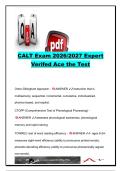
CALT Exam 2026/2027 Expert
Verifed Ace the Test


Orton-Gillingham Approach - ANSWER ✔✔instruction that is

multisensory, sequential, incremental, cumulative, individualized,

phonics-based, and explicit.

CTOPP (Comprehensive Test of Phonological Processing) -

ANSWER ✔✔assesses phonological awareness, phonological

memory and rapid naming.


TOWRE2- test of word reading efficiency - ANSWER ✔✔- ages 6-24-

measures sight-word efficiency (ability to pronounce printed words),

phonetic-decoding efficiency (ability to pronounce phonemically regular

non-words),

, DIBELS (Dynamic Indicators of Basic Early Literacy Skills) -

ANSWER ✔✔a set of procedures and measures for assessing the

acquisition of early literacy skills. They are designed to be short (one

minute) fluency measures used to regularly monitor the development of

early literacy and early reading skills.


Brigance - ANSWER ✔✔a series of 12 assessments, including

language development, science and math proficiencies and gross motor

skills.


AimsWeb - ANSWER ✔✔a benchmark and progress monitoring

system based on direct, frequent. and continuous student assessment

using brief, accurate measures of reading, math, spelling, and writing.


Tier 1 Vocabulary - ANSWER ✔✔Basic words-- rarely require direct

instruction and do not typically have multiple meanings.


Tier 2 Vocabulary - ANSWER ✔✔Vocabulary words that occur across

a variety of domains and are important for direct instruction.High

Frequency/ Multiple Meaning Vocabulary.


Tier 3 Vocabulary - ANSWER ✔✔Vocabulary words that are specific

to domains (i.e. jargon). Low Frequency/ Context Specific Vocabulary.
Información del documento

Subido en
14 de agosto de 2026
Número de páginas
8
Escrito en
2026/2027
Tipo
Examen
Contiene
Preguntas y respuestas
$18.99

¿Documento equivocado? Cámbialo gratis Dentro de los 14 días posteriores a la compra y antes de descargarlo, puedes elegir otro documento. Puedes gastar el importe de nuevo.
Escrito por estudiantes que aprobaron
Inmediatamente disponible después del pago
Leer en línea o como PDF

Seller avatar
Los indicadores de reputación están sujetos a la cantidad de artículos vendidos por una tarifa y las reseñas que ha recibido por esos documentos. Hay tres niveles: Bronce, Plata y Oro. Cuanto mayor reputación, más podrás confiar en la calidad del trabajo del vendedor.
NinjaNerd
3.4
(76)
Vendido
402
Seguidores
6
Artículos
15528
Última venta
2 días hace


Por qué los estudiantes eligen Stuvia

Creado por compañeros estudiantes, verificado por reseñas

Calidad en la que puedes confiar: escrito por estudiantes que aprobaron y evaluado por otros que han usado estos resúmenes.

¿No estás satisfecho? Elige otro documento

¡No te preocupes! Puedes elegir directamente otro documento que se ajuste mejor a lo que buscas.

Paga como quieras, empieza a estudiar al instante

Sin suscripción, sin compromisos. Paga como estés acostumbrado con tarjeta de crédito y descarga tu documento PDF inmediatamente.

Student with book image

“Comprado, descargado y aprobado. Así de fácil puede ser.”

Alisha Student

Preguntas frecuentes
