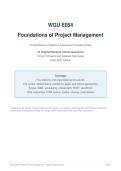
WGU E054
Foundations of Project Management
Comprehensive Objective Assessment Practice Guide
70 Original Multiple-Choice Questions
Correct Answers and Detailed Rationales
2026-2027 Edition
Coverage
Foundations and organizational structures
Life cycles, stakeholders, predictive, agile, and hybrid approaches
Scope, WBS, scheduling, critical path, PERT, and RACI
Risk responses, EVM, teams, quality, change, and closure
Independent study resource. These are original practice questions, not recalled or reproduced items from WGU’s live assessment.
Course details and assessment settings may change; confirm current requirements in your WGU course portal.
WGU E054 Foundations of Project Management - Original OA-Style Practice Page 1
,How to Use This Guide
Complete the questions without looking at the answers. For scenario items, identify the project stage, role,
constraint, and governing process before selecting the best response. Review every rationale, including items
answered correctly. A practical target is at least 80% on a closed-book attempt, followed by focused review of
weak domains.
Domain Questions Primary emphasis
1. Foundations 1-14 Projects, programs, portfolios, strategy, structures, roles
2. Life Cycles and Approaches15-35 Process groups, predictive/adaptive, Scrum, stakeholders
3. Planning and Scheduling 36-56 Scope, WBS, change control, dependencies, PERT, RACI
4. Risk and Performance 57-70 Risk responses, EVM, teams, quality, closure
WGU E054 Foundations of Project Management - Original OA-Style Practice Page 2
,Domain 1: Project Management Foundations
1. A hospital processes insurance claims every weekday using the same established workflow. How
should this work be classified?
A. A project
B. A program
C. A portfolio
D. Operations
Correct answer: D
Rationale: Operations are ongoing and repetitive. A project is temporary and creates a unique result.
2. An organization coordinates three related projects to modernize patient scheduling, billing, and
electronic records so their combined benefits can be managed together. What is this initiative?
A. A program
B. A portfolio
C. An operation
D. A work package
Correct answer: A
Rationale: A program manages related projects together to obtain benefits and control that would not result from
managing them separately.
3. Executives compare all proposed projects and programs to decide which investments best advance
corporate strategy. Which discipline are they practicing?
A. Project scheduling
B. Portfolio management
C. Quality control
D. Program execution
Correct answer: B
Rationale: Portfolio management selects and prioritizes investments according to strategy, value, risk, and available
resources.
4. Which characteristic most clearly distinguishes a project from routine operations?
A. It uses organizational resources
B. It has stakeholders
C. It is temporary and produces a unique result
D. It requires communication
Correct answer: C
Rationale: Both projects and operations use resources and stakeholders. Temporariness and uniqueness distinguish a
project.
WGU E054 Foundations of Project Management - Original OA-Style Practice Page 3
, 5. A sponsor requests additional features but refuses to change the deadline or budget. Which concept
should the project manager explain?
A. Organizational culture
B. The interdependence of project constraints
C. Progressive elaboration
D. Benefits ownership
Correct answer: B
Rationale: Scope, schedule, cost, quality, resources, and risk influence one another. More scope without other
adjustments may jeopardize performance.
6. What is the primary purpose of a business case?
A. Authorize daily task assignments
B. Explain why a proposed investment should be undertaken
C. Record defects found in testing
D. Describe every activity in the schedule
Correct answer: B
Rationale: The business case justifies the project through its need, expected value, costs, risks, alternatives, and
strategic alignment.
7. A project finishes on time and within budget, but customers do not use its deliverable and expected
benefits never occur. What is the best conclusion?
A. The project is fully successful because all baselines were met
B. The project may be unsuccessful because value and benefits were not achieved
C. The project is successful because customer adoption is an operational matter
D. The project should automatically become a program
Correct answer: B
Rationale: Modern success measures include stakeholder value, adoption, benefits, and strategic outcomes, not only
schedule and cost.
8. Which action best demonstrates project tailoring?
A. Removing governance from every small project
B. Applying the same templates to every initiative
C. Adapting methods and controls to project size, uncertainty, and risk
D. Allowing each team member to ignore organizational standards
Correct answer: C
Rationale: Tailoring selects an appropriate level and mix of processes while retaining necessary governance and
discipline.
WGU E054 Foundations of Project Management - Original OA-Style Practice Page 4
Foundations of Project Management
Comprehensive Objective Assessment Practice Guide
70 Original Multiple-Choice Questions
Correct Answers and Detailed Rationales
2026-2027 Edition
Coverage
Foundations and organizational structures
Life cycles, stakeholders, predictive, agile, and hybrid approaches
Scope, WBS, scheduling, critical path, PERT, and RACI
Risk responses, EVM, teams, quality, change, and closure
Independent study resource. These are original practice questions, not recalled or reproduced items from WGU’s live assessment.
Course details and assessment settings may change; confirm current requirements in your WGU course portal.
WGU E054 Foundations of Project Management - Original OA-Style Practice Page 1
,How to Use This Guide
Complete the questions without looking at the answers. For scenario items, identify the project stage, role,
constraint, and governing process before selecting the best response. Review every rationale, including items
answered correctly. A practical target is at least 80% on a closed-book attempt, followed by focused review of
weak domains.
Domain Questions Primary emphasis
1. Foundations 1-14 Projects, programs, portfolios, strategy, structures, roles
2. Life Cycles and Approaches15-35 Process groups, predictive/adaptive, Scrum, stakeholders
3. Planning and Scheduling 36-56 Scope, WBS, change control, dependencies, PERT, RACI
4. Risk and Performance 57-70 Risk responses, EVM, teams, quality, closure
WGU E054 Foundations of Project Management - Original OA-Style Practice Page 2
,Domain 1: Project Management Foundations
1. A hospital processes insurance claims every weekday using the same established workflow. How
should this work be classified?
A. A project
B. A program
C. A portfolio
D. Operations
Correct answer: D
Rationale: Operations are ongoing and repetitive. A project is temporary and creates a unique result.
2. An organization coordinates three related projects to modernize patient scheduling, billing, and
electronic records so their combined benefits can be managed together. What is this initiative?
A. A program
B. A portfolio
C. An operation
D. A work package
Correct answer: A
Rationale: A program manages related projects together to obtain benefits and control that would not result from
managing them separately.
3. Executives compare all proposed projects and programs to decide which investments best advance
corporate strategy. Which discipline are they practicing?
A. Project scheduling
B. Portfolio management
C. Quality control
D. Program execution
Correct answer: B
Rationale: Portfolio management selects and prioritizes investments according to strategy, value, risk, and available
resources.
4. Which characteristic most clearly distinguishes a project from routine operations?
A. It uses organizational resources
B. It has stakeholders
C. It is temporary and produces a unique result
D. It requires communication
Correct answer: C
Rationale: Both projects and operations use resources and stakeholders. Temporariness and uniqueness distinguish a
project.
WGU E054 Foundations of Project Management - Original OA-Style Practice Page 3
, 5. A sponsor requests additional features but refuses to change the deadline or budget. Which concept
should the project manager explain?
A. Organizational culture
B. The interdependence of project constraints
C. Progressive elaboration
D. Benefits ownership
Correct answer: B
Rationale: Scope, schedule, cost, quality, resources, and risk influence one another. More scope without other
adjustments may jeopardize performance.
6. What is the primary purpose of a business case?
A. Authorize daily task assignments
B. Explain why a proposed investment should be undertaken
C. Record defects found in testing
D. Describe every activity in the schedule
Correct answer: B
Rationale: The business case justifies the project through its need, expected value, costs, risks, alternatives, and
strategic alignment.
7. A project finishes on time and within budget, but customers do not use its deliverable and expected
benefits never occur. What is the best conclusion?
A. The project is fully successful because all baselines were met
B. The project may be unsuccessful because value and benefits were not achieved
C. The project is successful because customer adoption is an operational matter
D. The project should automatically become a program
Correct answer: B
Rationale: Modern success measures include stakeholder value, adoption, benefits, and strategic outcomes, not only
schedule and cost.
8. Which action best demonstrates project tailoring?
A. Removing governance from every small project
B. Applying the same templates to every initiative
C. Adapting methods and controls to project size, uncertainty, and risk
D. Allowing each team member to ignore organizational standards
Correct answer: C
Rationale: Tailoring selects an appropriate level and mix of processes while retaining necessary governance and
discipline.
WGU E054 Foundations of Project Management - Original OA-Style Practice Page 4