TF-CBT Exam • TF-CBT National Therapist Certification Program • 2026/2027
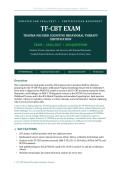
UPDATED FOR 2026/2027 • CERTIFICATION BLUEPRINT
TF-CBT EXAM
TRAUMA-FOCUSED COGNITIVE BEHAVIORAL THERAPY
CERTIFICATION
EXAM • 2026/2027 • 205 QUESTIONS
Realistic Practice Questions and Answers with Detailed Rationales,
Verified Clinical Citations, and Distractor Analysis for Every Item
205 VERIFIED Q&As Randomized Choice Order Updated for 2026/2027 Full Rationales
Overview
This comprehensive study guide provides 205 unique practice questions built for clinicians
preparing for the TF-CBT Therapist Certification Program Knowledge-Based Test for 2026/2027.
Every item is aligned to the PRACTICE model as set out in the TF-CBT treatment manual by Cohen,
Mannarino, and Deblinger, to DSM-5-TR diagnostic criteria, to the NCTSN Core Curriculum on
Childhood Trauma, and to the APA Ethical Principles and mandated reporting law. Each question
includes a clinical or regulatory citation, a written rationale, and a full distractor analysis explaining
why every incorrect option fails.
A note on the certifying authority: TF-CBT therapist certification is granted by the TF-CBT National Therapist
Certification Program at tfcbt.org, directed by the treatment developers Judith Cohen, Anthony Mannarino, and
Esther Deblinger. It is not issued by the National Child Traumatic Stress Network, which is a SAMHSA-funded
network of centers, nor by the Medical University of South Carolina, which hosts the prerequisite TF-CBTWeb
online course, nor by Carnegie Mellon University, which has no role in the model. Certification requires a
master's degree or higher, licensure, TF-CBTWeb, a two-day live training, a consultation series, three completed
cases, pre- and post-treatment standardized measures, and a passing score of 80 percent on the knowledge-
based test. Citations in this bank point to the source that actually governs each answer.
✓ KEY FEATURES
• 205 unique, verified questions with zero duplicate stems
• Randomized correct-answer placement across all four letters, verified by distribution audit
• Citations to the TF-CBT treatment manual, DSM-5-TR, ICD-11, APA ethics, HIPAA, CAPTA, and
NCTSN standards
• Real published figures: UCLA PTSD-RI cutoff of 35, CPSS-5 cutoff of 31, and the certification
criteria
• Detailed rationale plus per-option distractor analysis for every item
1 | TF-CBT National Therapist Certification Program
, TF-CBT Exam • TF-CBT National Therapist Certification Program • 2026/2027
• Master Quick Answer Key with compact grid layout and duplicate-check confirmation
▣ CORE CONTENT AREAS
• Section 1: Foundational Trauma Theory & Core Principles — 30 questions
• Section 2: TF-CBT Components & the PRACTICE Model — 35 questions
• Section 3: Assessment & Screening Instruments — 25 questions
• Section 4: Cognitive Coping & Processing — 30 questions
• Section 5: Parent-Child Dyad & Conjoint Work — 25 questions
• Section 6: TF-CBT for Special Populations & Settings — 30 questions
• Section 7: Professional Competence, Ethics & Certification Standards — 30 questions
2 | TF-CBT National Therapist Certification Program
, TF-CBT Exam • TF-CBT National Therapist Certification Program • 2026/2027
SECTION 1: FOUNDATIONAL TRAUMA THEORY & CORE PRINCIPLES
(30 QUESTIONS)
Neurobiology of trauma, DSM-5-TR PTSD criteria, attachment theory, and the developmental impact of
childhood trauma
1. Trauma-Focused Cognitive Behavioral Therapy was developed by:
A. Aaron Beck and Judith Beck
B. Francine Shapiro and Bessel van der Kolk
C. Marsha Linehan and Edna Foa
D. Judith Cohen, Anthony Mannarino, and Esther Deblinger
Correct Answer: D. Judith Cohen, Anthony Mannarino, and Esther Deblinger
Cohen, Mannarino & Deblinger (2017), Treating Trauma and Traumatic Grief in Children and Adolescents, 2nd ed.
Rationale: TF-CBT was jointly developed and tested over three decades by Cohen, Mannarino, and Deblinger,
whose treatment manual is the model's primary reference.
Distractor Analysis:
A is incorrect: "Aaron Beck and Judith Beck" — violates Cohen, Mannarino & Deblinger (2017), Treating
Trauma and Traumatic Grief in Children and Adolescents, 2nd ed. and would breach scope/safety vs correct
practice.
B is incorrect: "Francine Shapiro and Bessel van der Kolk" — violates Cohen, Mannarino & Deblinger
(2017), Treating Trauma and Traumatic Grief in Children and Adolescents, 2nd ed. and would breach
scope/safety vs correct practice.
C is incorrect: "Marsha Linehan and Edna Foa" — violates Cohen, Mannarino & Deblinger (2017), Treating
Trauma and Traumatic Grief in Children and Adolescents, 2nd ed. and would breach scope/safety vs correct
practice.
2. TF-CBT is best described as:
A. A single-session crisis debriefing protocol
B. An open-ended psychodynamic therapy
C. A components-based, phase-based treatment for trauma-exposed youth and their caregivers
D. A medication management protocol
Correct Answer: C. A components-based, phase-based treatment for trauma-exposed youth
and their caregivers
Cohen, Mannarino & Deblinger (2017); NCTSN Core Curriculum on Childhood Trauma
Rationale: TF-CBT delivers discrete skill components in three sequential phases, integrating child and caregiver
work throughout.
Distractor Analysis:
A is incorrect: "A single-session crisis debriefing protocol" — violates Cohen, Mannarino & Deblinger
(2017); NCTSN Core Curriculum on Childhood Trauma and would breach scope/safety vs correct practice.
B is incorrect: "An open-ended psychodynamic therapy" — violates Cohen, Mannarino & Deblinger (2017);
NCTSN Core Curriculum on Childhood Trauma and would breach scope/safety vs correct practice.
D is incorrect: "A medication management protocol" — violates Cohen, Mannarino & Deblinger (2017);
NCTSN Core Curriculum on Childhood Trauma and would breach scope/safety vs correct practice.
3 | TF-CBT National Therapist Certification Program
, TF-CBT Exam • TF-CBT National Therapist Certification Program • 2026/2027
3. The typical age range for which TF-CBT has been evaluated and is indicated is:
A. Birth to 3 years
B. Approximately 3 to 18 years
C. 18 to 25 years only
D. All ages including older adults
Correct Answer: B. Approximately 3 to 18 years
Cohen, Mannarino & Deblinger (2017); SAMHSA evidence-based practice designation
Rationale: TF-CBT was developed and tested for children and adolescents, with developmentally adapted
delivery across that span.
Distractor Analysis:
A is incorrect: "Birth to 3 years" — violates Cohen, Mannarino & Deblinger (2017); SAMHSA evidence-based
practice designation and would breach scope/safety vs correct practice.
C is incorrect: "18 to 25 years only" — violates Cohen, Mannarino & Deblinger (2017); SAMHSA evidence-
based practice designation and would breach scope/safety vs correct practice.
D is incorrect: "All ages including older adults" — violates Cohen, Mannarino & Deblinger (2017); SAMHSA
evidence-based practice designation and would breach scope/safety vs correct practice.
4. A child must meet full DSM-5-TR criteria for PTSD in order to receive TF-CBT.
A. True — a PTSD diagnosis is a prerequisite
B. True — insurance requires the diagnosis
C. False — youth with significant subclinical trauma symptoms are appropriate candidates
D. False — but only if the caregiver has PTSD
Correct Answer: C. False — youth with significant subclinical trauma symptoms are
appropriate candidates
Cohen, Mannarino & Deblinger (2017); DSM-5-TR, Trauma- and Stressor-Related Disorders
Rationale: TF-CBT targets trauma-related symptoms, and youth with partial or subclinical presentations
benefit substantially.
Distractor Analysis:
A is incorrect: "True — a PTSD diagnosis is a prerequisite" — violates Cohen, Mannarino & Deblinger
(2017); DSM-5-TR, Trauma- and Stressor-Related Disorders and would breach scope/safety vs correct
practice.
B is incorrect: "True — insurance requires the diagnosis" — violates Cohen, Mannarino & Deblinger (2017);
DSM-5-TR, Trauma- and Stressor-Related Disorders and would breach scope/safety vs correct practice.
D is incorrect: "False — but only if the caregiver has PTSD" — violates Cohen, Mannarino & Deblinger
(2017); DSM-5-TR, Trauma- and Stressor-Related Disorders and would breach scope/safety vs correct
practice.
4 | TF-CBT National Therapist Certification Program
UPDATED FOR 2026/2027 • CERTIFICATION BLUEPRINT
TF-CBT EXAM
TRAUMA-FOCUSED COGNITIVE BEHAVIORAL THERAPY
CERTIFICATION
EXAM • 2026/2027 • 205 QUESTIONS
Realistic Practice Questions and Answers with Detailed Rationales,
Verified Clinical Citations, and Distractor Analysis for Every Item
205 VERIFIED Q&As Randomized Choice Order Updated for 2026/2027 Full Rationales
Overview
This comprehensive study guide provides 205 unique practice questions built for clinicians
preparing for the TF-CBT Therapist Certification Program Knowledge-Based Test for 2026/2027.
Every item is aligned to the PRACTICE model as set out in the TF-CBT treatment manual by Cohen,
Mannarino, and Deblinger, to DSM-5-TR diagnostic criteria, to the NCTSN Core Curriculum on
Childhood Trauma, and to the APA Ethical Principles and mandated reporting law. Each question
includes a clinical or regulatory citation, a written rationale, and a full distractor analysis explaining
why every incorrect option fails.
A note on the certifying authority: TF-CBT therapist certification is granted by the TF-CBT National Therapist
Certification Program at tfcbt.org, directed by the treatment developers Judith Cohen, Anthony Mannarino, and
Esther Deblinger. It is not issued by the National Child Traumatic Stress Network, which is a SAMHSA-funded
network of centers, nor by the Medical University of South Carolina, which hosts the prerequisite TF-CBTWeb
online course, nor by Carnegie Mellon University, which has no role in the model. Certification requires a
master's degree or higher, licensure, TF-CBTWeb, a two-day live training, a consultation series, three completed
cases, pre- and post-treatment standardized measures, and a passing score of 80 percent on the knowledge-
based test. Citations in this bank point to the source that actually governs each answer.
✓ KEY FEATURES
• 205 unique, verified questions with zero duplicate stems
• Randomized correct-answer placement across all four letters, verified by distribution audit
• Citations to the TF-CBT treatment manual, DSM-5-TR, ICD-11, APA ethics, HIPAA, CAPTA, and
NCTSN standards
• Real published figures: UCLA PTSD-RI cutoff of 35, CPSS-5 cutoff of 31, and the certification
criteria
• Detailed rationale plus per-option distractor analysis for every item
1 | TF-CBT National Therapist Certification Program
, TF-CBT Exam • TF-CBT National Therapist Certification Program • 2026/2027
• Master Quick Answer Key with compact grid layout and duplicate-check confirmation
▣ CORE CONTENT AREAS
• Section 1: Foundational Trauma Theory & Core Principles — 30 questions
• Section 2: TF-CBT Components & the PRACTICE Model — 35 questions
• Section 3: Assessment & Screening Instruments — 25 questions
• Section 4: Cognitive Coping & Processing — 30 questions
• Section 5: Parent-Child Dyad & Conjoint Work — 25 questions
• Section 6: TF-CBT for Special Populations & Settings — 30 questions
• Section 7: Professional Competence, Ethics & Certification Standards — 30 questions
2 | TF-CBT National Therapist Certification Program
, TF-CBT Exam • TF-CBT National Therapist Certification Program • 2026/2027
SECTION 1: FOUNDATIONAL TRAUMA THEORY & CORE PRINCIPLES
(30 QUESTIONS)
Neurobiology of trauma, DSM-5-TR PTSD criteria, attachment theory, and the developmental impact of
childhood trauma
1. Trauma-Focused Cognitive Behavioral Therapy was developed by:
A. Aaron Beck and Judith Beck
B. Francine Shapiro and Bessel van der Kolk
C. Marsha Linehan and Edna Foa
D. Judith Cohen, Anthony Mannarino, and Esther Deblinger
Correct Answer: D. Judith Cohen, Anthony Mannarino, and Esther Deblinger
Cohen, Mannarino & Deblinger (2017), Treating Trauma and Traumatic Grief in Children and Adolescents, 2nd ed.
Rationale: TF-CBT was jointly developed and tested over three decades by Cohen, Mannarino, and Deblinger,
whose treatment manual is the model's primary reference.
Distractor Analysis:
A is incorrect: "Aaron Beck and Judith Beck" — violates Cohen, Mannarino & Deblinger (2017), Treating
Trauma and Traumatic Grief in Children and Adolescents, 2nd ed. and would breach scope/safety vs correct
practice.
B is incorrect: "Francine Shapiro and Bessel van der Kolk" — violates Cohen, Mannarino & Deblinger
(2017), Treating Trauma and Traumatic Grief in Children and Adolescents, 2nd ed. and would breach
scope/safety vs correct practice.
C is incorrect: "Marsha Linehan and Edna Foa" — violates Cohen, Mannarino & Deblinger (2017), Treating
Trauma and Traumatic Grief in Children and Adolescents, 2nd ed. and would breach scope/safety vs correct
practice.
2. TF-CBT is best described as:
A. A single-session crisis debriefing protocol
B. An open-ended psychodynamic therapy
C. A components-based, phase-based treatment for trauma-exposed youth and their caregivers
D. A medication management protocol
Correct Answer: C. A components-based, phase-based treatment for trauma-exposed youth
and their caregivers
Cohen, Mannarino & Deblinger (2017); NCTSN Core Curriculum on Childhood Trauma
Rationale: TF-CBT delivers discrete skill components in three sequential phases, integrating child and caregiver
work throughout.
Distractor Analysis:
A is incorrect: "A single-session crisis debriefing protocol" — violates Cohen, Mannarino & Deblinger
(2017); NCTSN Core Curriculum on Childhood Trauma and would breach scope/safety vs correct practice.
B is incorrect: "An open-ended psychodynamic therapy" — violates Cohen, Mannarino & Deblinger (2017);
NCTSN Core Curriculum on Childhood Trauma and would breach scope/safety vs correct practice.
D is incorrect: "A medication management protocol" — violates Cohen, Mannarino & Deblinger (2017);
NCTSN Core Curriculum on Childhood Trauma and would breach scope/safety vs correct practice.
3 | TF-CBT National Therapist Certification Program
, TF-CBT Exam • TF-CBT National Therapist Certification Program • 2026/2027
3. The typical age range for which TF-CBT has been evaluated and is indicated is:
A. Birth to 3 years
B. Approximately 3 to 18 years
C. 18 to 25 years only
D. All ages including older adults
Correct Answer: B. Approximately 3 to 18 years
Cohen, Mannarino & Deblinger (2017); SAMHSA evidence-based practice designation
Rationale: TF-CBT was developed and tested for children and adolescents, with developmentally adapted
delivery across that span.
Distractor Analysis:
A is incorrect: "Birth to 3 years" — violates Cohen, Mannarino & Deblinger (2017); SAMHSA evidence-based
practice designation and would breach scope/safety vs correct practice.
C is incorrect: "18 to 25 years only" — violates Cohen, Mannarino & Deblinger (2017); SAMHSA evidence-
based practice designation and would breach scope/safety vs correct practice.
D is incorrect: "All ages including older adults" — violates Cohen, Mannarino & Deblinger (2017); SAMHSA
evidence-based practice designation and would breach scope/safety vs correct practice.
4. A child must meet full DSM-5-TR criteria for PTSD in order to receive TF-CBT.
A. True — a PTSD diagnosis is a prerequisite
B. True — insurance requires the diagnosis
C. False — youth with significant subclinical trauma symptoms are appropriate candidates
D. False — but only if the caregiver has PTSD
Correct Answer: C. False — youth with significant subclinical trauma symptoms are
appropriate candidates
Cohen, Mannarino & Deblinger (2017); DSM-5-TR, Trauma- and Stressor-Related Disorders
Rationale: TF-CBT targets trauma-related symptoms, and youth with partial or subclinical presentations
benefit substantially.
Distractor Analysis:
A is incorrect: "True — a PTSD diagnosis is a prerequisite" — violates Cohen, Mannarino & Deblinger
(2017); DSM-5-TR, Trauma- and Stressor-Related Disorders and would breach scope/safety vs correct
practice.
B is incorrect: "True — insurance requires the diagnosis" — violates Cohen, Mannarino & Deblinger (2017);
DSM-5-TR, Trauma- and Stressor-Related Disorders and would breach scope/safety vs correct practice.
D is incorrect: "False — but only if the caregiver has PTSD" — violates Cohen, Mannarino & Deblinger
(2017); DSM-5-TR, Trauma- and Stressor-Related Disorders and would breach scope/safety vs correct
practice.
4 | TF-CBT National Therapist Certification Program