Test Bank Criminal Justice in America 11e George Cole, Christopher Smith, Christina DeJong, Bryan Byers
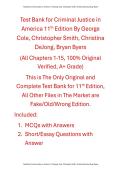
Test Bank for Criminal Justice in
America 11th Edition By George
Cole, Christopher Smith, Christina
DeJong, Bryan Byers
(All Chapters 1-15, 100% Original
Verified, A+ Grade)
This is The Only Original and
Complete Test Bank for 11th Edition,
All Other Files in The Market are
Fake/Old/Wrong Edition.
Included:
1. MCQs with Answers
2. Short/Essay Questions with
Answer
Test Bank Criminal Justice in America 11e George Cole, Christopher Smith, Christina DeJong, Bryan Byers
, Test Bank Criminal Justice in America 11e George Cole, Christopher Smith, Christina DeJong, Bryan Byers
The Textbook This Document Fully Covers (Chapters 1-15)
Criminal Justice in America 11e George Cole, Christopher Smith,
Christina DeJong, Bryan Byers
ISBN-13: 979-8214131085
ISBN: 979-8214131191
ISBN: 979-8214131160
Criminal Justice in America (11th Edition) provides a concise, reader-
friendly introduction to the foundations, internal components, and
current controversies shaping the United States criminal justice
system. Interdisciplinary Framework: The text seamlessly integrates
concepts, themes, and data from criminology, sociology, law, history,
psychology, and political science. This approach gives students a
well-rounded perspective rather than just a procedural overview.
Contemporary Controversies: It addresses highly relevant, modern
issues within the justice system, including updated policing
practices, systemic discrimination, ongoing prison reform, landmark
court decisions, and the influence of emerging technologies. Policy
and Citizenship Emphasis: Rather than relying purely on an
encyclopedic listing of laws, the text challenges students to think
critically about how public policy dictates how justice is practiced
and what "justice" truly means in American society. Career
Connections: This edition features "Career Connections" profiles
that introduce students to real-world professionals working across
the justice system, outlining their typical daily roles and providing
actionable advice for students planning their futures.
Test Bank Criminal Justice in America 11e George Cole, Christopher Smith, Christina DeJong, Bryan Byers
, Test Bank Criminal Justice in America 11e George Cole, Christopher Smith, Christina DeJong, Bryan Byers
Table of Contents
Part I: CRIME AND THE CRIMINAL JUSTICE SYSTEM.
1. The Criminal Justice System.
2. Crime and Crime Causation.
3. Criminal Justice and the Rule of Law.
Part II: POLICE.
4. Police.
5. Policing: Contemporary Issues and Challenges.
6. Police and Law.
Part III: COURTS.
7. Courts and Adjudication.
8. Pretrial Procedures, Plea Bargaining, and the Criminal Trial.
9. Punishment and Sentencing.
Part IV: CORRECTIONS.
10. Corrections.
11. Incarceration and Prison Society.
12. Probation and Intermediate Sanctions.
Part V: CONTEMPORARY ISSUES IN CRIMINAL JUSTICE.
13. Reentry into the Community.
14. Juvenile Justice.
15. Current Challenges in Criminal Justice.
Test Bank Criminal Justice in America 11e George Cole, Christopher Smith, Christina DeJong, Bryan Byers
, Test Bank Criminal Justice in America 11e George Cole, Christopher Smith, Christina DeJong, Bryan Byers
Name: Class: Date:
Chapter 01 - The Criminal Justice System
1. What are the three primary goals of the American criminal justice system?
a. Arresting criminals, prosecuting cases, and imposing sentences.
b. Investigating crimes, gathering evidence, and conducting trials.
c. Protecting victims, deterring offenders, and rehabilitating criminals.
d. Doing justice, controlling crime, and preventing crime.
ANSWER: d
2. How does the goal of doing justice serve as the foundation for the criminal justice system?
a. It ensures that all offenders receive a proportionate punishment for their crimes.
b. It provides the basis for rules, procedures, and institutions that protect individual rights.
c. It guarantees that every case will be heard by a judge in a court of law.
d. It focuses primarily on reducing crime rates through efficient processing.
ANSWER: b
3. What distinguishes mala in se crimes from mala prohibita crimes?
a. Mala in se crimes involve violence against persons, while mala prohibita crimes are property offenses.
b. Mala in se crimes are wrong in themselves while, mala prohibita are not necessarily wrong in themselves.
c. Mala in se crimes carry longer sentences, while mala prohibita crimes have shorter penalties.
d. Mala in se crimes are federal offenses, while mala prohibita crimes are state offenses.
ANSWER: b
4. A police department is implementing a new patrol strategy based on research showing it reduces burglary rates by 30
percent while maintaining constitutional protections. This approach best demonstrates which concept?
a. Crime control models that prioritize efficiency over individual rights.
b. Evidence-based practices that advance criminal justice goals effectively.
c. Traditional policing methods that rely on officer experience and intuition.
d. Community policing strategies that focus on building neighborhood relationships.
ANSWER: b
5. What is the key feature that defines federalism in the American criminal justice system?
a. Local governments have complete independence from state oversight.
b. Power is divided between central (national) and regional (state) governments.
c. Federal agencies handle all serious crimes while states manage minor offenses.
d. A single national authority controls all law enforcement agencies.
ANSWER: b
Copyright Cengage Learning. Powered by Cognero. Page 1
Test Bank Criminal Justice in America 11e George Cole, Christopher Smith, Christina DeJong, Bryan Byers
Test Bank for Criminal Justice in
America 11th Edition By George
Cole, Christopher Smith, Christina
DeJong, Bryan Byers
(All Chapters 1-15, 100% Original
Verified, A+ Grade)
This is The Only Original and
Complete Test Bank for 11th Edition,
All Other Files in The Market are
Fake/Old/Wrong Edition.
Included:
1. MCQs with Answers
2. Short/Essay Questions with
Answer
Test Bank Criminal Justice in America 11e George Cole, Christopher Smith, Christina DeJong, Bryan Byers
, Test Bank Criminal Justice in America 11e George Cole, Christopher Smith, Christina DeJong, Bryan Byers
The Textbook This Document Fully Covers (Chapters 1-15)
Criminal Justice in America 11e George Cole, Christopher Smith,
Christina DeJong, Bryan Byers
ISBN-13: 979-8214131085
ISBN: 979-8214131191
ISBN: 979-8214131160
Criminal Justice in America (11th Edition) provides a concise, reader-
friendly introduction to the foundations, internal components, and
current controversies shaping the United States criminal justice
system. Interdisciplinary Framework: The text seamlessly integrates
concepts, themes, and data from criminology, sociology, law, history,
psychology, and political science. This approach gives students a
well-rounded perspective rather than just a procedural overview.
Contemporary Controversies: It addresses highly relevant, modern
issues within the justice system, including updated policing
practices, systemic discrimination, ongoing prison reform, landmark
court decisions, and the influence of emerging technologies. Policy
and Citizenship Emphasis: Rather than relying purely on an
encyclopedic listing of laws, the text challenges students to think
critically about how public policy dictates how justice is practiced
and what "justice" truly means in American society. Career
Connections: This edition features "Career Connections" profiles
that introduce students to real-world professionals working across
the justice system, outlining their typical daily roles and providing
actionable advice for students planning their futures.
Test Bank Criminal Justice in America 11e George Cole, Christopher Smith, Christina DeJong, Bryan Byers
, Test Bank Criminal Justice in America 11e George Cole, Christopher Smith, Christina DeJong, Bryan Byers
Table of Contents
Part I: CRIME AND THE CRIMINAL JUSTICE SYSTEM.
1. The Criminal Justice System.
2. Crime and Crime Causation.
3. Criminal Justice and the Rule of Law.
Part II: POLICE.
4. Police.
5. Policing: Contemporary Issues and Challenges.
6. Police and Law.
Part III: COURTS.
7. Courts and Adjudication.
8. Pretrial Procedures, Plea Bargaining, and the Criminal Trial.
9. Punishment and Sentencing.
Part IV: CORRECTIONS.
10. Corrections.
11. Incarceration and Prison Society.
12. Probation and Intermediate Sanctions.
Part V: CONTEMPORARY ISSUES IN CRIMINAL JUSTICE.
13. Reentry into the Community.
14. Juvenile Justice.
15. Current Challenges in Criminal Justice.
Test Bank Criminal Justice in America 11e George Cole, Christopher Smith, Christina DeJong, Bryan Byers
, Test Bank Criminal Justice in America 11e George Cole, Christopher Smith, Christina DeJong, Bryan Byers
Name: Class: Date:
Chapter 01 - The Criminal Justice System
1. What are the three primary goals of the American criminal justice system?
a. Arresting criminals, prosecuting cases, and imposing sentences.
b. Investigating crimes, gathering evidence, and conducting trials.
c. Protecting victims, deterring offenders, and rehabilitating criminals.
d. Doing justice, controlling crime, and preventing crime.
ANSWER: d
2. How does the goal of doing justice serve as the foundation for the criminal justice system?
a. It ensures that all offenders receive a proportionate punishment for their crimes.
b. It provides the basis for rules, procedures, and institutions that protect individual rights.
c. It guarantees that every case will be heard by a judge in a court of law.
d. It focuses primarily on reducing crime rates through efficient processing.
ANSWER: b
3. What distinguishes mala in se crimes from mala prohibita crimes?
a. Mala in se crimes involve violence against persons, while mala prohibita crimes are property offenses.
b. Mala in se crimes are wrong in themselves while, mala prohibita are not necessarily wrong in themselves.
c. Mala in se crimes carry longer sentences, while mala prohibita crimes have shorter penalties.
d. Mala in se crimes are federal offenses, while mala prohibita crimes are state offenses.
ANSWER: b
4. A police department is implementing a new patrol strategy based on research showing it reduces burglary rates by 30
percent while maintaining constitutional protections. This approach best demonstrates which concept?
a. Crime control models that prioritize efficiency over individual rights.
b. Evidence-based practices that advance criminal justice goals effectively.
c. Traditional policing methods that rely on officer experience and intuition.
d. Community policing strategies that focus on building neighborhood relationships.
ANSWER: b
5. What is the key feature that defines federalism in the American criminal justice system?
a. Local governments have complete independence from state oversight.
b. Power is divided between central (national) and regional (state) governments.
c. Federal agencies handle all serious crimes while states manage minor offenses.
d. A single national authority controls all law enforcement agencies.
ANSWER: b
Copyright Cengage Learning. Powered by Cognero. Page 1
Test Bank Criminal Justice in America 11e George Cole, Christopher Smith, Christina DeJong, Bryan Byers