

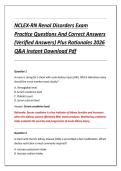
NCLEX-RN Renal Disorders Exam
Practice Questions And Correct Answers
(Verified Answers) Plus Rationales 2026
Q&A Instant Download Pdf
Question 1
A nurse is caring for a client with acute kidney injury (AKI). Which laboratory value
should the nurse monitor most closely?
A. Hemoglobin level
B. Serum creatinine level
C. Platelet count
D. Serum calcium level
Answer: Serum creatinine level
Rationale: Serum creatinine is a key indicator of kidney function and increases
when the kidneys cannot effectively filter waste products. Monitoring creatinine
helps evaluate the severity and progression of acute kidney injury.
Question 2
A client with chronic kidney disease (CKD) is prescribed a diet modification. Which
dietary restriction is most commonly required?
A. Increase potassium intake
B. Increase sodium intake
,C. Limit phosphorus intake
D. Increase protein intake
Answer: Limit phosphorus intake
Rationale: Clients with CKD often retain phosphorus because the kidneys cannot
eliminate it effectively. Excess phosphorus contributes to bone disease and
mineral imbalances.
Question 3
A nurse is assessing a client with nephrotic syndrome. Which finding is expected?
A. Severe dehydration
B. Proteinuria and edema
C. Increased urine output
D. Low blood glucose levels
Answer: Proteinuria and edema
Rationale: Nephrotic syndrome causes increased glomerular permeability,
leading to significant protein loss in urine and decreased plasma oncotic
pressure, resulting in edema.
Question 4
A nurse is caring for a client receiving hemodialysis. Which assessment finding
requires immediate intervention?
A. Fatigue after treatment
B. Mild muscle cramps
C. Chest pain during dialysis
D. Increased appetite
Answer: Chest pain during dialysis
,Rationale: Chest pain during hemodialysis may indicate serious complications
such as hypotension, disequilibrium syndrome, or cardiovascular problems and
requires immediate evaluation.
Question 5
Which assessment finding is most consistent with fluid overload in a client with
renal failure?
A. Dry mucous membranes
B. Hypotension
C. Crackles in the lungs
D. Decreased weight
Answer: Crackles in the lungs
Rationale: Fluid retention caused by impaired kidney function can lead to
pulmonary congestion, producing crackles on auscultation.
Question 6
A nurse is teaching a client with chronic kidney disease about potassium
restrictions. Which food should the client avoid?
A. Apples
B. White rice
C. Bananas
D. Bread
Answer: Bananas
Rationale: Bananas are high in potassium. Clients with CKD may need potassium
restriction because impaired kidneys cannot adequately remove potassium from
the blood.
, Question 7
A client with end-stage kidney disease asks why erythropoietin injections are
prescribed. What is the nurse’s best response?
A. They prevent infection
B. They increase red blood cell production
C. They lower blood pressure
D. They remove excess fluid
Answer: They increase red blood cell production
Rationale: Diseased kidneys produce less erythropoietin, resulting in decreased
red blood cell production and anemia. Replacement therapy stimulates
erythropoiesis.
Question 8
A nurse is caring for a client after a kidney biopsy. Which action is appropriate?
A. Encourage immediate ambulation
B. Monitor urine output and urine color
C. Restrict fluids completely
D. Apply heat to the biopsy site
Answer: Monitor urine output and urine color
Rationale: Hematuria and changes in urine output may indicate bleeding after a
kidney biopsy. Close monitoring is required for complications.
Question 9
Which finding is expected in a client with glomerulonephritis?
A. Hematuria
B. Increased appetite
Practice Questions And Correct Answers
(Verified Answers) Plus Rationales 2026
Q&A Instant Download Pdf
Question 1
A nurse is caring for a client with acute kidney injury (AKI). Which laboratory value
should the nurse monitor most closely?
A. Hemoglobin level
B. Serum creatinine level
C. Platelet count
D. Serum calcium level
Answer: Serum creatinine level
Rationale: Serum creatinine is a key indicator of kidney function and increases
when the kidneys cannot effectively filter waste products. Monitoring creatinine
helps evaluate the severity and progression of acute kidney injury.
Question 2
A client with chronic kidney disease (CKD) is prescribed a diet modification. Which
dietary restriction is most commonly required?
A. Increase potassium intake
B. Increase sodium intake
,C. Limit phosphorus intake
D. Increase protein intake
Answer: Limit phosphorus intake
Rationale: Clients with CKD often retain phosphorus because the kidneys cannot
eliminate it effectively. Excess phosphorus contributes to bone disease and
mineral imbalances.
Question 3
A nurse is assessing a client with nephrotic syndrome. Which finding is expected?
A. Severe dehydration
B. Proteinuria and edema
C. Increased urine output
D. Low blood glucose levels
Answer: Proteinuria and edema
Rationale: Nephrotic syndrome causes increased glomerular permeability,
leading to significant protein loss in urine and decreased plasma oncotic
pressure, resulting in edema.
Question 4
A nurse is caring for a client receiving hemodialysis. Which assessment finding
requires immediate intervention?
A. Fatigue after treatment
B. Mild muscle cramps
C. Chest pain during dialysis
D. Increased appetite
Answer: Chest pain during dialysis
,Rationale: Chest pain during hemodialysis may indicate serious complications
such as hypotension, disequilibrium syndrome, or cardiovascular problems and
requires immediate evaluation.
Question 5
Which assessment finding is most consistent with fluid overload in a client with
renal failure?
A. Dry mucous membranes
B. Hypotension
C. Crackles in the lungs
D. Decreased weight
Answer: Crackles in the lungs
Rationale: Fluid retention caused by impaired kidney function can lead to
pulmonary congestion, producing crackles on auscultation.
Question 6
A nurse is teaching a client with chronic kidney disease about potassium
restrictions. Which food should the client avoid?
A. Apples
B. White rice
C. Bananas
D. Bread
Answer: Bananas
Rationale: Bananas are high in potassium. Clients with CKD may need potassium
restriction because impaired kidneys cannot adequately remove potassium from
the blood.
, Question 7
A client with end-stage kidney disease asks why erythropoietin injections are
prescribed. What is the nurse’s best response?
A. They prevent infection
B. They increase red blood cell production
C. They lower blood pressure
D. They remove excess fluid
Answer: They increase red blood cell production
Rationale: Diseased kidneys produce less erythropoietin, resulting in decreased
red blood cell production and anemia. Replacement therapy stimulates
erythropoiesis.
Question 8
A nurse is caring for a client after a kidney biopsy. Which action is appropriate?
A. Encourage immediate ambulation
B. Monitor urine output and urine color
C. Restrict fluids completely
D. Apply heat to the biopsy site
Answer: Monitor urine output and urine color
Rationale: Hematuria and changes in urine output may indicate bleeding after a
kidney biopsy. Close monitoring is required for complications.
Question 9
Which finding is expected in a client with glomerulonephritis?
A. Hematuria
B. Increased appetite

