

NURS 5433 Final Exam Practice (2026/2027)
Comprehensive Integrated Advanced
Nursing Examination.
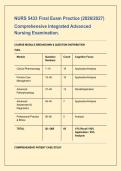
COURSE MODULE BREAKDOWN & QUESTION DISTRIBUTION
Table
Module Question Count Cognitive Focus
Numbers
Clinical Pharmacology 1–18 18 Application/Analysis
Primary Care 19–36 18 Application/Analysis
Management
Advanced 37–48 12 Recall/Application
Pathophysiology
Advanced 49–55 7 Application/Analysis
Assessment &
Diagnostics
Professional Practice 56–60 5 Analysis
& Ethics
TOTAL Q1–Q60 60 15% Recall / 60%
Application / 25%
Analysis
COMPREHENSIVE PATIENT CASE STUDY
,CASE 1 (Questions 1–5): Mr. J.D., a 68-year-old male with a 15-year history of type 2
diabetes mellitus, hypertension, and hyperlipidemia, presents to the primary care clinic
for a routine follow-up. Current medications include metformin 1000 mg BID, glipizide 10
mg daily, lisinopril 20 mg daily, atorvastatin 40 mg nightly, and aspirin 81 mg daily. Vital
signs: BP 148/92 mmHg, HR 78 bpm, RR 16, Temp 98.4°F, SpO₂ 96% on room air.
Weight 102 kg, BMI 33.2. Labs from last week: HbA1c 8.2%, eGFR 58 mL/min/1.73m²,
LDL 118 mg/dL, HDL 38 mg/dL, triglycerides 210 mg/dL, ALT 42 U/L, AST 38 U/L. He
reports occasional chest discomfort with exertion and decreased exercise tolerance
over the past month. He admits to dietary nonadherence and missing doses of his
medications 2–3 times per week.
Q1: Based on Mr. J.D.'s presentation and current guidelines, what is the most
appropriate next step in management of his glycemic control?
A. Increase glipizide to 20 mg daily to improve postprandial glucose control
B. Add a sodium-glucose cotransporter-2 (SGLT2) inhibitor given his cardiovascular risk
profile and eGFR
C. Switch from metformin to insulin glargine due to his elevated HbA1c
D. Discontinue metformin due to his eGFR of 58 and initiate pioglitazone monotherapy
Correct Answer: B [CORRECT]
Rationale: The ADA Standards of Care (2026) recommend adding an SGLT2 inhibitor
(e.g., empagliflozin, dapagliflozin) in patients with T2DM and established cardiovascular
disease or high cardiovascular risk, independent of glycemic control or metformin use.
Given his eGFR of 58 (still above the 30 mL/min/1.73m² threshold for most SGLT2
inhibitors), his elevated HbA1c of 8.2%, and reported anginal symptoms, an SGLT2
inhibitor provides both glycemic and cardioprotective benefits.
Q2: Mr. J.D.'s blood pressure remains above goal despite lisinopril 20 mg daily.
According to JNC-8 and current hypertension guidelines, what is the most appropriate
pharmacologic adjustment?
A. Add hydrochlorothiazide 25 mg daily and reassess in 4 weeks
B. Discontinue lisinopril and initiate losartan due to his diabetes
C. Add amlodipine 5 mg daily as a second-line agent
D. Increase lisinopril to 40 mg daily and add metoprolol succinate 25 mg daily
Correct Answer: C [CORRECT]
Rationale: The 2017 ACC/AHA hypertension guidelines recommend thiazide-like
diuretics, dihydropyridine calcium channel blockers (CCBs), or ACE inhibitors/ARBs as
, first-line therapy. For Black patients or those requiring dual therapy, the combination of
ACE inhibitor + CCB (e.g., amlodipine) is preferred over ACE inhibitor + thiazide, as
demonstrated in the ACCOMPLISH trial, which showed superior cardiovascular
outcomes with ACE inhibitor/CCB combinations in high-risk patients.
Q3: Select all that apply regarding Mr. J.D.'s lipid management and statin therapy.
A. His LDL of 118 mg/dL meets goal for a diabetic patient with multiple risk factors
B. Atorvastatin 40 mg is considered a moderate-intensity statin regimen
C. Given his age and diabetes, high-intensity statin therapy is indicated
D. Adding ezetimibe is preferred before increasing to high-intensity statin
E. Statin therapy should be held due to mildly elevated liver enzymes
Correct Answers: B, C [CORRECT]
Rationale: The 2018 AHA/ACC/Multi-Society Cholesterol Guidelines classify
atorvastatin 40 mg as moderate-intensity therapy (lowers LDL by 30–49%). However,
patients aged 40–75 with diabetes and multiple ASCVD risk factors (hypertension,
obesity, probable CAD given exertional chest pain) should receive high-intensity statin
therapy (atorvastatin 40–80 mg or rosuvastatin 20–40 mg) to achieve ≥50% LDL
reduction. Mildly elevated transaminases (<3x ULN) are not a contraindication to statin
therapy.
Q4: Mr. J.D. reports exertional chest discomfort. What is the most appropriate initial
diagnostic evaluation?
A. Immediate referral for cardiac catheterization given his diabetes and symptoms
B. Exercise stress testing with imaging due to his inability to achieve target heart rate
C. Coronary CT angiography to assess for obstructive coronary disease
D. Pharmacologic stress testing with myocardial perfusion imaging
Correct Answer: D [CORRECT]
Rationale: According to the 2021 AHA/ACC Chest Pain Guideline, patients with stable
chest pain and intermediate pre-test probability who are unable to exercise adequately
(due to obesity, deconditioning, or cardiovascular limitations) should undergo
pharmacologic stress testing with myocardial perfusion imaging or stress
echocardiography. His BMI of 33.2 and decreased exercise tolerance make exercise
stress testing less reliable.
Comprehensive Integrated Advanced
Nursing Examination.
COURSE MODULE BREAKDOWN & QUESTION DISTRIBUTION
Table
Module Question Count Cognitive Focus
Numbers
Clinical Pharmacology 1–18 18 Application/Analysis
Primary Care 19–36 18 Application/Analysis
Management
Advanced 37–48 12 Recall/Application
Pathophysiology
Advanced 49–55 7 Application/Analysis
Assessment &
Diagnostics
Professional Practice 56–60 5 Analysis
& Ethics
TOTAL Q1–Q60 60 15% Recall / 60%
Application / 25%
Analysis
COMPREHENSIVE PATIENT CASE STUDY
,CASE 1 (Questions 1–5): Mr. J.D., a 68-year-old male with a 15-year history of type 2
diabetes mellitus, hypertension, and hyperlipidemia, presents to the primary care clinic
for a routine follow-up. Current medications include metformin 1000 mg BID, glipizide 10
mg daily, lisinopril 20 mg daily, atorvastatin 40 mg nightly, and aspirin 81 mg daily. Vital
signs: BP 148/92 mmHg, HR 78 bpm, RR 16, Temp 98.4°F, SpO₂ 96% on room air.
Weight 102 kg, BMI 33.2. Labs from last week: HbA1c 8.2%, eGFR 58 mL/min/1.73m²,
LDL 118 mg/dL, HDL 38 mg/dL, triglycerides 210 mg/dL, ALT 42 U/L, AST 38 U/L. He
reports occasional chest discomfort with exertion and decreased exercise tolerance
over the past month. He admits to dietary nonadherence and missing doses of his
medications 2–3 times per week.
Q1: Based on Mr. J.D.'s presentation and current guidelines, what is the most
appropriate next step in management of his glycemic control?
A. Increase glipizide to 20 mg daily to improve postprandial glucose control
B. Add a sodium-glucose cotransporter-2 (SGLT2) inhibitor given his cardiovascular risk
profile and eGFR
C. Switch from metformin to insulin glargine due to his elevated HbA1c
D. Discontinue metformin due to his eGFR of 58 and initiate pioglitazone monotherapy
Correct Answer: B [CORRECT]
Rationale: The ADA Standards of Care (2026) recommend adding an SGLT2 inhibitor
(e.g., empagliflozin, dapagliflozin) in patients with T2DM and established cardiovascular
disease or high cardiovascular risk, independent of glycemic control or metformin use.
Given his eGFR of 58 (still above the 30 mL/min/1.73m² threshold for most SGLT2
inhibitors), his elevated HbA1c of 8.2%, and reported anginal symptoms, an SGLT2
inhibitor provides both glycemic and cardioprotective benefits.
Q2: Mr. J.D.'s blood pressure remains above goal despite lisinopril 20 mg daily.
According to JNC-8 and current hypertension guidelines, what is the most appropriate
pharmacologic adjustment?
A. Add hydrochlorothiazide 25 mg daily and reassess in 4 weeks
B. Discontinue lisinopril and initiate losartan due to his diabetes
C. Add amlodipine 5 mg daily as a second-line agent
D. Increase lisinopril to 40 mg daily and add metoprolol succinate 25 mg daily
Correct Answer: C [CORRECT]
Rationale: The 2017 ACC/AHA hypertension guidelines recommend thiazide-like
diuretics, dihydropyridine calcium channel blockers (CCBs), or ACE inhibitors/ARBs as
, first-line therapy. For Black patients or those requiring dual therapy, the combination of
ACE inhibitor + CCB (e.g., amlodipine) is preferred over ACE inhibitor + thiazide, as
demonstrated in the ACCOMPLISH trial, which showed superior cardiovascular
outcomes with ACE inhibitor/CCB combinations in high-risk patients.
Q3: Select all that apply regarding Mr. J.D.'s lipid management and statin therapy.
A. His LDL of 118 mg/dL meets goal for a diabetic patient with multiple risk factors
B. Atorvastatin 40 mg is considered a moderate-intensity statin regimen
C. Given his age and diabetes, high-intensity statin therapy is indicated
D. Adding ezetimibe is preferred before increasing to high-intensity statin
E. Statin therapy should be held due to mildly elevated liver enzymes
Correct Answers: B, C [CORRECT]
Rationale: The 2018 AHA/ACC/Multi-Society Cholesterol Guidelines classify
atorvastatin 40 mg as moderate-intensity therapy (lowers LDL by 30–49%). However,
patients aged 40–75 with diabetes and multiple ASCVD risk factors (hypertension,
obesity, probable CAD given exertional chest pain) should receive high-intensity statin
therapy (atorvastatin 40–80 mg or rosuvastatin 20–40 mg) to achieve ≥50% LDL
reduction. Mildly elevated transaminases (<3x ULN) are not a contraindication to statin
therapy.
Q4: Mr. J.D. reports exertional chest discomfort. What is the most appropriate initial
diagnostic evaluation?
A. Immediate referral for cardiac catheterization given his diabetes and symptoms
B. Exercise stress testing with imaging due to his inability to achieve target heart rate
C. Coronary CT angiography to assess for obstructive coronary disease
D. Pharmacologic stress testing with myocardial perfusion imaging
Correct Answer: D [CORRECT]
Rationale: According to the 2021 AHA/ACC Chest Pain Guideline, patients with stable
chest pain and intermediate pre-test probability who are unable to exercise adequately
(due to obesity, deconditioning, or cardiovascular limitations) should undergo
pharmacologic stress testing with myocardial perfusion imaging or stress
echocardiography. His BMI of 33.2 and decreased exercise tolerance make exercise
stress testing less reliable.

