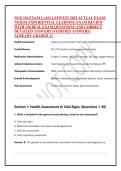
NUR 336 EXAM 1 (ASU) NEWEST 2025 ACTUAL EXAM|
NUR336 EXPERIENTIAL LEARNING EXAM REVIEW
WITH 150 REAL EXAM QUESTIONS AND CORRECT
DETAILED ANSWERS (VERIFIED ANSWERS)
ALREADY GRADED A+
Health Assessment Head-to-toe assessment, vital signs, lung/heart/abdominal assessmen
Cranial Nerves CN I-XII: function and assessment techniques
Medication Administration 6 rights, 3 checks, IM/SUBQ injection, NG tube, oxygen delivery
Safety & Infection Control Hand hygiene, fall prevention, transfer techniques, PPE
Therapeutic Communication SBAR, zones of touch, communication with sensory impairments
Growth & Development Pediatric milestones, developmental theories, family-centered care
Pain Assessment FLACC scale, numeric rating, pain characteristics
Section 1: Health Assessment & Vital Signs (Questions 1-30)
1. What is included in the general survey during a head-to-toe assessment?
A. Only vital signs
B. Determine orientation and assess overall appearance
C. Only skin assessment
D. Only respiratory assessment
Answer: B. The general survey determines orientation and assesses overall appearance .
,2. What is the expected range for normal heart rate in an adult?
A. 40-60 bpm
B. 60-100 bpm
C. 80-120 bpm
D. 100-140 bpm
Answer: B. Normal adult heart rate is 60-100 bpm .
3. What is the expected range for normal respiratory rate in an adult?
A. 8-12 breaths/min
B. 12-20 breaths/min
C. 20-28 breaths/min
D. 28-36 breaths/min
Answer: B. Normal adult respiratory rate is 12-20 breaths/min .
4. What is the expected range for normal blood pressure in an adult?
A. 90--70 mmHg
B. 100--79 mmHg
C. 120--89 mmHg
D. 140--99 mmHg
Answer: B. Normal adult blood pressure is 100-119/60-79 mmHg .
,5. What is the expected range for normal oxygen saturation (SpO2) in a healthy
adult?
A. 85-90%
B. 90-94%
C. 95-100%
D. 98-100%
Answer: C. Normal SpO2 is 95-100% .
6. What is the expected temperature range for a healthy adult?
A. 35.0-36.0°C (95.0-96.8°F)
B. 36.0-37.5°C (96.8-99.5°F)
C. 37.5-38.5°C (99.5-101.3°F)
D. 38.5-39.5°C (101.3-103.1°F)
Answer: B. Normal adult temperature is 36.0-37.5°C (96.8-99.5°F) .
7. Delayed capillary refill indicates:
A. Normal perfusion
B. Poor blood flow
C. Infection
D. Dehydration
Answer: B. Delayed capillary refill indicates poor blood flow .
, 8. What does PERRLA stand for in a pupil assessment?
A. Pupils Equal, Round, Reactive to Light, Accommodation
B. Pupils Equal, Regular, Responsive to Light, Assessment
C. Pupils Equal, Round, Responsive to Light, Adjustment
D. Pupils Equal, Regular, Reactive to Light, Accommodation
Answer: A. PERRLA is the standard for pupil assessment .
9. When auscultating the lungs, the nurse should:
A. Only listen to the posterior chest
B. Listen in a zigzag pattern comparing both sides
C. Listen only to the anterior chest
D. Listen only at the base of the lungs
Answer: B. Auscultation should be in a zigzag pattern, comparing one side to the
other .
10. Crackles (rales) are caused by:
A. Air moving through constricted airways
B. Air moving through liquid or collapsed alveoli snapping open
C. Foreign body in a larger airway
D. Inflammation of pleural membranes
NUR336 EXPERIENTIAL LEARNING EXAM REVIEW
WITH 150 REAL EXAM QUESTIONS AND CORRECT
DETAILED ANSWERS (VERIFIED ANSWERS)
ALREADY GRADED A+
Health Assessment Head-to-toe assessment, vital signs, lung/heart/abdominal assessmen
Cranial Nerves CN I-XII: function and assessment techniques
Medication Administration 6 rights, 3 checks, IM/SUBQ injection, NG tube, oxygen delivery
Safety & Infection Control Hand hygiene, fall prevention, transfer techniques, PPE
Therapeutic Communication SBAR, zones of touch, communication with sensory impairments
Growth & Development Pediatric milestones, developmental theories, family-centered care
Pain Assessment FLACC scale, numeric rating, pain characteristics
Section 1: Health Assessment & Vital Signs (Questions 1-30)
1. What is included in the general survey during a head-to-toe assessment?
A. Only vital signs
B. Determine orientation and assess overall appearance
C. Only skin assessment
D. Only respiratory assessment
Answer: B. The general survey determines orientation and assesses overall appearance .
,2. What is the expected range for normal heart rate in an adult?
A. 40-60 bpm
B. 60-100 bpm
C. 80-120 bpm
D. 100-140 bpm
Answer: B. Normal adult heart rate is 60-100 bpm .
3. What is the expected range for normal respiratory rate in an adult?
A. 8-12 breaths/min
B. 12-20 breaths/min
C. 20-28 breaths/min
D. 28-36 breaths/min
Answer: B. Normal adult respiratory rate is 12-20 breaths/min .
4. What is the expected range for normal blood pressure in an adult?
A. 90--70 mmHg
B. 100--79 mmHg
C. 120--89 mmHg
D. 140--99 mmHg
Answer: B. Normal adult blood pressure is 100-119/60-79 mmHg .
,5. What is the expected range for normal oxygen saturation (SpO2) in a healthy
adult?
A. 85-90%
B. 90-94%
C. 95-100%
D. 98-100%
Answer: C. Normal SpO2 is 95-100% .
6. What is the expected temperature range for a healthy adult?
A. 35.0-36.0°C (95.0-96.8°F)
B. 36.0-37.5°C (96.8-99.5°F)
C. 37.5-38.5°C (99.5-101.3°F)
D. 38.5-39.5°C (101.3-103.1°F)
Answer: B. Normal adult temperature is 36.0-37.5°C (96.8-99.5°F) .
7. Delayed capillary refill indicates:
A. Normal perfusion
B. Poor blood flow
C. Infection
D. Dehydration
Answer: B. Delayed capillary refill indicates poor blood flow .
, 8. What does PERRLA stand for in a pupil assessment?
A. Pupils Equal, Round, Reactive to Light, Accommodation
B. Pupils Equal, Regular, Responsive to Light, Assessment
C. Pupils Equal, Round, Responsive to Light, Adjustment
D. Pupils Equal, Regular, Reactive to Light, Accommodation
Answer: A. PERRLA is the standard for pupil assessment .
9. When auscultating the lungs, the nurse should:
A. Only listen to the posterior chest
B. Listen in a zigzag pattern comparing both sides
C. Listen only to the anterior chest
D. Listen only at the base of the lungs
Answer: B. Auscultation should be in a zigzag pattern, comparing one side to the
other .
10. Crackles (rales) are caused by:
A. Air moving through constricted airways
B. Air moving through liquid or collapsed alveoli snapping open
C. Foreign body in a larger airway
D. Inflammation of pleural membranes