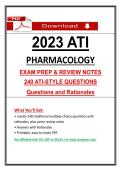
2023 ATI
PHARMACOLOGY
EXAM PREP & REVIEW NOTES
240 ATI-STYLE QUESTIONS
Questions and Rationales
What You’ll Get:
• mostly 240 traditional multiple-choice questions with
rationales, plus some review notes
• Answers with Rationales
• Printable, easy-to-study PDF
Not affiliated with ATI, VATI or NCLEX. For study purposes only.
, Preview Questions Below
Get the Complete PDF After Purchase
"If you require further clarification or in need of any
study resources, feel free to Message me."
,10. A nurse orienting a newly licensed nurse is reviewing the procedure for taking
a telephone prescription. Which of the following statements should the nurse
identify as an indication that the newly licensed nurse understands the process?
A. "A second nurse enters the prescription into the client's medical record."
B. "Another nurse should listen to the phone call."
C. "The provider can clarify the prescription when he signs the health record."
D. "I should omit the 'read back' if this is a one-time prescription
B. "Another nurse should listen to the phone call."
(A second nurse should listen to a telephone prescription to prevent errors in
communication.)
2. A staff educator is reviewing medication dosages and factors that influence
medication metabolism with a group of nurses at an in-service presentation.
Which of the following factors should the educator include as a reason to
administer lower medication dosages? (Select all that apply.)
A. Increased renal secretion
B. Increased medication-metabolizing enzymes
C. Liver failure
D. Peripheral vascular disease
E. Concurrent use of medication the same pathway metabolizes
C. Liver failure
E. Concurrent use of medication the same pathway metabolizes
C. Liver failure decreases metabolism and thus increases the concentration of a
medication. This requires decreasing the dosage.
E. When the same pathway metabolizes two medications, they compete for metabolism,
thereby increasing the concentration of one or both medications. This requires
decreasing the dosage of one or both
3. A nurse is preparing to administer eye drops to a client. Which of the following
actions should the nurse take? (Select all that apply.)
A. Have the client lie on her side.
,B. Ask the client to look up at the ceiling.
C. Tell the client to blink when the drops enter her eye.
D. Drop the medication into the center of the client's conjunctival sac.
E. Instruct the client to close her eye gently after instillation
B. Ask the client to look up at the ceiling.
D. Drop the medication into the center of the client's conjunctival sac.
E. Instruct the client to close her eye gently after instillation
(B. The client should look upward to keep the drops from falling onto her cornea.
D. The nurse should drop the medication into the
center of the conjunctival sac to promote distribution.
E. The client should close her eye gently to promote distribution of the medication)
4. A nurse is completing discharge teaching for a client who has a new
prescription for transdermal patches. Which of the following statements should
the nurse identify as an indication that the client understands the instructions?
A. "I will clean the site with an alcohol swab before I apply the patch."
B. "I will rotate the application sites weekly."
C. "I will apply the patch to an area of skin with no hair."
D. "I will place the new patch on the site of the old patch.
C. "I will apply the patch to an area of skin with no hair."
(The client should apply the patch to a hairless area of skin to promote absorption of the
medication.)
5. A nurse reviewing a client's medical record notes a new prescription for
verifying the trough level of the client's medication. Which of the following
actions should the nurse take?
A. Obtain a blood specimen immediately prior to administering the next dose of
medication.
B. Verify that the client has been taking the medication for 24 hr before obtaining
a blood specimen.
C. Ask the client to provide a urine specimen after the next dose of medication.
D. Administer the medication,and obtain a blood specimen 30 min late
A. Obtain a blood specimen immediately prior to administering the next dose of
medication.
,(To verify trough levels of a medication, the nurse should obtain a blood specimen
immediately before administering the next dose of medication.)
6. A nurse is preparing a client's medications. Which of the following actions
should the nurse take in following legal practice guidelines? (Select all that
apply.)
A. Maintain skill competency.
B. Determine the dosage.
C. Monitor for adverse effects.
D. Safeguard medications.
E. Identify the client's diagnosis
A. Maintain skill competency.
C. Monitor for adverse effects.
D. Safeguard medications.
(A.maintaining skill competency and using appropriate administration techniques are
legal responsibilities of the nurse
C. A nurse is legally responsible for monitoring for side and adverse effects of
medication
D. Safeguarding of medications, such as controlled substances, is a legal responsibility
of the nurse)
7. A nurse reviewing a client's health record notes a new prescription for
Lisinopril 10 mg PO once every day. The nurse should identify this as which of
the following types of prescription?
A. Single
B. Stat
C. Routine
D. Standing
C. Routine
(A routine or standard prescription identifies medications to give on a regular schedule
with or without a termination date or a specific number of doses. The nurse will
,administer
this medication every day until the provider discontinues it.)
8. A nurse is reviewing a new prescription for Ondansetron 4 mg PO PRN for
nausea and vomiting for a client who has Hyperemesis Gravidarum. The nurse
should clarify which of the following parts of the prescription with the provider?
A. Name
B. Dosage
C. Route
D. Frequency
D. Frequency
(This prescription does not include the time or frequency of medication administration.
The nurse must clarify this with the prescribing provide)
9. A nurse is admitting a client and completing a preassessment before
administering medications. Which of the following data should the nurse include
in the preassessment? (Select all that apply.)
A. Use of herbal teas
B. Daily fluid intake
C. Current health status
D. Previous surgical history
E. Food allergies
A. Use of herbal teas
C. Current health status
E. Food allergies
(A. The nurse should inquire about the client's use of herbal products, which often
contain caffeine, prior to medication administration because caffeine can affect
medication biotransformation
C. The nurse should review the client's current health status because new prescriptions
can cause alterations in current health status
E. The nurse should inquire about food allergies during the preassessment to identify
any potential reactions or interactions)
,10. A provider prescribes phenobarbital for a client who has a seizure disorder.
The medication has a long half-life of 4 days. How many times per day should the
nurse expect to administer this medication?
A. One
B. Two
C. Three
D. Four
A. One
(Medications with long half-lives remain at their therapeutic levels between doses for
long periods of time. The nurse should expect to administer this medication once a day.)
11. A nurse is preparing to administer vancomycin 1 g by intermittent IV bolus.
Available is vancomycin 1 g in 100 mL of dextrose 5% in water (D5W) to infuse
over 45 min. The drop factor of the manual IV tubing is 10 gtt/mL. The nurse
should adjust the manual IV infusion to deliver how many gtt/min? (Round the
answer to the nearest whole number. Do not use a trailing zero.
22
12. A nurse is preparing to administer clindamycin 200 mg by intermittent IV
bolus. The amount available is clindamycin injection 200 mg in 100 mL 0.9%
sodium chloride (0.9% NaCl) to infuse over 30 min. The nurse should set the IV
pump to deliver how many mL/hr? (Round
the answer to the nearest whole number. Do not use a trailing zero.
200
13. A nurse is preparing to administer furosemide 80 mg PO daily. The amount
available is furosemide oral
solution 10 mg/1 mL. how many mL should the nurse administer? (Round the
answer to the nearest whole number. Do not use a trailing zero.)
8
14. A nurse is preparing to administer Haloperidol 2 mg PO every 12 hr. The
amount available is haloperidol 1 mg/tablet. how many tablets should the nurse
,administer? (Round the answer to the nearest whole number. Do not use a trailing
zero.
2
15. A nurse is preparing to administer Amoxicillin 20 mg/kg/day PO to divide
equally every 12 hr to a preschooler who weighs 44 lb. The amount available is
amoxicillin suspension 250 mg/5 mL. how many mL should the nurse administer
per dose? (Round the answer to the nearest whole number. Do not use a trailing
zero.)
4
16. A nurse is preparing to administer heparin 15,000 units subcutaneously every
12 hr. The amount available is heparin injection 20,000 units/mL. How many mL
should the nurse administer per dose? (Round the answer to the nearest tenth.
Do not use a trailing zero.
0.8
17. A nurse is preparing to administer acetaminophen 650 mg PO every 6 hr PRN
for pain. The amount available is acetaminophen liquid 500 mg/5 mL.
how many mL should
the nurse administer per dose? (Round the answer to the nearest tenth. Use a
leading zero if it applies. Do not use a trailing zero.
6.5
18. A nurse is preparing to administer dextrose 5% in water (D5W) 750 mL IV to
infuse over 6 hr. The nurse should set the IV pump to
deliver how many mL/hr? (Round the answer to the nearest whole number. Do not
use a trailing zero.
125
19. A nurse is assessing a client's IV infusion site. Which of the following findings
should the nurse identify as an indication of phlebitis? (Select all that apply.)
A. Pallor
B. Dampness
C. Erythema
D. Coolness
E. Pain
,C. Erythema
E. Pain
(C. Erythema at the insertion site is a manifestation of phlebitis.
E.Pain at the insertion site is a manifestation of phlebitis.)
20. A nurse manager is reviewing the facility's policies for IV therapy with the
members of his team. The nurse manager should remind the team that which of
the following techniques helps minimize the risk of catheter embolism?
A. Performing hand hygiene before and after IV insertion
B. Rotating IV sites at least every 72 hr
C. Minimizing tourniquet time
D. Avoiding reinserting the needle into an IV catheter
D. Avoiding reinserting the needle into an IV catheter
(The nurse manager should remind the members of the team to avoid reinserting the
stylet needle into an IV catheter. This action can result in severing the end of the
catheter and consequently cause a catheter embolism)
21. A nurse is preparing to initiate IV therapy for an older adult client. Which of
the following actions should the nurse plan to take?
A. Use a disposable razor to remove excess hair on the extremity.
B. Select the back of the client's hand to insert the IV catheter.
C. Distend the veins by using a blood pressure cuff.
D. Direct the client to raise his arm above his heart
C. Distend the veins by using a blood pressure cuff.
(The nurse should distend the veins using a blood pressure cuff to reduce overfilling of
the vein,which can result in a hematoma)
22. A nurse assessing a client's IV catheter insertion site notes a hematoma.
Which of the following actions should the nurse take? (Select all that apply.)
A. Stop the infusion.
B. Apply alcohol to the insertion site.
C. Apply warm compresses to the insertion site
, D. Elevate the client's arm.
E. Obtain a specimen for culture at the insertion site
C. Apply warm compresses to the insertion site
D. Elevate the client's arm.
(C. Warm compresses can help promote healing of a hematoma.
D. Elevation of the arm helps reduce edema, which can cause pressure and pain and
additional bleeding in the area of the hematoma.)
23. A nurse in a clinic is caring for a group of clients. The nurse should contact
the provider about a potential contraindication to a medication for which of the
following clients? (Select all that apply.)
A. A client at 8 weeks of gestation who asks for an Influenza immunization
B. A client who takes Prednisone and has a possible Fungal infection
C. A client who has chronic liver disease and is taking Hydrocodone
D. A client who has Peptic Ulcer Disease, takes Sucralfate, and tells the nurse she
has started taking OTC Aluminum Hydroxide
E. A client who has a prosthetic heart valve, takes Warfarin, and reports a
suspected pregnancy
B. A client who takes Prednisone and has a possible Fungal infection
C. A client who has chronic liver disease and is taking Hydrocodone
E. A client who has a prosthetic heart valve, takes Warfarin, and reports a suspected
pregnancy
(B. Glucocorticoids should not be taken by a client who has a possible systemic fungal
infection. The nurse should recognize a contraindication and notify the provider.
C. Acetaminophen is contraindicated due to toxicity for a client who has a liver disorder.
The nurse should notify the provider, who can prescribe a medication that does not
contain acetaminophen.
E. Warfarin is a Pregnancy Category X medication, which can cause severe birth
defects to the fetus. The nurse should notify the provider about the suspected
pregnancy)
24. A nurse is preparing to administer an IM dose of penicillin to a client who has
a new prescription. The client states she took penicillin 3 years ago and
PHARMACOLOGY
EXAM PREP & REVIEW NOTES
240 ATI-STYLE QUESTIONS
Questions and Rationales
What You’ll Get:
• mostly 240 traditional multiple-choice questions with
rationales, plus some review notes
• Answers with Rationales
• Printable, easy-to-study PDF
Not affiliated with ATI, VATI or NCLEX. For study purposes only.
, Preview Questions Below
Get the Complete PDF After Purchase
"If you require further clarification or in need of any
study resources, feel free to Message me."
,10. A nurse orienting a newly licensed nurse is reviewing the procedure for taking
a telephone prescription. Which of the following statements should the nurse
identify as an indication that the newly licensed nurse understands the process?
A. "A second nurse enters the prescription into the client's medical record."
B. "Another nurse should listen to the phone call."
C. "The provider can clarify the prescription when he signs the health record."
D. "I should omit the 'read back' if this is a one-time prescription
B. "Another nurse should listen to the phone call."
(A second nurse should listen to a telephone prescription to prevent errors in
communication.)
2. A staff educator is reviewing medication dosages and factors that influence
medication metabolism with a group of nurses at an in-service presentation.
Which of the following factors should the educator include as a reason to
administer lower medication dosages? (Select all that apply.)
A. Increased renal secretion
B. Increased medication-metabolizing enzymes
C. Liver failure
D. Peripheral vascular disease
E. Concurrent use of medication the same pathway metabolizes
C. Liver failure
E. Concurrent use of medication the same pathway metabolizes
C. Liver failure decreases metabolism and thus increases the concentration of a
medication. This requires decreasing the dosage.
E. When the same pathway metabolizes two medications, they compete for metabolism,
thereby increasing the concentration of one or both medications. This requires
decreasing the dosage of one or both
3. A nurse is preparing to administer eye drops to a client. Which of the following
actions should the nurse take? (Select all that apply.)
A. Have the client lie on her side.
,B. Ask the client to look up at the ceiling.
C. Tell the client to blink when the drops enter her eye.
D. Drop the medication into the center of the client's conjunctival sac.
E. Instruct the client to close her eye gently after instillation
B. Ask the client to look up at the ceiling.
D. Drop the medication into the center of the client's conjunctival sac.
E. Instruct the client to close her eye gently after instillation
(B. The client should look upward to keep the drops from falling onto her cornea.
D. The nurse should drop the medication into the
center of the conjunctival sac to promote distribution.
E. The client should close her eye gently to promote distribution of the medication)
4. A nurse is completing discharge teaching for a client who has a new
prescription for transdermal patches. Which of the following statements should
the nurse identify as an indication that the client understands the instructions?
A. "I will clean the site with an alcohol swab before I apply the patch."
B. "I will rotate the application sites weekly."
C. "I will apply the patch to an area of skin with no hair."
D. "I will place the new patch on the site of the old patch.
C. "I will apply the patch to an area of skin with no hair."
(The client should apply the patch to a hairless area of skin to promote absorption of the
medication.)
5. A nurse reviewing a client's medical record notes a new prescription for
verifying the trough level of the client's medication. Which of the following
actions should the nurse take?
A. Obtain a blood specimen immediately prior to administering the next dose of
medication.
B. Verify that the client has been taking the medication for 24 hr before obtaining
a blood specimen.
C. Ask the client to provide a urine specimen after the next dose of medication.
D. Administer the medication,and obtain a blood specimen 30 min late
A. Obtain a blood specimen immediately prior to administering the next dose of
medication.
,(To verify trough levels of a medication, the nurse should obtain a blood specimen
immediately before administering the next dose of medication.)
6. A nurse is preparing a client's medications. Which of the following actions
should the nurse take in following legal practice guidelines? (Select all that
apply.)
A. Maintain skill competency.
B. Determine the dosage.
C. Monitor for adverse effects.
D. Safeguard medications.
E. Identify the client's diagnosis
A. Maintain skill competency.
C. Monitor for adverse effects.
D. Safeguard medications.
(A.maintaining skill competency and using appropriate administration techniques are
legal responsibilities of the nurse
C. A nurse is legally responsible for monitoring for side and adverse effects of
medication
D. Safeguarding of medications, such as controlled substances, is a legal responsibility
of the nurse)
7. A nurse reviewing a client's health record notes a new prescription for
Lisinopril 10 mg PO once every day. The nurse should identify this as which of
the following types of prescription?
A. Single
B. Stat
C. Routine
D. Standing
C. Routine
(A routine or standard prescription identifies medications to give on a regular schedule
with or without a termination date or a specific number of doses. The nurse will
,administer
this medication every day until the provider discontinues it.)
8. A nurse is reviewing a new prescription for Ondansetron 4 mg PO PRN for
nausea and vomiting for a client who has Hyperemesis Gravidarum. The nurse
should clarify which of the following parts of the prescription with the provider?
A. Name
B. Dosage
C. Route
D. Frequency
D. Frequency
(This prescription does not include the time or frequency of medication administration.
The nurse must clarify this with the prescribing provide)
9. A nurse is admitting a client and completing a preassessment before
administering medications. Which of the following data should the nurse include
in the preassessment? (Select all that apply.)
A. Use of herbal teas
B. Daily fluid intake
C. Current health status
D. Previous surgical history
E. Food allergies
A. Use of herbal teas
C. Current health status
E. Food allergies
(A. The nurse should inquire about the client's use of herbal products, which often
contain caffeine, prior to medication administration because caffeine can affect
medication biotransformation
C. The nurse should review the client's current health status because new prescriptions
can cause alterations in current health status
E. The nurse should inquire about food allergies during the preassessment to identify
any potential reactions or interactions)
,10. A provider prescribes phenobarbital for a client who has a seizure disorder.
The medication has a long half-life of 4 days. How many times per day should the
nurse expect to administer this medication?
A. One
B. Two
C. Three
D. Four
A. One
(Medications with long half-lives remain at their therapeutic levels between doses for
long periods of time. The nurse should expect to administer this medication once a day.)
11. A nurse is preparing to administer vancomycin 1 g by intermittent IV bolus.
Available is vancomycin 1 g in 100 mL of dextrose 5% in water (D5W) to infuse
over 45 min. The drop factor of the manual IV tubing is 10 gtt/mL. The nurse
should adjust the manual IV infusion to deliver how many gtt/min? (Round the
answer to the nearest whole number. Do not use a trailing zero.
22
12. A nurse is preparing to administer clindamycin 200 mg by intermittent IV
bolus. The amount available is clindamycin injection 200 mg in 100 mL 0.9%
sodium chloride (0.9% NaCl) to infuse over 30 min. The nurse should set the IV
pump to deliver how many mL/hr? (Round
the answer to the nearest whole number. Do not use a trailing zero.
200
13. A nurse is preparing to administer furosemide 80 mg PO daily. The amount
available is furosemide oral
solution 10 mg/1 mL. how many mL should the nurse administer? (Round the
answer to the nearest whole number. Do not use a trailing zero.)
8
14. A nurse is preparing to administer Haloperidol 2 mg PO every 12 hr. The
amount available is haloperidol 1 mg/tablet. how many tablets should the nurse
,administer? (Round the answer to the nearest whole number. Do not use a trailing
zero.
2
15. A nurse is preparing to administer Amoxicillin 20 mg/kg/day PO to divide
equally every 12 hr to a preschooler who weighs 44 lb. The amount available is
amoxicillin suspension 250 mg/5 mL. how many mL should the nurse administer
per dose? (Round the answer to the nearest whole number. Do not use a trailing
zero.)
4
16. A nurse is preparing to administer heparin 15,000 units subcutaneously every
12 hr. The amount available is heparin injection 20,000 units/mL. How many mL
should the nurse administer per dose? (Round the answer to the nearest tenth.
Do not use a trailing zero.
0.8
17. A nurse is preparing to administer acetaminophen 650 mg PO every 6 hr PRN
for pain. The amount available is acetaminophen liquid 500 mg/5 mL.
how many mL should
the nurse administer per dose? (Round the answer to the nearest tenth. Use a
leading zero if it applies. Do not use a trailing zero.
6.5
18. A nurse is preparing to administer dextrose 5% in water (D5W) 750 mL IV to
infuse over 6 hr. The nurse should set the IV pump to
deliver how many mL/hr? (Round the answer to the nearest whole number. Do not
use a trailing zero.
125
19. A nurse is assessing a client's IV infusion site. Which of the following findings
should the nurse identify as an indication of phlebitis? (Select all that apply.)
A. Pallor
B. Dampness
C. Erythema
D. Coolness
E. Pain
,C. Erythema
E. Pain
(C. Erythema at the insertion site is a manifestation of phlebitis.
E.Pain at the insertion site is a manifestation of phlebitis.)
20. A nurse manager is reviewing the facility's policies for IV therapy with the
members of his team. The nurse manager should remind the team that which of
the following techniques helps minimize the risk of catheter embolism?
A. Performing hand hygiene before and after IV insertion
B. Rotating IV sites at least every 72 hr
C. Minimizing tourniquet time
D. Avoiding reinserting the needle into an IV catheter
D. Avoiding reinserting the needle into an IV catheter
(The nurse manager should remind the members of the team to avoid reinserting the
stylet needle into an IV catheter. This action can result in severing the end of the
catheter and consequently cause a catheter embolism)
21. A nurse is preparing to initiate IV therapy for an older adult client. Which of
the following actions should the nurse plan to take?
A. Use a disposable razor to remove excess hair on the extremity.
B. Select the back of the client's hand to insert the IV catheter.
C. Distend the veins by using a blood pressure cuff.
D. Direct the client to raise his arm above his heart
C. Distend the veins by using a blood pressure cuff.
(The nurse should distend the veins using a blood pressure cuff to reduce overfilling of
the vein,which can result in a hematoma)
22. A nurse assessing a client's IV catheter insertion site notes a hematoma.
Which of the following actions should the nurse take? (Select all that apply.)
A. Stop the infusion.
B. Apply alcohol to the insertion site.
C. Apply warm compresses to the insertion site
, D. Elevate the client's arm.
E. Obtain a specimen for culture at the insertion site
C. Apply warm compresses to the insertion site
D. Elevate the client's arm.
(C. Warm compresses can help promote healing of a hematoma.
D. Elevation of the arm helps reduce edema, which can cause pressure and pain and
additional bleeding in the area of the hematoma.)
23. A nurse in a clinic is caring for a group of clients. The nurse should contact
the provider about a potential contraindication to a medication for which of the
following clients? (Select all that apply.)
A. A client at 8 weeks of gestation who asks for an Influenza immunization
B. A client who takes Prednisone and has a possible Fungal infection
C. A client who has chronic liver disease and is taking Hydrocodone
D. A client who has Peptic Ulcer Disease, takes Sucralfate, and tells the nurse she
has started taking OTC Aluminum Hydroxide
E. A client who has a prosthetic heart valve, takes Warfarin, and reports a
suspected pregnancy
B. A client who takes Prednisone and has a possible Fungal infection
C. A client who has chronic liver disease and is taking Hydrocodone
E. A client who has a prosthetic heart valve, takes Warfarin, and reports a suspected
pregnancy
(B. Glucocorticoids should not be taken by a client who has a possible systemic fungal
infection. The nurse should recognize a contraindication and notify the provider.
C. Acetaminophen is contraindicated due to toxicity for a client who has a liver disorder.
The nurse should notify the provider, who can prescribe a medication that does not
contain acetaminophen.
E. Warfarin is a Pregnancy Category X medication, which can cause severe birth
defects to the fetus. The nurse should notify the provider about the suspected
pregnancy)
24. A nurse is preparing to administer an IM dose of penicillin to a client who has
a new prescription. The client states she took penicillin 3 years ago and