

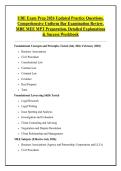
UBE Exam Prep 2026 Updated Practice Questions,
Comprehensive Uniform Bar Examination Review,
MBE MEE MPT Preparation, Detailed Explanations
& Success Workbook
Foundational Concepts and Principles Tested (July 2026–February 2028)
• Business Associations
• Civil Procedure
• Constitutional Law
• Contract Law
• Criminal Law
• Evidence
• Real Property
• Torts
Foundational Lawyering Skills Tested
• Legal Research
• Legal Writing
• Issue Spotting and Analysis
• Investigation and Evaluation
• Client Counseling and Advising
• Negotiation and Dispute Resolution
• Client Relationship and Management
MEE Subjects (Effective July 2026)
• Business Associations (Agency and Partnership; Corporations and LLCs)
• Civil Procedure
, • Constitutional Law
• Contracts
• Criminal Law & Procedure
• Evidence
• Real Property
• Torts
Subjects Removed from MEE Starting July 2026
• Conflict of Laws
• Family Law
• Trusts and Estates
• Secured Transactions
SECTION I: CIVIL PROCEDURE (Questions 1–15)
Question 1
A plaintiff files a complaint in federal court against a corporation headquartered in
State A. The plaintiff is a citizen of State B. The amount in controversy is $85,000.
The defendant corporation has its principal place of business in State A and is
incorporated in State A. The plaintiff properly serves the defendant. The defendant
moves to dismiss for lack of subject matter jurisdiction. How should the court rule?
A. Grant the motion, because the amount in controversy does not exceed $75,000
B. Grant the motion, because there is not complete diversity of citizenship
C. Deny the motion, because there is diversity jurisdiction
D. Deny the motion, because federal question jurisdiction exists
Correct Answer: C
Rationale: Diversity jurisdiction requires: (1) complete diversity of citizenship
between plaintiffs and defendants, and (2) an amount in controversy exceeding
$75,000. Here, the plaintiff is a citizen of State B, and the defendant corporation is
a citizen of State A (both its state of incorporation and principal place of business
are State A). There is complete diversity. The amount in controversy is $85,000,
,which exceeds the $75,000 threshold. Therefore, diversity jurisdiction exists. There
is no federal question apparent on the face of the complaint, so D is incorrect. The
motion should be denied.
Question 2
A plaintiff files a lawsuit in federal court asserting a claim under federal law. The
defendant files a motion to dismiss for failure to state a claim upon which relief
can be granted. In deciding the motion, the court may consider:
A. Only the allegations in the complaint
B. The allegations in the complaint and any documents attached to the complaint
C. The allegations in the complaint, documents attached to the complaint, and
matters subject to judicial notice
D. All of the above, plus affidavits submitted by the parties
Correct Answer: C
Rationale: On a Rule 12(b)(6) motion to dismiss for failure to state a claim, the
court generally considers only the complaint's allegations. However, the court may
also consider documents attached to the complaint, documents incorporated by
reference, and matters subject to judicial notice. Affidavits (D) are not considered
on a 12(b)(6) motion — if the court considers matters outside the pleadings, the
motion is converted to a motion for summary judgment under Rule 56.
Question 3
A plaintiff files a complaint in federal court alleging diversity jurisdiction. The
complaint states that the plaintiff is a citizen of State A and the defendant is a
citizen of State B. During discovery, the defendant discovers that the plaintiff was
actually a citizen of State B at the time the complaint was filed. The defendant
moves to dismiss for lack of subject matter jurisdiction. What is the proper
standard for the court to apply?
A. The court must dismiss the case because there is no diversity jurisdiction
B. The court may retain jurisdiction if the plaintiff can show that the jurisdictional
allegation was made in good faith
C. The court may retain jurisdiction if the plaintiff can show that the jurisdictional
, allegation was not made in bad faith
D. The court must dismiss the case unless the plaintiff amends the complaint
Correct Answer: B
Rationale: Subject matter jurisdiction is determined at the time the complaint is
filed. However, if a party makes a jurisdictional allegation in good faith, the court
may retain jurisdiction even if the allegation turns out to be incorrect, provided the
party had a reasonable basis for the allegation. The key inquiry is whether the
jurisdictional allegation was made in good faith. If the plaintiff knowingly made a
false allegation, the court would dismiss. But if the plaintiff reasonably believed
the allegation was true, the court may retain jurisdiction.
Question 4
A plaintiff files a complaint in federal court. The defendant is properly served and
files an answer. The defendant also files a motion for judgment on the pleadings.
Which of the following is TRUE about a motion for judgment on the pleadings?
A. It may be filed only before the answer is served
B. It is decided based on the pleadings alone
C. It is the same as a motion to dismiss for failure to state a claim
D. It may be filed only by the plaintiff
Correct Answer: B
Rationale: A motion for judgment on the pleadings under Rule 12(c) is decided
based on the pleadings alone (the complaint and answer). It may be filed after the
pleadings are closed. It is similar to a Rule 12(b)(6) motion but is filed after the
answer. Either party may file such a motion. The court considers only the
pleadings and may not consider matters outside the pleadings.
Question 5
A plaintiff files a complaint in federal court. The defendant fails to answer or
otherwise respond within the time allowed. What must the plaintiff do to obtain a
default judgment?
Comprehensive Uniform Bar Examination Review,
MBE MEE MPT Preparation, Detailed Explanations
& Success Workbook
Foundational Concepts and Principles Tested (July 2026–February 2028)
• Business Associations
• Civil Procedure
• Constitutional Law
• Contract Law
• Criminal Law
• Evidence
• Real Property
• Torts
Foundational Lawyering Skills Tested
• Legal Research
• Legal Writing
• Issue Spotting and Analysis
• Investigation and Evaluation
• Client Counseling and Advising
• Negotiation and Dispute Resolution
• Client Relationship and Management
MEE Subjects (Effective July 2026)
• Business Associations (Agency and Partnership; Corporations and LLCs)
• Civil Procedure
, • Constitutional Law
• Contracts
• Criminal Law & Procedure
• Evidence
• Real Property
• Torts
Subjects Removed from MEE Starting July 2026
• Conflict of Laws
• Family Law
• Trusts and Estates
• Secured Transactions
SECTION I: CIVIL PROCEDURE (Questions 1–15)
Question 1
A plaintiff files a complaint in federal court against a corporation headquartered in
State A. The plaintiff is a citizen of State B. The amount in controversy is $85,000.
The defendant corporation has its principal place of business in State A and is
incorporated in State A. The plaintiff properly serves the defendant. The defendant
moves to dismiss for lack of subject matter jurisdiction. How should the court rule?
A. Grant the motion, because the amount in controversy does not exceed $75,000
B. Grant the motion, because there is not complete diversity of citizenship
C. Deny the motion, because there is diversity jurisdiction
D. Deny the motion, because federal question jurisdiction exists
Correct Answer: C
Rationale: Diversity jurisdiction requires: (1) complete diversity of citizenship
between plaintiffs and defendants, and (2) an amount in controversy exceeding
$75,000. Here, the plaintiff is a citizen of State B, and the defendant corporation is
a citizen of State A (both its state of incorporation and principal place of business
are State A). There is complete diversity. The amount in controversy is $85,000,
,which exceeds the $75,000 threshold. Therefore, diversity jurisdiction exists. There
is no federal question apparent on the face of the complaint, so D is incorrect. The
motion should be denied.
Question 2
A plaintiff files a lawsuit in federal court asserting a claim under federal law. The
defendant files a motion to dismiss for failure to state a claim upon which relief
can be granted. In deciding the motion, the court may consider:
A. Only the allegations in the complaint
B. The allegations in the complaint and any documents attached to the complaint
C. The allegations in the complaint, documents attached to the complaint, and
matters subject to judicial notice
D. All of the above, plus affidavits submitted by the parties
Correct Answer: C
Rationale: On a Rule 12(b)(6) motion to dismiss for failure to state a claim, the
court generally considers only the complaint's allegations. However, the court may
also consider documents attached to the complaint, documents incorporated by
reference, and matters subject to judicial notice. Affidavits (D) are not considered
on a 12(b)(6) motion — if the court considers matters outside the pleadings, the
motion is converted to a motion for summary judgment under Rule 56.
Question 3
A plaintiff files a complaint in federal court alleging diversity jurisdiction. The
complaint states that the plaintiff is a citizen of State A and the defendant is a
citizen of State B. During discovery, the defendant discovers that the plaintiff was
actually a citizen of State B at the time the complaint was filed. The defendant
moves to dismiss for lack of subject matter jurisdiction. What is the proper
standard for the court to apply?
A. The court must dismiss the case because there is no diversity jurisdiction
B. The court may retain jurisdiction if the plaintiff can show that the jurisdictional
allegation was made in good faith
C. The court may retain jurisdiction if the plaintiff can show that the jurisdictional
, allegation was not made in bad faith
D. The court must dismiss the case unless the plaintiff amends the complaint
Correct Answer: B
Rationale: Subject matter jurisdiction is determined at the time the complaint is
filed. However, if a party makes a jurisdictional allegation in good faith, the court
may retain jurisdiction even if the allegation turns out to be incorrect, provided the
party had a reasonable basis for the allegation. The key inquiry is whether the
jurisdictional allegation was made in good faith. If the plaintiff knowingly made a
false allegation, the court would dismiss. But if the plaintiff reasonably believed
the allegation was true, the court may retain jurisdiction.
Question 4
A plaintiff files a complaint in federal court. The defendant is properly served and
files an answer. The defendant also files a motion for judgment on the pleadings.
Which of the following is TRUE about a motion for judgment on the pleadings?
A. It may be filed only before the answer is served
B. It is decided based on the pleadings alone
C. It is the same as a motion to dismiss for failure to state a claim
D. It may be filed only by the plaintiff
Correct Answer: B
Rationale: A motion for judgment on the pleadings under Rule 12(c) is decided
based on the pleadings alone (the complaint and answer). It may be filed after the
pleadings are closed. It is similar to a Rule 12(b)(6) motion but is filed after the
answer. Either party may file such a motion. The court considers only the
pleadings and may not consider matters outside the pleadings.
Question 5
A plaintiff files a complaint in federal court. The defendant fails to answer or
otherwise respond within the time allowed. What must the plaintiff do to obtain a
default judgment?

