
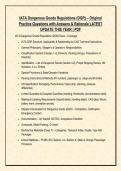
IATA Dangerous Goods Regulations (DGR) – Original
Practice Questions with Answers & Rationale LATEST
UPDATE THIS YEAR | PDF
IATA Dangerous Goods Regulations (DGR) Exam –Coverage
IATA DGR Structure, Applicability & Relationship to ICAO Technical Instructions
General Philosophy, Shipper’s & Operator’s Responsibilities
Classification System (Classes 1–9, Divisions, Packing Groups, Precedence of
Hazards)
Identification – List of Dangerous Goods (Section 4.2), Proper Shipping Names, UN
Numbers, n.o.s. Entries
Special Provisions & State/Operator Variations
Packing Instructions & Methods (PI numbers, passenger vs. cargo aircraft limits)
UN Specification Packaging, Performance Tests (drop, stacking, pressure
differential)
Limited Quantities & Excepted Quantities (marking, thresholds, documentation relief)
Marking & Labeling Requirements (hazard labels, handling labels, CAO label, lithium
battery mark, orientation arrows)
Shipper’s Declaration for Dangerous Goods (DGD) – Completion, Certification,
Emergency Contact
Documentation – Air Waybill, NOTOC, Acceptance Checklist
Overpacks, Mixed Packing, Q-Value
Radioactive Materials (Class 7) – Categories, Transport Index, Fissile, Type A/B
Packages
Lithium Batteries – PI 965–970, Section I vs. Section II, State of Charge, Passenger
Provisions
, Infectious Substances – Category A (PI 620), Category B (UN3373, PI 650), Exempt
Specimens
Dry Ice (UN1845) – Declaration, Marking, Refrigerant Use
Explosives (Class 1) – Divisions, Compatibility Groups, Passenger/Cargo
Restrictions
Gases, Flammable Liquids, Solids, Oxidizers, Organic Peroxides,
Toxic/Corrosive/Miscellaneous
Segregation & Stowage on Aircraft (Table 9.3.A)
Passenger & Crew Baggage Provisions (Table 2.3.A)
Emergency Response – Drill Codes, ERG, Spill/Leak Procedures, Incident Reporting
Security – High Consequence Dangerous Goods, Security Awareness Training
Training Requirements – Categories, Recurrency (24 months), Recordkeeping (36
months)
Acceptance Procedures & Dangerous Goods Checklist
Retention Periods (DGD, Checklist, Training Records)
Forbidden Items, Cargo Aircraft Only, Hidden Dangerous Goods
Q1. Which organization publishes the Dangerous Goods Regulations for air transport?
A) ICAO
B) IATA
C) FAA
D) UN
,Answer: B – IATA publishes the DGR; ICAO publishes the Technical Instructions.
Q2. The IATA DGR is based primarily on the:
A) IMDG Code
B) ICAO Technical Instructions
C) ADR
D) UN Model Regulations
Answer: B – The DGR incorporates the ICAO Technical Instructions and adds additional
operational requirements.
Q3. Dangerous goods are defined as articles or substances capable of posing a significant
risk to:
A) Health, safety, property, or the environment
B) The economy
C) The aircraft's speed
D) Passengers only
Answer: A – As per the DGR, dangerous goods can pose a risk to health, safety, property,
or the environment.
Q4. What are the three primary packing groups based on the degree of danger?
A) I, II, III
B) A, B, C
, C) 1, 2, 3
D) High, Medium, Low
Answer: A – Packing Group I indicates great danger, II medium danger, III minor danger.
Q5. The primary hazard of a dangerous good with multiple risks is determined by the:
A) Packaging group
B) Precedence of hazards table
C) Shipper's preference
D) Alphabetical order
Answer: B – The classification system uses a precedence of hazards table to assign the
primary class/division.
Q6. Which hazard class includes explosives?
A) Class 1
B) Class 2
C) Class 3
D) Class 4
Answer: A – Explosives are Class 1.
Q7. Division 1.1 refers to:
A) Articles with a mass explosion hazard
B) Articles with a projection hazard

