

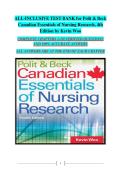
ALL-INCLUSIVE TEST BANK for Polit & Beck
Canadian Essentials of Nursing Research, 4th
Edition by Kevin Woo
COMPLETE CHAPTERS 1-18| VERIFIED QUESTIONS
AND 100% ACCURATE ANSWERS
ALL ANSWERS ARE AT THE END OF EACH CHAPTER
TB
Ac
1
er
,Chapter 1: Introduction to Nursing Research in an Evidence-Based Practice Environment
1. What is the highest priority for the importance of research in the nursing profession?
A) Research findings provide evidence for informing nurses' decisions and actions.
B) Conduct research to better understand the context of nursing practice.
C) Document the role that nurses serve in society.
D) Establish nursing research areas of study.
2. Which group would be best served by clinical nursing research?
A) Nursing administrators
B) Practicing nurses
C) Nurses' clients
D) Healthcare policymakers
3. In the United States, in what area does research play an important role in nursing?
A) Chronic illness
B) Credentialing and status
C) Nurses' personalities
D) Nurses' education
4. What is the role of a consumer of nursing research?
A) Read research reports for relevant findings.
B) Participate in generating evidence by doing research.
C) Participate in journal club in a practice setting.
D) Solve clinical problems and make clinical decisions.
TB
Ac
2
er
,5. What was the concern of most nursing studies in the early 1900s?
A) Client satisfaction
B) Clinical problems
C) Health promotion
D) Nursing education
6. Which topic most closely conforms to the priorities that have been suggested for future nursing research?
A) Attitudes of nursing students toward smoking.
B) Promotion of excellence in nursing science.
C) Nursing staff morale and turnover.
D) Number of doctorate prepared nurses in various clinical specialties.
7. What is the process of deductive reasoning?
A) Verifying assumptions that are part of our heritage.
B) Developing specific predictions from general principles.
C) Empirically testing observations that are made known through our senses.
D) Forming generalizations from specific observations.
8. What is the ontological assumption of those espousing a naturalistic paradigm?
A) Objective reality and those natural phenomena are regular and orderly.
B) Phenomena are not haphazard and result from prior causes.
C) Reality is multiply constructed and multiply interpreted by humans.
D) Reality is not fixed, but is rather a construction of human minds.
9. What is the epistemological assumption of those espousing a positivist paradigm?
A) The researcher is objective and independent of those being studied.
TB
B) Phenomena are not haphazard, but rather have antecedent causes.
Ac
3
er
, C) The researcher instructs those being studied to be objective in providing information.
D) Reality is not fixed, but is rather a construction of human minds.
10. Which is not a characteristic of traditional scientific method?
A) Control over external factors.
B) Systematic measurement and observation of natural phenomena.
C) Deductive reasoning.
D) Emphasis on a holistic view of a phenomenon, studied in a rich context.
11. What is empiricism?
A) Making generalizations from specific observations.
B) Deducing specific predictions from generalizations.
C) Gathering evidence rooted in reality.
D) Verifying the assumptions on which the study was based.
12. What is a hallmark of the scientific method?
A) Infallible
B) Holistic
C) Systematic
D) Flexible
13. Which of the following limits the power of the scientific method to answer questions about human life?
A) The necessity of departing from traditional beliefs.
B) The difficulty of accurately measuring complex human traits.
C) The inability to control potential biases.
D) The shortage of theories about human behavior.
TB
Ac
4
er
Canadian Essentials of Nursing Research, 4th
Edition by Kevin Woo
COMPLETE CHAPTERS 1-18| VERIFIED QUESTIONS
AND 100% ACCURATE ANSWERS
ALL ANSWERS ARE AT THE END OF EACH CHAPTER
TB
Ac
1
er
,Chapter 1: Introduction to Nursing Research in an Evidence-Based Practice Environment
1. What is the highest priority for the importance of research in the nursing profession?
A) Research findings provide evidence for informing nurses' decisions and actions.
B) Conduct research to better understand the context of nursing practice.
C) Document the role that nurses serve in society.
D) Establish nursing research areas of study.
2. Which group would be best served by clinical nursing research?
A) Nursing administrators
B) Practicing nurses
C) Nurses' clients
D) Healthcare policymakers
3. In the United States, in what area does research play an important role in nursing?
A) Chronic illness
B) Credentialing and status
C) Nurses' personalities
D) Nurses' education
4. What is the role of a consumer of nursing research?
A) Read research reports for relevant findings.
B) Participate in generating evidence by doing research.
C) Participate in journal club in a practice setting.
D) Solve clinical problems and make clinical decisions.
TB
Ac
2
er
,5. What was the concern of most nursing studies in the early 1900s?
A) Client satisfaction
B) Clinical problems
C) Health promotion
D) Nursing education
6. Which topic most closely conforms to the priorities that have been suggested for future nursing research?
A) Attitudes of nursing students toward smoking.
B) Promotion of excellence in nursing science.
C) Nursing staff morale and turnover.
D) Number of doctorate prepared nurses in various clinical specialties.
7. What is the process of deductive reasoning?
A) Verifying assumptions that are part of our heritage.
B) Developing specific predictions from general principles.
C) Empirically testing observations that are made known through our senses.
D) Forming generalizations from specific observations.
8. What is the ontological assumption of those espousing a naturalistic paradigm?
A) Objective reality and those natural phenomena are regular and orderly.
B) Phenomena are not haphazard and result from prior causes.
C) Reality is multiply constructed and multiply interpreted by humans.
D) Reality is not fixed, but is rather a construction of human minds.
9. What is the epistemological assumption of those espousing a positivist paradigm?
A) The researcher is objective and independent of those being studied.
TB
B) Phenomena are not haphazard, but rather have antecedent causes.
Ac
3
er
, C) The researcher instructs those being studied to be objective in providing information.
D) Reality is not fixed, but is rather a construction of human minds.
10. Which is not a characteristic of traditional scientific method?
A) Control over external factors.
B) Systematic measurement and observation of natural phenomena.
C) Deductive reasoning.
D) Emphasis on a holistic view of a phenomenon, studied in a rich context.
11. What is empiricism?
A) Making generalizations from specific observations.
B) Deducing specific predictions from generalizations.
C) Gathering evidence rooted in reality.
D) Verifying the assumptions on which the study was based.
12. What is a hallmark of the scientific method?
A) Infallible
B) Holistic
C) Systematic
D) Flexible
13. Which of the following limits the power of the scientific method to answer questions about human life?
A) The necessity of departing from traditional beliefs.
B) The difficulty of accurately measuring complex human traits.
C) The inability to control potential biases.
D) The shortage of theories about human behavior.
TB
Ac
4
er

