

WGU C790 EXAM 300 ACTUAL QUESTIONS AND
CORRECT ANSWERS WITH RATIONALE
LATEST UPDATE ALREADY GRADED A+
ASSURED PASS
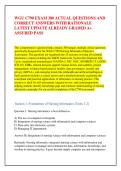
This comprehensive question bank contains 300 unique, multiple-choice questions
specifically designed for the WGU C790 Nursing Informatics Objective
Assessment. The questions are organized into 25 sections covering all essential
informatics content including the DIKW framework, System Development Life
Cycle, standardized terminologies (NANDA-I, NIC, NOC, SNOMED CT, LOINC,
ICD-10), EHRs, clinical decision support, human factors and usability, project
management, evidence-based practice models, data governance, security and
privacy (HIPAA), and emerging trends like telehealth and artificial intelligence.
Each question includes a correct answer and a detailed rationale explaining the
conceptual and practical applications of informatics in nursing practice. This
resource is ideal for self-assessment, targeted review, and exam preparation,
helping students identify knowledge gaps and reinforce understanding of nursing
informatics principles for successful completion of the C790 assessment.
Section 1: Foundations of Nursing Informatics (Units 1-2)
Question 1: Nursing informatics is best defined as:
A) The use of computers in hospitals
B) Integration of nursing science with information and computer sciences
C) Data entry into electronic systems
D) Managing IT departments
Answer: B) Integration of nursing science with information and computer sciences
Rationale: Nursing informatics integrates nursing science with information and
computer sciences to manage and communicate data, information, knowledge, and
wisdom in nursing practice. It goes beyond simple computer use and encompasses
,the full scope of information management to support clinical decision-making and
improve patient outcomes .
Question 2: A nurse enters a patient's blood pressure reading of "120/80" into the
electronic health record. Before any clinical context is applied, this value is
considered:
A) Information
B) Knowledge
C) Wisdom
D) Data
Answer: D) Data
Rationale: Data are discrete, objective facts or measurements without
interpretation. The blood pressure reading becomes information when interpreted
within clinical context (e.g., "patient's blood pressure is elevated"). Knowledge
involves synthesis, and wisdom represents applied clinical judgment .
Question 3: When lab results are interpreted as "hyperkalemia," this represents:
A) Data
B) Information
C) Knowledge
D) Wisdom
Answer: C) Knowledge
Rationale: Recognizing abnormal potassium levels as hyperkalemia reflects
applied understanding of the clinical significance of lab values. This represents
knowledge in the DIKW framework. Data are raw values, information provides
context, and wisdom involves clinical decision-making based on knowledge .
Question 4: Wisdom in the DIKW model involves:
A) Charting findings
B) Critical decision-making
C) Collecting statistics
D) Storing data
,Answer: B) Critical decision-making
Rationale: Wisdom reflects clinical judgment and appropriate action based on
knowledge. It is the highest level of the DIKW framework and involves applying
knowledge to make sound clinical decisions that benefit patients .
Question 5: Which statement best describes the DIKW framework?
A) It is a linear hierarchy where each level builds upon the previous one
B) It is a cyclical process where data always comes first
C) It is only applicable to research settings
D) It excludes clinical decision-making
Answer: A) It is a linear hierarchy where each level builds upon the previous one
Rationale: The DIKW framework describes a hierarchical relationship where data
becomes information, then knowledge, then wisdom. Each level builds upon and
transforms the previous level to create increasingly meaningful and actionable
insights for clinical practice .
Question 6: The goal of evidence-based practice (EBP) is:
A) To reduce healthcare costs
B) Improvement of systems and microsystems within healthcare based on science
C) To increase patient satisfaction scores
D) To reduce documentation time
Answer: B) Improvement of systems and microsystems within healthcare based on
science
Rationale: The goal of EBP is improvement of systems and microsystems within
healthcare, with these improvements based on science. EBP transforms research
findings into practical applications that improve patient outcomes and the quality
of care .
Question 7: The STEEEP principles were established by which organization?
A) World Health Organization (WHO)
B) Institute of Medicine (IOM)
C) Centers for Disease Control (CDC)
, D) American Nurses Association (ANA)
Answer: B) Institute of Medicine (IOM)
Rationale: The Institute of Medicine (IOM) expert panel issued recommendations
for urgent action to redesign healthcare so that it is safe, timely, effective, efficient,
equitable, and patient-centered (STEEEP) .
Question 8: In the STEEEP framework, the "S" stands for:
A) Systematic
B) Safe
C) Sustainable
D) Standardized
Answer: B) Safe
Rationale: The "S" in STEEEP stands for Safe—avoid injuries to patients from the
care that is intended to help them. This is one of the six IOM quality aims for
healthcare redesign .
Question 9: In the STEEEP framework, the "T" stands for:
A) Trustworthy
B) Timely
C) Transparent
D) Team-based
Answer: B) Timely
Rationale: The "T" in STEEEP stands for Timely—reduce waits and sometimes
harmful delays for both those who receive and those who give care. This is one of
the six IOM quality aims for healthcare redesign .
Question 10: In the STEEEP framework, the first "E" stands for:
A) Efficient
B) Effective
C) Equitable
D) Evidence-based
CORRECT ANSWERS WITH RATIONALE
LATEST UPDATE ALREADY GRADED A+
ASSURED PASS
This comprehensive question bank contains 300 unique, multiple-choice questions
specifically designed for the WGU C790 Nursing Informatics Objective
Assessment. The questions are organized into 25 sections covering all essential
informatics content including the DIKW framework, System Development Life
Cycle, standardized terminologies (NANDA-I, NIC, NOC, SNOMED CT, LOINC,
ICD-10), EHRs, clinical decision support, human factors and usability, project
management, evidence-based practice models, data governance, security and
privacy (HIPAA), and emerging trends like telehealth and artificial intelligence.
Each question includes a correct answer and a detailed rationale explaining the
conceptual and practical applications of informatics in nursing practice. This
resource is ideal for self-assessment, targeted review, and exam preparation,
helping students identify knowledge gaps and reinforce understanding of nursing
informatics principles for successful completion of the C790 assessment.
Section 1: Foundations of Nursing Informatics (Units 1-2)
Question 1: Nursing informatics is best defined as:
A) The use of computers in hospitals
B) Integration of nursing science with information and computer sciences
C) Data entry into electronic systems
D) Managing IT departments
Answer: B) Integration of nursing science with information and computer sciences
Rationale: Nursing informatics integrates nursing science with information and
computer sciences to manage and communicate data, information, knowledge, and
wisdom in nursing practice. It goes beyond simple computer use and encompasses
,the full scope of information management to support clinical decision-making and
improve patient outcomes .
Question 2: A nurse enters a patient's blood pressure reading of "120/80" into the
electronic health record. Before any clinical context is applied, this value is
considered:
A) Information
B) Knowledge
C) Wisdom
D) Data
Answer: D) Data
Rationale: Data are discrete, objective facts or measurements without
interpretation. The blood pressure reading becomes information when interpreted
within clinical context (e.g., "patient's blood pressure is elevated"). Knowledge
involves synthesis, and wisdom represents applied clinical judgment .
Question 3: When lab results are interpreted as "hyperkalemia," this represents:
A) Data
B) Information
C) Knowledge
D) Wisdom
Answer: C) Knowledge
Rationale: Recognizing abnormal potassium levels as hyperkalemia reflects
applied understanding of the clinical significance of lab values. This represents
knowledge in the DIKW framework. Data are raw values, information provides
context, and wisdom involves clinical decision-making based on knowledge .
Question 4: Wisdom in the DIKW model involves:
A) Charting findings
B) Critical decision-making
C) Collecting statistics
D) Storing data
,Answer: B) Critical decision-making
Rationale: Wisdom reflects clinical judgment and appropriate action based on
knowledge. It is the highest level of the DIKW framework and involves applying
knowledge to make sound clinical decisions that benefit patients .
Question 5: Which statement best describes the DIKW framework?
A) It is a linear hierarchy where each level builds upon the previous one
B) It is a cyclical process where data always comes first
C) It is only applicable to research settings
D) It excludes clinical decision-making
Answer: A) It is a linear hierarchy where each level builds upon the previous one
Rationale: The DIKW framework describes a hierarchical relationship where data
becomes information, then knowledge, then wisdom. Each level builds upon and
transforms the previous level to create increasingly meaningful and actionable
insights for clinical practice .
Question 6: The goal of evidence-based practice (EBP) is:
A) To reduce healthcare costs
B) Improvement of systems and microsystems within healthcare based on science
C) To increase patient satisfaction scores
D) To reduce documentation time
Answer: B) Improvement of systems and microsystems within healthcare based on
science
Rationale: The goal of EBP is improvement of systems and microsystems within
healthcare, with these improvements based on science. EBP transforms research
findings into practical applications that improve patient outcomes and the quality
of care .
Question 7: The STEEEP principles were established by which organization?
A) World Health Organization (WHO)
B) Institute of Medicine (IOM)
C) Centers for Disease Control (CDC)
, D) American Nurses Association (ANA)
Answer: B) Institute of Medicine (IOM)
Rationale: The Institute of Medicine (IOM) expert panel issued recommendations
for urgent action to redesign healthcare so that it is safe, timely, effective, efficient,
equitable, and patient-centered (STEEEP) .
Question 8: In the STEEEP framework, the "S" stands for:
A) Systematic
B) Safe
C) Sustainable
D) Standardized
Answer: B) Safe
Rationale: The "S" in STEEEP stands for Safe—avoid injuries to patients from the
care that is intended to help them. This is one of the six IOM quality aims for
healthcare redesign .
Question 9: In the STEEEP framework, the "T" stands for:
A) Trustworthy
B) Timely
C) Transparent
D) Team-based
Answer: B) Timely
Rationale: The "T" in STEEEP stands for Timely—reduce waits and sometimes
harmful delays for both those who receive and those who give care. This is one of
the six IOM quality aims for healthcare redesign .
Question 10: In the STEEEP framework, the first "E" stands for:
A) Efficient
B) Effective
C) Equitable
D) Evidence-based

