
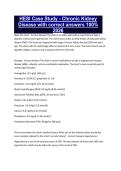
HESI Case Study - Chronic Kidney
Disease with correct answers 100%
2026
Meet the client - Correct Answers The client is an older adult with a long history of type 2
diabetes mellitus and hypertension. The client record notes a family history of polycystic kidney
disease (PKD). The client was diagnosed with stage 4 chronic kidney disease (CKD) two years
ago. The client calls the nephrology office to speak to the clinic nurse. The client reports loss of
appetite, fatigue, nocturia, and occasional shortness of breath.
Etiology - Correct Answers The client's current medications include a angiotension receptor
blocker (ARB), a diuretic, and an oral diabetic medication. The client's most recent lab work (3
months ago) includes:
Hemoglobin: 10.5 g/dL (105 g/L)
Hematocrit: 30.0% (0.3 proportion of 1.0)
Creatinine: 2.25 mg/dL (171.56 mcmol/L)
Blood Urea Nitrogen (BUN): 25 mg/dL (8.92 mmol/L)
Glomerular Filtration Rate (GFR): 28 mL/min/1.73m2
Sodium: 132 mEq/L (132 mmol/L)
Potassium: 3.8 mEq/L (3.8 mmol/L)
Calcium: 8.9 mg/dL (2.23 mmol/L)
Phosphorus: 4.0 mg/dL (1.29 mmol/L)
Parathyroid Hormone (PTH): 98 pg/mL (98 ng/L)
The nurse reviews the client's medical history. What part of the medical history should the
nurse consider relevant to the client's current history? - Correct Answers Hypertension.
Hypertension is one of the primary causes of CKD. The vast majority of clients with CKD have
hypertension, which may be either the cause or the result of CKD.
,Polycystic kidney disease.
PKD gene mutation will develop kidney cysts by age 30. Half of these people develop chronic
kidney disease (CKD) by age 50 years.
Diabetes Mellitus.
Uncontrolled diabetes is a leading causative factor in renal disease.
Which additional symptoms should the nurse ask about? - Correct Answers Nausea
Ammonia is a breakdown product of urea. When ammonia accumulates in the gastrointestinal
tract, it causes irritation, nausea, vomiting, a metallic taste in the mouth, and bleeding.
Decreased attention span.
Problems ranging from lethargy to seizures or coma, which may indicate uremic
encephalopathy.
Itching
Calcium phosphate crystals and urea accumulate in the skin, causing itching.
Based on the client's symptoms, what should the nurse suspect? - Correct Answers The client
has uremia and may need to start dialysis.
Classic signs of uremia are nausea, vomiting, fatigue, weight loss, anorexia, muscle cramps,
pruritis, and a change in mental status.
The nurse determines that the client is demonstrating progression of chronic kidney disease and
is uremic.
The nurse is teaching the client about progression of chronic kidney disease (CKD). Which
evaluation statement documented by the nurse indicates the client's understanding of the
, disease process? - Correct Answers The client acknowledges that renal replacement therapy will
need to be initiated immediately to rid the body of waste and maintain fluid balance.
CKD is fatal unless some form of renal replacement therapy such as dialysis or organ
transplantation is done.
Diagnostic evaluation - Correct Answers The nurse contacts the healthcare provider (HCP)
regarding the client's symptoms. The HCP orders laboratory testing.
The following diagnostic tests are performed and results are as follows:
Hemoglobin: 7.8 g/dL (78 g/L)
Hematocrit: 30% (0.30 proportion of 1.0)
Creatinine: 4.5 mg/dL (397.80 mcmol/L)
Blood urea nitrogen (BUN): 100 mg/dL (35.7 mmol/L)
Glomerular filtration rate (GFR): 9 mL/min/1.73m2
Sodium: 135 mEql/L (135 mmol/L)
Potassium: 5.5 mEq/L (5.5 mmol/L)
Calcium: 9.2 mg/dL (2.3 mmol/L)
Phosphorus: 5.5 mg/dL (1.78 mmol/L)
Parathyroid hormone: 182 pg/mL (182 mg/L)
Arterial blood gases: pH 7.35, PO2 96 mmHg, PCO2 30 mmHg, HCO3 18 mEq/L (18 mmol/L)
Which lab value would the nurse be most concerned about? - Correct Answers Glomerular
filtration rate (GFR) of 9 mL/min/1.73m2.
Estimated glomerular filtration rate (GFR) is the best test to measure level of kidney function
and determine stage of kidney disease.
The client's hemoglobin level is 7.8 g/dL (78 g/L). What action should the nurse take? - Correct
Answers Obtain an order to start an erythropoietin stimulating agent (ESA).

