
• ¿Documento equivocado? Cámbialo gratis
  • Escrito por estudiantes que aprobaron
  • Inmediatamente disponible después del pago
  • Leer en línea o como PDF
Vender
¿Dónde estudias?
Tu idioma
Document preview thumbnail
Vista previa 1 fuera de 2 páginas
Notas de lectura

This image explain what is a structure

Document preview thumbnail
Vista previa 1 fuera de 2 páginas

Cells are the fundamental building blocks of all living organisms. They are the smallest unit of life capable of performing all life processes. Every organism, from a tiny bacterium to a massive oak tree, is made of cells. Organisms can be unicellular, consisting of a single cell, or they can be multicellular, composed of billions of specialized cells. The study of cells is known as cell biology or cytology. Robert Hooke was the first scientist to discover cells in 1665. He observed a thin slice of cork under a microscope and saw box-like structures. He named these structures 'cells' because they looked like the rooms monks lived in. Over time, scientists developed the Cell Theory to explain the nature of cells. The Cell Theory states that all living things are made of one or more cells. It also states that cells are the basic units of structure and function in living things. Furthermore, the theory says that all cells come from pre-existing cells through division. Despite their small size, cells are highly organized and complex structures. Every cell contains genetic material in the form of DNA. DNA holds the instructions for all cell activities. Within the cell, several structures called organelles perform specific jobs. The nucleus is the control center of the cell, holding the genetic material. The cytoplasm is a jelly-like substance that fills the cell and surrounds the organelles. The cell membrane acts as a protective barrier and controls what enters and leaves. Plant cells have an additional rigid cell wall for support and structure. They also contain chloroplasts, which use sunlight to make food through photosynthesis. Ribosomes are responsible for making proteins. The endoplasmic reticulum is involved in protein and lipid synthesis. The Golgi apparatus modifies, sorts, and packages proteins for delivery. Mitochondria, often called the powerhouses of the cell, generate energy through cellular respiration. Lysosomes contain enzymes to break down waste materials and cellular debris. Vacuoles store water, nutrients, and waste products, and are much larger in plant cells. The cytoskeleton provides the cell with shape and internal organization. Cell division is essential for growth, repair, and reproduction. There are two main types of cell division: mitosis and meiosis. Mitosis creates identical body cells for growth and repair. Meiosis produces gametes, such as sperm and egg cells, with half the genetic material for sexual reproduction. Cell communication allows cells to send and receive signals to coordinate functions. Stem cells are unique cells that can develop into many different types of cells. Cancer occurs when cells divide uncontrollably and form tumors. In summary, cells are the essential building blocks that make all life possible.

Vista previa del contenido

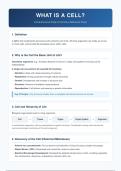
WHAT IS A CELL?
Comprehensive Study & Summary Reference Sheet


1. Definition

A cell is the fundamental structural and functional unit of life. All living organisms are made up of one
or more cells, and all vital life processes occur within cells.


2. Why is the Cell the Basic Unit of Life?

Unicellular organisms (e.g., Amoeba, Bacteria) consist of a single cell capable of carrying out life
independently.

A single cell can perform all essential life functions:
• Nutrition: Intake and intake processing of nutrients
• Respiration: Energy production through cellular processes
• Growth: Development and increase in structural size
• Excretion: Removal of metabolic waste products
• Reproduction: Cell division and passing on genetic information

Key Principle: Any structure smaller than a complete cell cannot survive on its own.


3. Cell and Hierarchy of Life

Biological organization levels in living organisms:


Cell → Tissue → Organ → Organ System → Organism


In multicellular organisms, cells are specialized for specific functions. Coordination among cells ensures the
survival and proper functioning of the entire organism.


4. Discovery of the Cell (Historical Milestones)

• Antonie van Leeuwenhoek: First to observe and describe a living cell using a simple microscope.
• Robert Brown (1831): Discovered and named the nucleus in plant cells.
• Electron Microscope Development: Revealed the detailed ultrastructure of cells, including organelles
like mitochondria, ribosomes, endoplasmic reticulum (ER), etc.


Libro relacionado
 image
NCERT Science
Editorial: 2007 ISBN: 9788174506542 Edición: Desconocido

Información del documento

Año escolar
1
Subido en
8 de agosto de 2026
Número de páginas
2
Escrito en
2026/2027
Tipo
Notas de lectura
Profesor(es)
Cell
Contiene
Todas las clases
$12.09

¿Documento equivocado? Cámbialo gratis Dentro de los 14 días posteriores a la compra y antes de descargarlo, puedes elegir otro documento. Puedes gastar el importe de nuevo.
Escrito por estudiantes que aprobaron
Inmediatamente disponible después del pago
Leer en línea o como PDF

Vendido
0
Seguidores
0
Artículos
1
Última venta
-


Por qué los estudiantes eligen Stuvia

Creado por compañeros estudiantes, verificado por reseñas

Calidad en la que puedes confiar: escrito por estudiantes que aprobaron y evaluado por otros que han usado estos resúmenes.

¿No estás satisfecho? Elige otro documento

¡No te preocupes! Puedes elegir directamente otro documento que se ajuste mejor a lo que buscas.

Paga como quieras, empieza a estudiar al instante

Sin suscripción, sin compromisos. Paga como estés acostumbrado con tarjeta de crédito y descarga tu documento PDF inmediatamente.

Student with book image

“Comprado, descargado y aprobado. Así de fácil puede ser.”

Alisha Student

Preguntas frecuentes
