
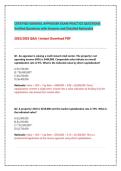
CERTIFIED GENERAL APPRAISER EXAM PRACTICE QUESTIONS
Verified Questions with Answers and Detailed Rationales
2025/2026 Q&A | Instant Download PDF
Q1. An appraiser is valuing a multi-tenant retail center. The property’s net
operating income (NOI) is $480,000. Comparable sales indicate an overall
capitalization rate of 8%. What is the indicated value by direct capitalization?
A) $5,760,000
B) **$6,000,000**
C) $6,250,000
D) $6,400,000
Rationale: Value = NOI ÷ Cap Rate = $480,000 ÷ 0.08 = $6,000,000. Direct
capitalization converts a single year's income into a value indication by dividing it by the
capitalization rate derived from market data .
Q2. A property’s NOI is $250,000 and the market capitalization rate is 10%. What is
the indicated value?
A) $2,000,000
B) $2,250,000
C) **$2,500,000**
D) $2,750,000
Rationale: Value = NOI ÷ Cap Rate = $250,000 ÷ 0.10 = $2,500,000. This is a
fundamental application of the income approach using direct capitalization .
,Q3. A property sells for $4,000,000 with NOI of $360,000. What is the overall
capitalization rate?
A) 8%
B) 9%
C) 10%
D) 11%
Rationale: Cap Rate = NOI ÷ Sale Price = $360,000 ÷ $4,000,000 = 0.09 = 9%. The
overall capitalization rate is extracted from comparable sales in the market .
Q4. A property has potential gross income of $600,000. Vacancy and collection
loss is 8%. Operating expenses are $250,000. What is the net operating income?
A) **$302,000**
B) $298,000
C) $310,000
D) $320,000
Rationale: Effective Gross Income = $600,000 × 0.92 = $552,000. NOI = $552,000 -
$250,000 = $302,000. NOI is calculated after vacancy losses but before debt service and
income taxes .
Q5. In a discounted cash flow (DCF) analysis, the discount rate primarily reflects:
A) Property tax rate
B) Market rent growth
C) Required yield of investors
D) Depreciation rate
Rationale: The discount rate reflects investor return requirements and perceived risk. It is
the rate used to convert future income streams into present value based on investor
expectations .
,Q6. Yield capitalization differs from direct capitalization because it:
A) Ignores reversion
B) Converts single-year income
C) Discounts multiple future cash flows
D) Uses gross rent multipliers
Rationale: Yield capitalization (also called discounted cash flow analysis) analyzes multi-
year projections and discounts future cash flows and reversion value to present value.
Direct capitalization converts single-year income into value .
Q7. An overall cap rate is derived from:
A) Mortgage terms only
B) Equity yield only
C) Market extraction from comparable sales
D) Property tax ratio
Rationale: The overall capitalization rate (OAR) is extracted from comparable sales by
dividing the NOI of the comparable property by its sale price. Market extraction is the
preferred method for deriving cap rates .
Q8. The band-of-investment technique combines:
A) Market rent and expenses
B) Land and building values
C) Mortgage and equity components
D) Sales and cost data
Rationale: The band-of-investment technique weights the mortgage (debt) component
and the equity component based on their respective contributions to value, reflecting the
weighted average cost of capital .
, Q9. A property's reversion value is $5,000,000 in 5 years. The discount rate is 10%.
The present value factor is approximately 0.621. What is the present value of the
reversion?
A) **$3,105,000**
B) $3,500,000
C) $4,050,000
D) $4,500,000
Rationale: PV of Reversion = Future Value × PV Factor = $5,000,000 × 0.621 =
$3,105,000. The reversion is the anticipated resale value at the end of the holding period .
Q10. What is the terminal capitalization rate in a DCF analysis applied to?
A) First-year NOI
B) Annual expenses
C) Reversion value
D) Mortgage balance
Rationale: The terminal capitalization rate is applied to the stabilized NOI in the year
following the holding period to calculate the reversion (resale) value in the final year of a
DCF analysis .
SECTION 2: HIGHEST AND BEST USE ANALYSIS
Q11. What are the four criteria, in chronological order, that an appraiser must
apply when analyzing the Highest and Best Use of a property?
A) Legally permissible, Financially feasible, Physically possible, Maximally productive
B) Physically possible, Legally permissible, Financially feasible, Maximally
productive
Verified Questions with Answers and Detailed Rationales
2025/2026 Q&A | Instant Download PDF
Q1. An appraiser is valuing a multi-tenant retail center. The property’s net
operating income (NOI) is $480,000. Comparable sales indicate an overall
capitalization rate of 8%. What is the indicated value by direct capitalization?
A) $5,760,000
B) **$6,000,000**
C) $6,250,000
D) $6,400,000
Rationale: Value = NOI ÷ Cap Rate = $480,000 ÷ 0.08 = $6,000,000. Direct
capitalization converts a single year's income into a value indication by dividing it by the
capitalization rate derived from market data .
Q2. A property’s NOI is $250,000 and the market capitalization rate is 10%. What is
the indicated value?
A) $2,000,000
B) $2,250,000
C) **$2,500,000**
D) $2,750,000
Rationale: Value = NOI ÷ Cap Rate = $250,000 ÷ 0.10 = $2,500,000. This is a
fundamental application of the income approach using direct capitalization .
,Q3. A property sells for $4,000,000 with NOI of $360,000. What is the overall
capitalization rate?
A) 8%
B) 9%
C) 10%
D) 11%
Rationale: Cap Rate = NOI ÷ Sale Price = $360,000 ÷ $4,000,000 = 0.09 = 9%. The
overall capitalization rate is extracted from comparable sales in the market .
Q4. A property has potential gross income of $600,000. Vacancy and collection
loss is 8%. Operating expenses are $250,000. What is the net operating income?
A) **$302,000**
B) $298,000
C) $310,000
D) $320,000
Rationale: Effective Gross Income = $600,000 × 0.92 = $552,000. NOI = $552,000 -
$250,000 = $302,000. NOI is calculated after vacancy losses but before debt service and
income taxes .
Q5. In a discounted cash flow (DCF) analysis, the discount rate primarily reflects:
A) Property tax rate
B) Market rent growth
C) Required yield of investors
D) Depreciation rate
Rationale: The discount rate reflects investor return requirements and perceived risk. It is
the rate used to convert future income streams into present value based on investor
expectations .
,Q6. Yield capitalization differs from direct capitalization because it:
A) Ignores reversion
B) Converts single-year income
C) Discounts multiple future cash flows
D) Uses gross rent multipliers
Rationale: Yield capitalization (also called discounted cash flow analysis) analyzes multi-
year projections and discounts future cash flows and reversion value to present value.
Direct capitalization converts single-year income into value .
Q7. An overall cap rate is derived from:
A) Mortgage terms only
B) Equity yield only
C) Market extraction from comparable sales
D) Property tax ratio
Rationale: The overall capitalization rate (OAR) is extracted from comparable sales by
dividing the NOI of the comparable property by its sale price. Market extraction is the
preferred method for deriving cap rates .
Q8. The band-of-investment technique combines:
A) Market rent and expenses
B) Land and building values
C) Mortgage and equity components
D) Sales and cost data
Rationale: The band-of-investment technique weights the mortgage (debt) component
and the equity component based on their respective contributions to value, reflecting the
weighted average cost of capital .
, Q9. A property's reversion value is $5,000,000 in 5 years. The discount rate is 10%.
The present value factor is approximately 0.621. What is the present value of the
reversion?
A) **$3,105,000**
B) $3,500,000
C) $4,050,000
D) $4,500,000
Rationale: PV of Reversion = Future Value × PV Factor = $5,000,000 × 0.621 =
$3,105,000. The reversion is the anticipated resale value at the end of the holding period .
Q10. What is the terminal capitalization rate in a DCF analysis applied to?
A) First-year NOI
B) Annual expenses
C) Reversion value
D) Mortgage balance
Rationale: The terminal capitalization rate is applied to the stabilized NOI in the year
following the holding period to calculate the reversion (resale) value in the final year of a
DCF analysis .
SECTION 2: HIGHEST AND BEST USE ANALYSIS
Q11. What are the four criteria, in chronological order, that an appraiser must
apply when analyzing the Highest and Best Use of a property?
A) Legally permissible, Financially feasible, Physically possible, Maximally productive
B) Physically possible, Legally permissible, Financially feasible, Maximally
productive

