

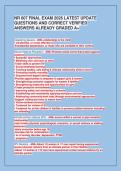
NR 607 FINAL EXAM 2026 LATEST UPDATE
QUESTIONS AND CORRECT VERIFIED
ANSWERS ALREADY GRADED A+
Classifying abusers - ANS--relationship to the child
• intrafamilial, or incest offenders
-Extrafamilial perpetrators, or those who are unrelated to their victims
Sexual Violence Prevention - ANS--Promote social norms that protect against
violence
• Bystander approaches
• Mobilizing men and boys as allies
-Teach skills to prevent SV
• Social-emotional learning
• Teaching healthy, safe dating & intimate relationship skills to teens
• Promoting healthy sexuality
• Empowerment-based training
-Provide opportunities to empower & support girls & women
• Strengthening economic supports for women & families
• Strengthening leadership and opportunities for girls
-Create protective environments
• Improving safety and monitoring in schools
• Establishing and consistently applying workplace policies
• Addressing community-level risks through environmental approaches
-Support victims/survivors to lessen harm
• Victim-centered services
• Treatment for victims of SV
• Treatment for at-risk children & families to prevent problem behavior including
sex offending
intimate partner violence (IPV) - ANS--occurs within a current or past romantic
relationship
-may involve physical, psychological, economic, or sexual violence or stalking
behaviors
-many encounter before age 18
-Increase risk for victimization:
• hx of anxiety disorder, depression, PTSD
• pregnancy
IPV Statistics - ANS--About 1/5 women & 1/7 men report having experienced
severe physical violence from an intimate partner in their lifetime
-About 1/4 women & 1/10 men have experienced contact sexual violence by an
intimate partner
,-10% of women & 2% of men report having been stalked by an intimate partner
-26% of women and 15% of men experienced intimate partner violence for the first
time before age 18
Consequences of IPV - ANS--can lead to serious physical injury & even death
• 35% of female IPV survivors & 11% of male IPV survivors experience physical
injury r/t IPV
• over half of female homicide victims are killed by a current or former male
intimate partner
-Poor health outcomes
• mental: depression, anxiety, PTSD, high-risk behaviors such as substance
misuse
• physical: cardiac, neurological, digestive, & reproductive system disorders
• development of chronic diseases and pain
Perpetrators of IPV - ANS--may be a maladaptive defense against rejection from an
intimate partner, a form of retaliation, or a result of poor conflict resolution
-Many IPV perpetrators suffer from mental health disorders and have experienced
childhood trauma
-hx of borderline personality disorder or antisocial personality disorder is
correlated with an increased risk for IPV perpetration
-close relationship exists between alcohol use and violence
IPV Prevention - ANS--Teach safe and healthy relationship skills
• Social-emotional learning programs for youth
• Healthy relationship programs for couples
-Engage Influential adults and peers
• Men & boys as allies in prevention
• Bystander empowerment & education
• Family-based programs
-Disrupt the developmental pathways toward partner violence
• Early childhood home visitation
• Preschool enrichment with family engagement
• Parenting skill & family relationship programs
• Treatment for at-risk children, youth, & families
-Create protective environments
• Improve school climate & safety
• Improve organizational policies & workplace climate
• Modify the physical & social environments of neighborhoods
-Strengthen economic supports for families
• Strengthen household financial security
• Strengthen work-family supports
-Support survivors to increase safety & lessen harms
• Victim-centered services
• Housing programs
• First responder & civil legal protections
,• Patient-centered approaches
• Treatment & support for survivors of IPV, including teen dating violence
Providing Care to Survivors of Violence - ANS--must be individualized
-Addressing safety needs is critical
-Trauma-informed approaches
• help providers avoid retraumatizing clients
-understand the role stigma & shame play in clients' willingness to ask for
help/support
-Social support (especially emotional & financial) is an important factor in
improving mental health outcomes for survivors
Mandated Reporting - ANS--Many federal & state laws include mandated reporting
requirements r/t abuse & IPV
-requirements for children differ from requirements for adults
Providing Care to Perpetrators of Violence - ANS--CBT & relapse prevention care to
sex offenders & intimate partner violence offenders
• can help reduce recidivism rates
-tailor interventions to the perpetrators' unique characteristics, taking into
account risk factors
• anger or hostility, trauma hx, offending patterns, personality styles, readiness to
change, substance abuse
-Cultural training may be beneficial for providers working with IPV in LGBTQ
relationships
-Often, perpetrators mandated to attend therapy instead of a prison sentence or
as a condition of parole
• When tx not voluntary, may lack self-motivation to change behaviors
• Including motivational strategies such as MI can increase the success of court-
mandated therapy
Duty to Warn - ANS--Most states have laws that either require or allow mental
health professionals to disclose confidential information to protect others from
clients who they believe may become violent
-1976 case Tarasoff v. Regents of the University of California, courts in California
imposed a legal duty to warn third parties if clients posed a risk to the parties'
safety leading to the passage of duty to warn laws in most other states
Complex Post-Traumatic Stress Disorder (CPTSD) - ANS--prolonged & repeated
trauma may be more severe than symptoms caused by time-limited trauma
-have a poorer prognosis and may benefit from different treatments than
individuals with PTSD
-
Complex symptoms of PTSD - ANS--Symptoms
• emotional dysregulation
, • dissociation
• impaired perception of self or perpetrator
• difficulty in relationships
• sense of hopelessness or despair
• loss of faith
-common in clients who have experienced:
• childhood trauma, including sexual abuse
• persons who have been unable to leave a violent situation, such as prisoners of
war
• prolonged intimate partner violence
• victims of human trafficking
Treatment of CPTSD - ANS--cognitive processing therapy (CPT)
-prolonged exposure (PE)
-Skills Training in Affective and Interpersonal Regulation (STAIR)
• allows clients the choice in identifying target problems & interventions
Prolonged exposure - ANS-a treatment approach in which clients confront not only
trauma-related objects and situations, but also their painful memories of
traumatic experiences
-work to approach things you have steered clear of since the event
-challenge the "I can't" rules to prove to self that "you can"
Cognitive processing therapy (CPT) - ANS-psychotherapy to build skills to deal with
effects of trauma in other areas of life
-discuss how "stuck points" (negative thoughts about the trauma) have changed
you
-practice strategies to change/challenge "stuck points"
-usually takes about 3 months of weekly visits
STAIR - ANS-Skills Training in Affective & Interpersonal Regulation
-Evidence-Based Psychotherapy for people struggling with the after effects of
trauma
-Can help with emotions and relationships
-STAIR Coach app
• training plan: suggested activities to help learn & practice skills
• self-care, set goals, tools
• readings
• mood journal, understand & track mood over time
• progress section, assessment
Complementary and Alternative Medicine (CAM) Treatments for CPTSD - ANS--
mindfulness
-acupuncture
-yoga
QUESTIONS AND CORRECT VERIFIED
ANSWERS ALREADY GRADED A+
Classifying abusers - ANS--relationship to the child
• intrafamilial, or incest offenders
-Extrafamilial perpetrators, or those who are unrelated to their victims
Sexual Violence Prevention - ANS--Promote social norms that protect against
violence
• Bystander approaches
• Mobilizing men and boys as allies
-Teach skills to prevent SV
• Social-emotional learning
• Teaching healthy, safe dating & intimate relationship skills to teens
• Promoting healthy sexuality
• Empowerment-based training
-Provide opportunities to empower & support girls & women
• Strengthening economic supports for women & families
• Strengthening leadership and opportunities for girls
-Create protective environments
• Improving safety and monitoring in schools
• Establishing and consistently applying workplace policies
• Addressing community-level risks through environmental approaches
-Support victims/survivors to lessen harm
• Victim-centered services
• Treatment for victims of SV
• Treatment for at-risk children & families to prevent problem behavior including
sex offending
intimate partner violence (IPV) - ANS--occurs within a current or past romantic
relationship
-may involve physical, psychological, economic, or sexual violence or stalking
behaviors
-many encounter before age 18
-Increase risk for victimization:
• hx of anxiety disorder, depression, PTSD
• pregnancy
IPV Statistics - ANS--About 1/5 women & 1/7 men report having experienced
severe physical violence from an intimate partner in their lifetime
-About 1/4 women & 1/10 men have experienced contact sexual violence by an
intimate partner
,-10% of women & 2% of men report having been stalked by an intimate partner
-26% of women and 15% of men experienced intimate partner violence for the first
time before age 18
Consequences of IPV - ANS--can lead to serious physical injury & even death
• 35% of female IPV survivors & 11% of male IPV survivors experience physical
injury r/t IPV
• over half of female homicide victims are killed by a current or former male
intimate partner
-Poor health outcomes
• mental: depression, anxiety, PTSD, high-risk behaviors such as substance
misuse
• physical: cardiac, neurological, digestive, & reproductive system disorders
• development of chronic diseases and pain
Perpetrators of IPV - ANS--may be a maladaptive defense against rejection from an
intimate partner, a form of retaliation, or a result of poor conflict resolution
-Many IPV perpetrators suffer from mental health disorders and have experienced
childhood trauma
-hx of borderline personality disorder or antisocial personality disorder is
correlated with an increased risk for IPV perpetration
-close relationship exists between alcohol use and violence
IPV Prevention - ANS--Teach safe and healthy relationship skills
• Social-emotional learning programs for youth
• Healthy relationship programs for couples
-Engage Influential adults and peers
• Men & boys as allies in prevention
• Bystander empowerment & education
• Family-based programs
-Disrupt the developmental pathways toward partner violence
• Early childhood home visitation
• Preschool enrichment with family engagement
• Parenting skill & family relationship programs
• Treatment for at-risk children, youth, & families
-Create protective environments
• Improve school climate & safety
• Improve organizational policies & workplace climate
• Modify the physical & social environments of neighborhoods
-Strengthen economic supports for families
• Strengthen household financial security
• Strengthen work-family supports
-Support survivors to increase safety & lessen harms
• Victim-centered services
• Housing programs
• First responder & civil legal protections
,• Patient-centered approaches
• Treatment & support for survivors of IPV, including teen dating violence
Providing Care to Survivors of Violence - ANS--must be individualized
-Addressing safety needs is critical
-Trauma-informed approaches
• help providers avoid retraumatizing clients
-understand the role stigma & shame play in clients' willingness to ask for
help/support
-Social support (especially emotional & financial) is an important factor in
improving mental health outcomes for survivors
Mandated Reporting - ANS--Many federal & state laws include mandated reporting
requirements r/t abuse & IPV
-requirements for children differ from requirements for adults
Providing Care to Perpetrators of Violence - ANS--CBT & relapse prevention care to
sex offenders & intimate partner violence offenders
• can help reduce recidivism rates
-tailor interventions to the perpetrators' unique characteristics, taking into
account risk factors
• anger or hostility, trauma hx, offending patterns, personality styles, readiness to
change, substance abuse
-Cultural training may be beneficial for providers working with IPV in LGBTQ
relationships
-Often, perpetrators mandated to attend therapy instead of a prison sentence or
as a condition of parole
• When tx not voluntary, may lack self-motivation to change behaviors
• Including motivational strategies such as MI can increase the success of court-
mandated therapy
Duty to Warn - ANS--Most states have laws that either require or allow mental
health professionals to disclose confidential information to protect others from
clients who they believe may become violent
-1976 case Tarasoff v. Regents of the University of California, courts in California
imposed a legal duty to warn third parties if clients posed a risk to the parties'
safety leading to the passage of duty to warn laws in most other states
Complex Post-Traumatic Stress Disorder (CPTSD) - ANS--prolonged & repeated
trauma may be more severe than symptoms caused by time-limited trauma
-have a poorer prognosis and may benefit from different treatments than
individuals with PTSD
-
Complex symptoms of PTSD - ANS--Symptoms
• emotional dysregulation
, • dissociation
• impaired perception of self or perpetrator
• difficulty in relationships
• sense of hopelessness or despair
• loss of faith
-common in clients who have experienced:
• childhood trauma, including sexual abuse
• persons who have been unable to leave a violent situation, such as prisoners of
war
• prolonged intimate partner violence
• victims of human trafficking
Treatment of CPTSD - ANS--cognitive processing therapy (CPT)
-prolonged exposure (PE)
-Skills Training in Affective and Interpersonal Regulation (STAIR)
• allows clients the choice in identifying target problems & interventions
Prolonged exposure - ANS-a treatment approach in which clients confront not only
trauma-related objects and situations, but also their painful memories of
traumatic experiences
-work to approach things you have steered clear of since the event
-challenge the "I can't" rules to prove to self that "you can"
Cognitive processing therapy (CPT) - ANS-psychotherapy to build skills to deal with
effects of trauma in other areas of life
-discuss how "stuck points" (negative thoughts about the trauma) have changed
you
-practice strategies to change/challenge "stuck points"
-usually takes about 3 months of weekly visits
STAIR - ANS-Skills Training in Affective & Interpersonal Regulation
-Evidence-Based Psychotherapy for people struggling with the after effects of
trauma
-Can help with emotions and relationships
-STAIR Coach app
• training plan: suggested activities to help learn & practice skills
• self-care, set goals, tools
• readings
• mood journal, understand & track mood over time
• progress section, assessment
Complementary and Alternative Medicine (CAM) Treatments for CPTSD - ANS--
mindfulness
-acupuncture
-yoga

