
• ¿Documento equivocado? Cámbialo gratis
  • Escrito por estudiantes que aprobaron
  • Inmediatamente disponible después del pago
  • Leer en línea o como PDF
Vender
¿Dónde estudias?
Tu idioma
Document preview thumbnail
Vista previa 1 fuera de 1 páginas
Notas de lectura

Engineering:"build your own future" highlights

Document preview thumbnail
Vista previa 1 fuera de 1 páginas

Engineering is the application of scientific knowledge, mathematics, and technology to design, build, improve, and maintain machines, structures, systems, and processes that solve real-world problems. It is one of the oldest and most respected professions, playing a vital role in improving the quality of life and driving technological advancement. Engineers develop innovative solutions that make transportation safer, communication faster, healthcare more effective, and industries more productive. Engineering consists of several major branches, each with a unique focus. Civil engineering involves the planning and construction of roads, bridges, buildings, dams, airports, and water supply systems. Mechanical engineering focuses on the design and production of machines, engines, robots, and manufacturing equipment. Electrical engineering deals with electrical power systems, electronics, telecommunications, and automation. Computer engineering combines hardware and software to develop computer systems, embedded devices, and digital technologies. Chemical engineering applies chemistry, physics, and biology to manufacture products such as medicines, fuels, fertilizers, and food. Other specialized fields include aerospace engineering, biomedical engineering, environmental engineering, industrial engineering, and petroleum engineering. The engineering design process begins with identifying a problem or need. Engineers then conduct research, collect data, and develop possible solutions. They create detailed designs using engineering principles and computer-aided design (CAD) software. After designing, engineers build prototypes, perform testing, analyze results, and improve the design until it meets safety, quality, and performance standards. Finally, the product or system is manufactured, implemented, and monitored for continuous improvement. Engineering has transformed modern society in countless ways. Engineers have developed clean water systems, renewable energy technologies, medical equipment, smartphones, satellites, artificial intelligence, high-speed transportation, and sustainable buildings. They also contribute to solving global challenges such as climate change, pollution, energy shortages, cybersecurity, and disaster management. Their work supports economic growth, innovation, and the development of smarter and more sustainable communities. Successful engineers require strong technical knowledge and practical skills. A solid understanding of mathematics, physics, chemistry, and computer science is essential. Engineers must also possess critical thinking, creativity, problem-solving abilities, teamwork, communication skills, and ethical responsibility. Because technology changes rapidly, engineers must continue learning throughout their careers to stay updated with new tools and innovations. Engineering offers excellent career opportunities in government organizations, private industries, research institutions, healthcare, construction, manufacturing, aerospace, information technology, and energy sectors. With increasing demand for skilled professionals, engineering remains one of the most rewarding and influential careers worldwide. In conclusion, engineering is a profession dedicated to creating practical solutions that improve human life. By combining scientific knowledge with creativity and innovation, engineers build the infrastructure, technologies, and systems that shape the modern world. Their contributions continue to drive progress, making engineering an essential field for the future of society. This description is suitable for a college assignment and is approximately 700–900 words, depending on formatting.

Vista previa del contenido

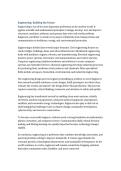
Engineering: Building the Future
Engineering is one of the most important professions in the modern world. It
applies scientific and mathematical principles to design, develop, test, and improve
structures, machines, software, and systems that solve real-world problems.
Engineers contribute to nearly every aspect of daily life, from transportation and
communication to healthcare, energy, and environmental protection.

Engineering is divided into several major branches. Civil engineering focuses on
roads, bridges, buildings, dams, and other infrastructure. Mechanical engineering
deals with machines, engines, robotics, and manufacturing. Electrical engineering
involves power systems, electronics, telecommunications, and control systems.
Computer engineering combines hardware and software to create computer
systems and embedded devices. Chemical engineering develops industrial processes
for producing fuels, medicines, food products, and chemicals. Other specialized
fields include aerospace, biomedical, environmental, and industrial engineering.

The engineering design process begins by identifying a problem or need. Engineers
then research possible solutions, create designs, build prototypes, test their ideas,
evaluate the results, and improve the design before final production. This process
requires creativity, critical thinking, teamwork, and attention to safety and quality.

Engineering has transformed society by enabling clean water systems, reliable
electricity, modern transportation, advanced medical equipment, smartphones,
satellites, and renewable energy technologies. Engineers also play a vital role in
addressing global challenges such as climate change, sustainable development,
cybersecurity, and resource conservation.

To become a successful engineer, students need a strong foundation in mathematics,
physics, chemistry, and computer science. Communication skills, ethical decision-
making, and lifelong learning are equally important because technology changes
rapidly.

In conclusion, engineering is a profession that combines knowledge, innovation, and
practical problem-solving to improve human life. It creates opportunities for
economic growth, technological advancement, and sustainable development. As the
world continues to evolve, engineers will remain essential in designing solutions
that make communities safer, healthier, and more connected.


Información del documento

Subido en
6 de agosto de 2026
Número de páginas
1
Escrito en
2026/2027
Tipo
Notas de lectura
Profesor(es)
Zain khilji
Contiene
Todas las clases
$27.49

¿Documento equivocado? Cámbialo gratis Dentro de los 14 días posteriores a la compra y antes de descargarlo, puedes elegir otro documento. Puedes gastar el importe de nuevo.
Escrito por estudiantes que aprobaron
Inmediatamente disponible después del pago
Leer en línea o como PDF

Vendido
0
Seguidores
0
Artículos
1
Última venta
-


Por qué los estudiantes eligen Stuvia

Creado por compañeros estudiantes, verificado por reseñas

Calidad en la que puedes confiar: escrito por estudiantes que aprobaron y evaluado por otros que han usado estos resúmenes.

¿No estás satisfecho? Elige otro documento

¡No te preocupes! Puedes elegir directamente otro documento que se ajuste mejor a lo que buscas.

Paga como quieras, empieza a estudiar al instante

Sin suscripción, sin compromisos. Paga como estés acostumbrado con tarjeta de crédito y descarga tu documento PDF inmediatamente.

Student with book image

“Comprado, descargado y aprobado. Así de fácil puede ser.”

Alisha Student

Preguntas frecuentes