
wal s'ssuaG
2V C 2/1 = U derots ygrenE
0 = E : edisnI i_V fo mus = V
Vq = enod krow Real Number s
R < r erehw
ytitnauq ralacs C 91-^01 x 6.1
V fo smret ni E ot ralucidneprep
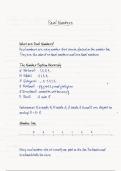
What ar e Real Number s?
Re al nu mbers are every number tha t can be placed o n the n umber line.
They are the union of ration al numytbiveittrimsreap nd irrartotiocnuadnlocneudmistbueO rs.
nortcele eerf
tniop lairotauqe
The NumbertJeS9e1-h0ys1 sxen6to.1tit=ieniVisfmeonpi1reHpiues rarc hy 0q / W = V
suaG
N (Natural) : 1, 2, 3, 4, .
)a2(q=p
W ( W h ole) : 0, 1, 2, 3, . .
noitanibmoc seires
Z (Integers) : . ., -2, -1, 0, 1, 2, .
cirehpS
rotcudQnoc(lRaa tional) : p/q, q not 0, p and q inter g/ Qekr=sV
ot eud laitnetoP elpmaxQE' (Irra tional) : cannot be writ ten as p /q
R (Real) : Q union Q'd / A 0spe = C
ecnatica paC
Containment: yNgreisneinnissisdol e W, W inside Z, Z inside Q. Q a0 n= dE : eQdis'nIare d isjoint (no
overlap)y.roRehT= Q + Q'.
: etoN Number LelipnmeaxE rotcudnoc lacirehpS rotcudnoc edistuO
capac lacirehps
.. -3 -2 -1 0 1 2 3 ..
ecafrus hguorht xulf
ip wal dr3 s'notweN
metsys fo ygrene laitnetop
ytisned egrahc raenil ygrene citenik
id laitnetop
Every real nu mber sit s at exactly one point on the line. Rationals and
rir/ r V iona ls both
Q ka= t live here.
metsys fo ygrene laitnetop 0q / W = V
, ecafrus laitnetopiuqe derots ygrenE
Q fo smret ni
dleiF cirtcelE
elpmaxE ) noitavired (
noc cirtceleid
Euclid's Division Lemma 2r / ateht soc p
ip
Statement
For any two positive integers a and b, there exist unique integers q and r
0spe ip ) noitavireVdq =( enod krow
satisfying: a = bq + r where 0 <= r < b.
0spe ip
iralop
a = b q + r, 0 <= r < b
tazitnauQ
egrahc ot eud dleif
noitacilppA ytitnauq ralacs
a = dividend, b = 0dspievi sipor4, /q1 = quotient, r = remainder ) a 2 ( q J= p91-01 x 6.1 = Ve 1
) egrahc tniop (
WnorotrcekleeederEf xample
ed egrahc raenil
Take a = 17, b = 5. Long divi sion: = 3 remainder 2. So 17 = 5 x 3 + 2.
C heck: 0 < = 2 < 5. Verif ied! r/Qk=V
p lellarap
ateht soc p l E
n A other Example ) egrahc tniopy(tisned egrahcRra>enril
dl e i F c i r t c e erehw
Take a = 1 00, b = 7. = 14, remainder 2. So 100 = 7 x 14 + 2. Check: 7 x 14
) foorp (
, + = enocitazitnauQ
9 9 8 1
= 8 2 00. Corr ! t
laitnetop nommoc
) foorp (
Reme mber: Euclid's Division Lemme Lemma. dleif mrofinu
enil dleif ilpphAe lemma guarantees tha t UNI QUE q and r a lwa ys exist for any a > 0,
noitacT
b > 0. Th e uniqueness0 =isE fwi hat m ake s it power ful.
snirotcudnoc edi egrahc ot eud dleif
enogitraubhircttsnidiops(uounitnoC VC=Q roticapac lacirehps
Why 0 <= r < b?
J 91-01 x 6.1 = Ve 1 r
If = b, we can absorb it into q. So r must stay below b.
ecafrus laitnetopiuqe
, nortcele eerf
) noitavire) da (2 ( q = p
Vq = U wal s'bmoluoC
metsys fo ygrene laitneyrteotptab htiw roticapaC
Euc lid's Division Algorithm
s'bmoluoC
wal s'bmoluoC
Pu rpose: Fiyngrdeniengni sHCF
sol
l
Eu s ' lgo
c
roticapac lacirehipd
s a ri t h m uses repeate d application of the Divi sion Lemma to
3m / C
find the HCF (Highest Common Factor) of two positive integers.
r/Qk= V
m/C
Steps
) egrahc tniop ( 2r / ateht soc p
: etoN ygren e c i t e n i k
1 Apply Lemma:Wri te a = bq + r (laerlugce m r=alosp ma ller x q + r)
elor
enod krow on
ecafrus hguorht xulf
2 Check r:If r = 0, HCF = b. Stop h ere.
ssorc revenVsefonilsdmlerief t ni
noitacilpp3A Replace:Make b the new dividend, r the new divisor.
laitnetop nommoc
tcudorp ralacs
elucelom ralop ) foorp (
4 Repeat:Apply lemma again to (b, r). Keep going.
tlov = C / J
d / A 0spe = C 0q / W = V
ehs etinifni
5 Termination:Sequence r1 > r2 > r3. . must reach 0.
egrahc decudni
R > r erehw
ytisned ygrene dleiF cirtcelE
Key Identity Used V fo smret ni
HCF(a, b) = HCF(b, r) where a = bq + r
) foorp (
TelphmiasxEis the heart of the algorithm. The HCF of (a, b) equals2mt/hCe HCF of (b,
r). So we can k eep reducing until r = 0.
rotcudnoc edistuO
c e/dCisni 0 = E fi
rotcudnom
Why Doe s It T erminate? C 91-^01 x 6.1
ytisned ygrene
Since b > yrro1eh>T r2 > r3 > . >= 0, remainders form a strict ly decreasing
sequence of non-negative integers. It MUST reach 0.


