
1
7.1 - The Periodic Table
The Periodic Table
The Periodic Table - Then
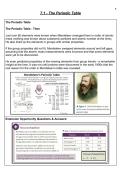
Just over 60 elements were known when Mendeleev arranged them in order of atomic
mass (nothing was known about subatomic particles and atomic number at the time).
He also lined up the elements in groups with similar properties.
If the group properties did not fit, Mendeleev swapped elements around and left gaps,
assuming that the atomic mass measurements were incorrect and that some elements
were yet to be discovered.
He even predicted properties of the missing elements from group trends - a remarkable
insight at the time. It was not until protons were discovered in the early 1900s that the
real reason for the order in Mendeleev's table was revealed.
Extension Opportunity Questions & Answers:
, 2
The Periodic Table - Now
As of 2014, the periodic table has 114 elements arranged in seven horizontal periods
and 18 vertical groups (Figure 2). The periodic table is the most important
organisational tool in chemistry. It is the first point of reference for chemists everywhere
and most chemistry laboratories have a periodic table prominently placed on the wall.
At Room Temperature…
Liquids: Bromine & Mercury
Metalloids: Boron, Silicon, Germanium, Arsenic & Antinomy (Tellurium & Polonium)
You do not need to memorise the periodic table (although some people have done so).
It is nevertheless helpful to know where the common elements are positioned, and
most students know the atomic numbers and relative atomic masses of common
elements such as hydrogen, carbon, nitrogen, and oxygen. It is essential that you are
able to use the periodic table.
Hydrogen Carbon Nitrogen Oxygen

