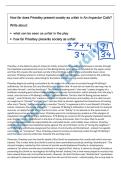
Priestley, in the didactic play An Inspector Calls, presents the extent of unfairness in society through
the Capitalist and patriarchal norms of the Birling family (who serve as a symbol for the upper class)
and how this causes the eventual suicide of Eva Smith (a symbol of the vulnerable lower-class
women). Priestley wishes to criticise Capitalist and patriarchal values, and condemns the suffering
they cause within society, advocating for Socialism and promoting social responsibility.
Priestley begins by setting a precedent for the extent of unfairness in society through Mr Birling’s
selfishness. He lectures Eric and Gerald by telling them that “A man has to make his own way, has to
look after himself – and his family too”. The notion of making one’s “own way” creates imagery of a
bulldozer trampling past others towards material success and stardom, which already, from the play’s
onset, sets the tone of Mr Birling’s selfish Capitalist beliefs. The fact that Mr Birling pauses before
saying “– and his family too” creates a chink in his façade of honour and nobility, as it is clear he was
so caught up in “himself” and his “own” success that he almost neglected the importance of looking
after one’s “family”, but he proceeds to mention “family” to appease to Eric’s and Gerald’s Christian
values. However, the pause, shown by “–”, exposes Mr Birling’s infatuation in himself and his material
success, so really the rule of 3 in the list is ironic, as his “family” is not placed on the same level of
significance as his material success. Priestley warns his contemporary audience of the dangers of
Capitalism through Mr Birling’s selfishness: if Mr Birling (a construct for the greedy Capitalist) deems
even his own family insignificant in the face of money and power, then it is clear that he would
completely neglect social responsibility for vulnerable lower- and middle-class citizens. Priestley
does this to present how Capitalism goes against the very Christian norms of “loving thy neighbour”,
as Mr Birling’s selfishness juxtaposes the notion of community and familyhood – indeed, he regards
community as “nonsense”. Thus, Priestley presents society as extremely unfair through Mr Birling’s
(and the upper class’s) unfairness towards the working class.
Moreover, Priestley uses the horrific death of Eva Smith to emphasise the cruelty with which she was
treated. This is clear when Eva Smith is said to have committed suicide by drinking “disinfectant”. The
visceral imagery created by this manner of suicide would displease Priestley’s contemporary
audience, for whom suicide was considered a sin against God. Hence, it seems as though Priestley is
presenting Eva Smith as sacrilegious for killing herself. Indeed, this is how many people in society may
have viewed those who committed suicide. However, the fact that Eva uses “disinfectant” symbolises
an attempt to cleanse herself and her soul from the evil of the world – unfortunately, Eva is only able to
the Capitalist and patriarchal norms of the Birling family (who serve as a symbol for the upper class)
and how this causes the eventual suicide of Eva Smith (a symbol of the vulnerable lower-class
women). Priestley wishes to criticise Capitalist and patriarchal values, and condemns the suffering
they cause within society, advocating for Socialism and promoting social responsibility.
Priestley begins by setting a precedent for the extent of unfairness in society through Mr Birling’s
selfishness. He lectures Eric and Gerald by telling them that “A man has to make his own way, has to
look after himself – and his family too”. The notion of making one’s “own way” creates imagery of a
bulldozer trampling past others towards material success and stardom, which already, from the play’s
onset, sets the tone of Mr Birling’s selfish Capitalist beliefs. The fact that Mr Birling pauses before
saying “– and his family too” creates a chink in his façade of honour and nobility, as it is clear he was
so caught up in “himself” and his “own” success that he almost neglected the importance of looking
after one’s “family”, but he proceeds to mention “family” to appease to Eric’s and Gerald’s Christian
values. However, the pause, shown by “–”, exposes Mr Birling’s infatuation in himself and his material
success, so really the rule of 3 in the list is ironic, as his “family” is not placed on the same level of
significance as his material success. Priestley warns his contemporary audience of the dangers of
Capitalism through Mr Birling’s selfishness: if Mr Birling (a construct for the greedy Capitalist) deems
even his own family insignificant in the face of money and power, then it is clear that he would
completely neglect social responsibility for vulnerable lower- and middle-class citizens. Priestley
does this to present how Capitalism goes against the very Christian norms of “loving thy neighbour”,
as Mr Birling’s selfishness juxtaposes the notion of community and familyhood – indeed, he regards
community as “nonsense”. Thus, Priestley presents society as extremely unfair through Mr Birling’s
(and the upper class’s) unfairness towards the working class.
Moreover, Priestley uses the horrific death of Eva Smith to emphasise the cruelty with which she was
treated. This is clear when Eva Smith is said to have committed suicide by drinking “disinfectant”. The
visceral imagery created by this manner of suicide would displease Priestley’s contemporary
audience, for whom suicide was considered a sin against God. Hence, it seems as though Priestley is
presenting Eva Smith as sacrilegious for killing herself. Indeed, this is how many people in society may
have viewed those who committed suicide. However, the fact that Eva uses “disinfectant” symbolises
an attempt to cleanse herself and her soul from the evil of the world – unfortunately, Eva is only able to